 Μake us preferred on Google
The decision, announced by European Council President António Costa following Friday’s informal EU summit in Dublin, seeks to give Europe a coordinated presence in a diplomatic process that has so far been driven primarily by Washington, Moscow and Kyiv. It follows weeks of disagreements among European leaders over how the continent should be represented and who should speak on its behalf.
The announcement came after US President Donald Trump’s special envoys Steve Witkoff and Jared Kushner met Russian President Vladimir Putin in Moscow on Thursday. Witkoff subsequently indicated that Putin was willing to give European participation in the negotiations a try, although the Kremlin has yet to formally endorse the proposed format.
Ukrainian President Volodymyr Zelenskyy has also welcomed the prospect of European participation, stressing that the continent must have a voice in discussions concerning Ukraine’s future and its own security.
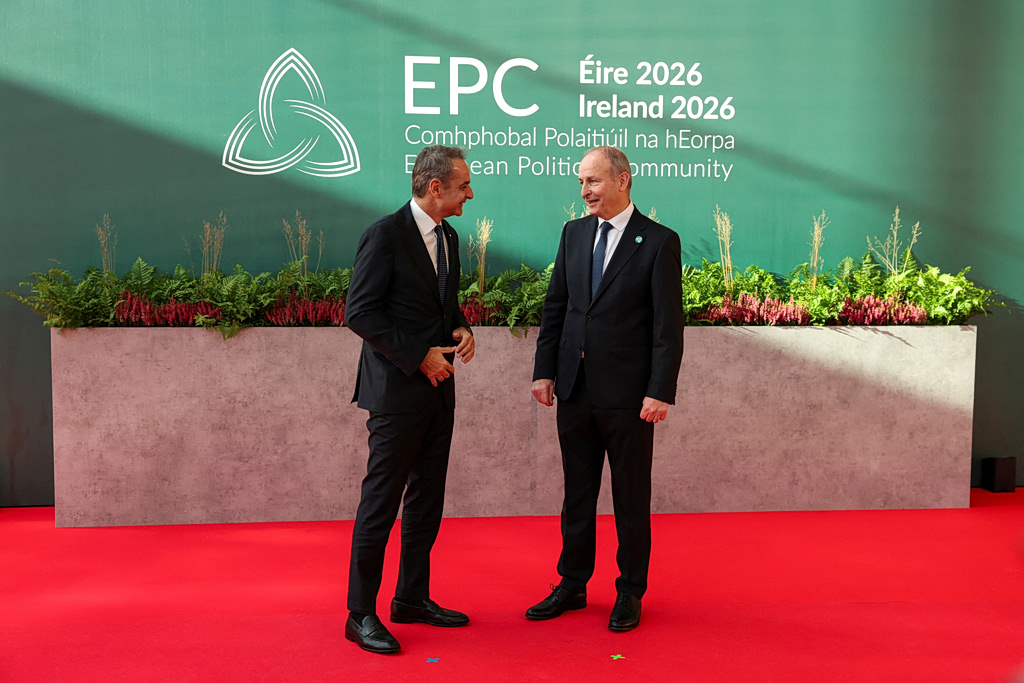
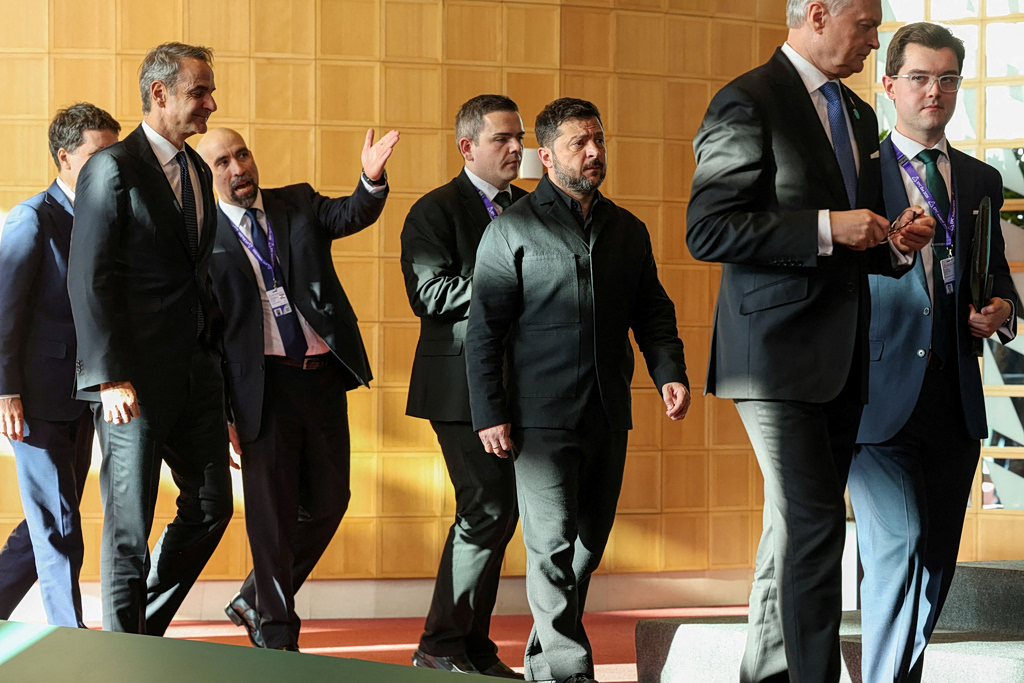
Ireland’s Taoiseach (Prime Minister) Micheal Martin welcomes Greek Prime Minister Kyriakos Mitsotakis at the European Political Community summit in Dublin, Ireland, November 12, 2026. REUTERS/Cathal McNaughton
Five countries, European institutions in the same team
According to Costa, the European delegation will comprise representatives of the EU institutions and five countries belonging to the Coalition of the Willing, which supports Ukraine: France, Germany, the United Kingdom, Poland and Italy.
The composition carries particular political significance. The UK, although outside the European Union following Brexit, retains a central role in European security policy and support for Kyiv. The inclusion of Poland and Italy also broadens representation beyond the traditional France-Germany-Britain grouping, commonly known as the E3.
The decision reflects a compromise between competing approaches that have emerged in European capitals over recent weeks. The challenge was to ensure that Europe would have a place at the negotiating table without creating the impression that its representation belonged exclusively to the largest member states or to the institutions in Brussels.
The debate had exposed differences among EU leaders over whether Europe should appoint a single representative or be represented by a broader team. Italian Prime Minister Giorgia Meloni had argued for a single envoy, warning that multiple diplomatic channels and competing formats could undermine Europe’s credibility.
French President Emmanuel Macron and German Chancellor Friedrich Merz, meanwhile, have stressed the need for European unity and a coordinated position. EU foreign policy chief Kaja Kallas has also argued that the EU’s institutional leadership should participate, pointing to her responsibilities in foreign and security policy and those of Costa as European Council president.
The precise institutional composition and the individuals who will take part in the negotiations have yet to be fully clarified.
Greece backs institutional representation alongside major countries
Prime Minister Kyriakos Mitsotakis had advocated a format combining representation by the European institutions with the participation of some of the continent’s leading countries, a position he outlined upon arriving at the ninth European Political Community summit in Dublin on Thursday.
“There can be no discussion about a long-lasting peace deal in Ukraine, and certainly no discussion about a future European security architecture without the participation of Europe at the table of the discussions,” Mitsotakis said, adding that the format of European participation would be discussed on Friday.
The Greek position reflects Athens’ insistence that any agreement ending the war must take account of Europe’s security interests and that the continent cannot be excluded from decisions concerning its future security architecture.
Mitsotakis also identified a ceasefire as the first priority in the diplomatic process, highlighting the need to protect commercial shipping in the Black Sea. As the leader of a maritime country, he said, Greece was particularly concerned about attacks on commercial vessels and reiterated his call for a global ceasefire covering such attacks.
Although Greece was not among the five countries specifically named by Costa, its preferred approach of combining EU institutional representation with the participation of leading member states is reflected in the agreed format.
Europe’s security concerns remain central
The decision comes amid renewed diplomatic activity following US-brokered discussions involving Russian and Ukrainian representatives in Abu Dhabi earlier in the week. European countries have been involved in parallel contacts but were not initially part of the main negotiating format.
European leaders have expressed concern that a bilateral understanding between Washington and Moscow could determine the future of European security without their participation. They have also maintained that any lasting settlement must safeguard Ukraine’s sovereignty and territorial integrity.
The European Council has identified a ceasefire, the restoration of navigation in the Black Sea and the creation of conditions for a lasting peace agreement as priorities. Costa has stressed that Russia must demonstrate a genuine willingness to end the war, pointing to its continuing attacks on Ukrainian civilians.
The proposed European team therefore represents an attempt to establish a common diplomatic presence, although its effectiveness will also depend on whether Moscow accepts its participation and whether the European countries involved can maintain a coordinated position.
The broader challenge remains ensuring that any eventual settlement is acceptable to Kyiv, safeguards European security interests and provides the basis for a lasting end to Russia’s war against Ukraine.