 Μake us preferred on Google
 Athens is significantly expanding the operational capabilities of its coast guard with new offshore patrol vessels, high-speed interceptors, drones and autonomous maritime systems, coinciding with what the country views as stepped activities by Turkey in the Aegean and eastern Mediterranean, including efforts to use environmental initiatives to advance its maritime claims.
The project is being carried out largely through the Aigis 2 program, a major acquisitions program undertaken to strengthen the Hellenic Coast Guard. Apparently, the aim is no longer simply to increase the number of vessels but to create a modern surveillance network capable of detecting incidents at greater distances and responding rapidly across Greece’s extensive maritime area.
The effort comes against the backdrop of a series of recent Turkish moves in the Aegean and eastern Mediterranean.
Official Turkey has unilaterally declared marine parks in the northern Aegean and eastern Mediterranean, while Turkish researchers have promoted – mostly through pro-government Turkish media – the idea of “joint management” of marine areas, including a coral reef between Gökçeada (Imbros) and Samothrace. Athens has rejected such moves as legally baseless, arguing that they could have implications for Turkish jurisdiction.
The new coast guard capabilities are intended to strengthen Greece’s ability to monitor such activity and respond to incidents at sea.
The force currently operates about 230 vessels, giving it a significant numerical advantage over the respective Turkish Coast Guard.
Its larger offshore fleet includes four operational vessels, among them a modern Damen Stan Patrol 5509 and three Israeli-built Sa’ar-class vessels measuring 58 meters in length.
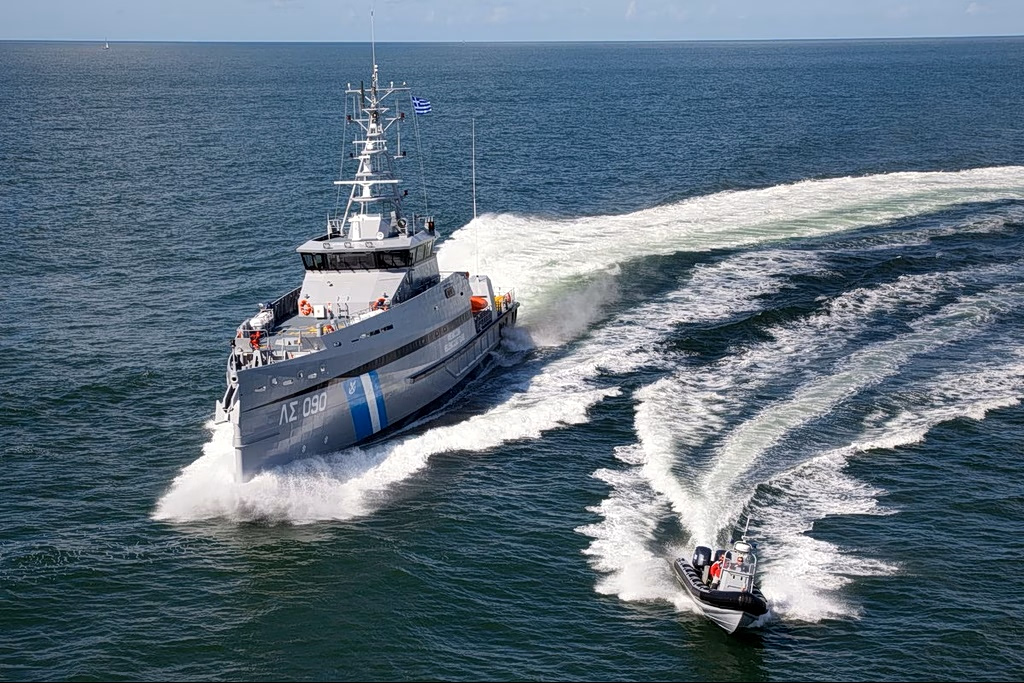
The next phase is considerably more ambitious: AIGIS 2 provides for four new offshore patrol vessels, in a 2+2 configuration, measuring more than 80 meters and costing about 360 million euros in total. The vessels will be equipped with 30- or 40-millimeter guns and helicopter decks, substantially increasing the Coast Guard’s endurance and ability to maintain a presence offshore.
Credit: Hellenic Coast Guard
Speeds of More Than 50 Knots
The transformation also extends to smaller vessels.
The coast guard currently operates four Italian-built Cantiere Navale Vittoria coastal patrol boats, with six additional vessels of more than 30 meters planned.
Athens already has more than 60 high-speed boats measuring between 15 and 25 meters, while contracts have been signed for seven new Watercat 2000 Patrol vessels. Deliveries are scheduled to begin in October 2026 and continue through next summer.
AIGIS 2 also provides for 14 new vessels longer than 18 meters capable of speeds exceeding 50 knots, along with 10 new interceptors capable of exceeding 60 knots.
The combination of greater range and speed is designed to reduce response times, allowing Coast Guard units to cover large areas and pursue fast-moving targets.
From Vessels to Drones
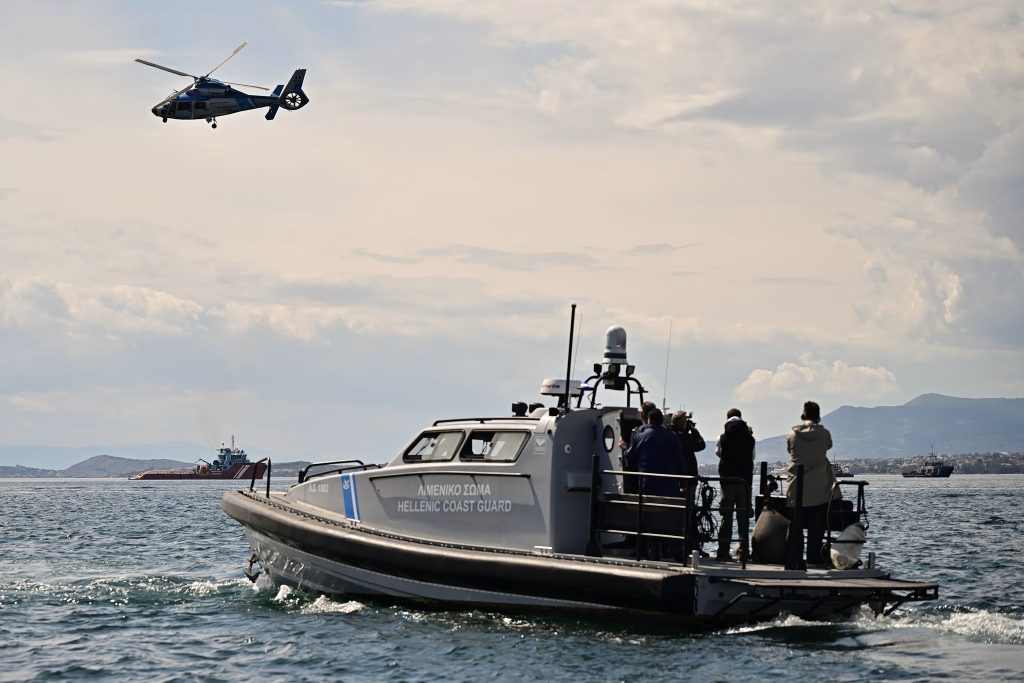
The expansion is not confined to the sea, as the Hellenic Coast Guard currently operates three twin-engine F406 Caravan II aircraft equipped with surface-search radar and thermal cameras, as well as six AS365 N3 Dauphin helicopters used for search and rescue and surveillance.
The fleet is set to be reinforced by a range of unmanned aircraft.
AIGIS 2 includes two VTOL systems, comprising four aircraft capable of vertical takeoff and landing from islands or ships and remaining airborne for more than 10 hours. They will carry cameras, thermal sensors and specialized radars designed to detect speedboats and small craft.
The program also calls for 20 smaller tactical drones, three heavy multicopters capable of carrying approximately 40-50 kilograms of cargo, and five automated drones able to take off, return and recharge without continuous human intervention.
In addition, Greece is moving ahead with the acquisition of four more fixed-wing VTOL drones, worth 30 million euros, for long-duration, long-range missions.
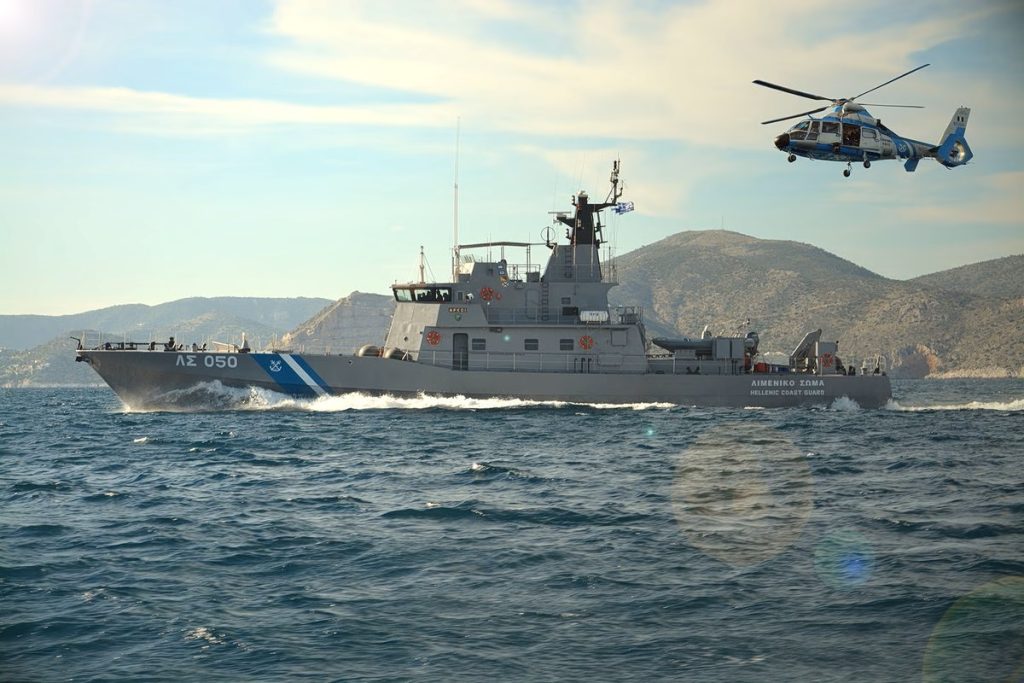
Credit: Hellenic Coast Guard
Surveillance beneath the waves
Perhaps the most significant element of the planned system lies beneath the water.
The program includes plans to acquire two systems of unmanned surface vessels and three systems of autonomous underwater vehicles, with a combined value of about 50 million euros.
The result will be a layered surveillance network: ships and high-speed craft at sea, aircraft and drones in the air, and autonomous systems operating both on the surface and underwater.
Rather than relying primarily on crewed vessels and their speed, the Coast Guard will increasingly be able to detect targets from a distance, track them continuously and deploy the most appropriate asset to the scene.