Greece has flatly rejected Ankara’s latest objections regarding Athens’ marine spatial planning in the Aegean Sea as “unfounded, wholly unacceptable and dismissible,” saying a recently announced framework for renewable energy projects does not affect the country’s sovereign rights in wider region.
Turkey has again challenged a Greek initiative covering the Aegean, prompting Athens to accuse Ankara of insisting on revisionist positions that have no basis in international law. The latest exchange comes just 12 days after Ankara objected to Greece’s new special spatial planning framework for tourism.
In a statement Thursday, the Greek foreign ministry said the Turkish objections represented a repetition of “unfounded” claims and demonstrated an “insistence on revisionist positions” that have no legal basis. The ministry said the status of sovereignty in the Aegean was “absolutely clear,” with Greek sovereignty defined conclusively by international treaties.
“Any other approach runs counter to international law and will receive a corresponding response,” the ministry added.

At the same time, Athens reiterated its support for dialogue and good-neighborly relations with Turkey, noting that Greece remains committed to resolving what it considers the sole bilateral dispute between the two countries, namely, the delimitation of the continental shelf and exclusive economic zone in the Aegean in accordance with international law.
A day earlier, Turkey objected to Greece’s new special spatial planning framework for renewable energy sources, which has entered into force and includes provisions covering maritime areas of the Aegean.
Turkish Foreign Ministry spokesman Oncu Keceli said the framework, like other similar Greek initiatives, had “no legal consequences” for Turkey regarding Aegean issues. He said Ankara’s position concerned “geographical formations whose ownership has not been transferred to Greece by international agreements.”
Keceli said such actions did not alter Turkey’s legal position on the Aegean and called for unilateral actions to be avoided in “enclosed or semi-enclosed seas” such as the Aegean and Mediterranean, echoing a long-standing and mostly unilateral interpretation by Turkey.
“Turkey, as one of the two coastal states of the Aegean Sea, is always ready to cooperate with Greece,” Keceli said, reiterating Ankara’s call for an “honest and comprehensive” approach to bilateral issues based on international law, equality and good-neighborly relations. He also referred to the Athens Declaration on Friendly Relations and Good-Neighbourly Relations, signed by Greece and Turkey on Dec. 7, 2023.
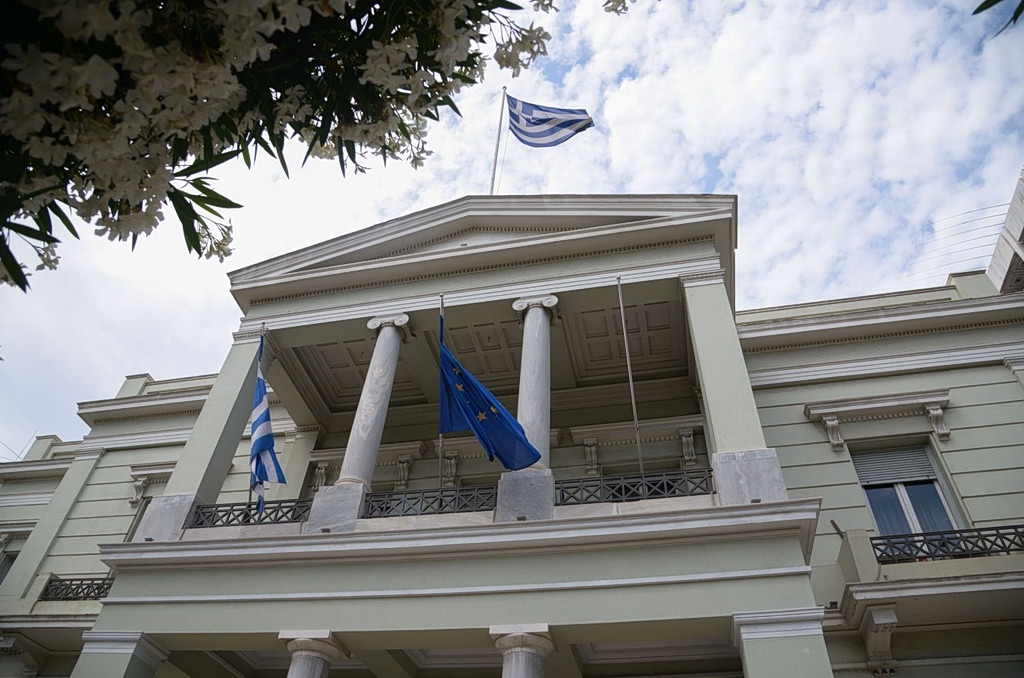
The foreign ministry in Athens.
What Greece’s new renewable energy framework provides
The new framework updates the rules governing the siting of new renewable energy projects and energy storage facilities, taking into account current environmental, social and economic conditions.
It also introduces tighter safeguards for the environment, local communities and cultural heritage, with the framework designed to support Greece’s energy targets through 2050. The previous special spatial planning framework was adopted in December 2008.
For new photovoltaic installations, the framework establishes uniform nationwide rules and excludes environmentally, culturally and spatially protected areas. New solar stations are barred from Natura 2000 areas, forests, Ramsar wetlands, small island wetlands, national parks, natural monuments, aesthetic forests and landscapes of particular natural beauty.
Other exclusions include cultural heritage protection areas, protected terraces, roadless areas and bathing beaches.
New photovoltaic installations are also subject to a land-coverage ceiling. At the regional-unit level, they may cover no more than 1.5% of the total area, with the aim of protecting landscapes, agricultural land and competing land uses.
Floating photovoltaic installations are prohibited in diving parks, newer shipwreck sites, anchorage areas and artificial underwater attractions. For projects in marine areas and lakes, fishing grounds and required safety distances must be taken into account.
New exclusion zones for wind farms
The framework also introduces restrictions on wind farm development, with the stated aim of balancing wind energy expansion with environmental protection, landscape preservation and the interests of local communities.
Wind farms are prohibited in Attica, the Metropolitan Area of Thessaloniki, areas above 1,200 meters in elevation, Ramsar wetlands, small island wetlands, landscapes of particular natural beauty, national park cores and specified nature-protection zones.
Restrictions also apply to islands smaller than 300 square kilometers, with exceptions for critical or public-benefit infrastructure and energy-system security.
Similar restrictions apply to certain undeveloped areas with tourism and recreational uses, active quarrying, mining and extraction zones, roadless areas and bathing beaches.
Additional exclusion zones include historic sites, archaeological monuments, protected monuments dating from after 1830, areas with water sources for human consumption and so-called “untrodden” beaches.