 Μake us preferred on Google
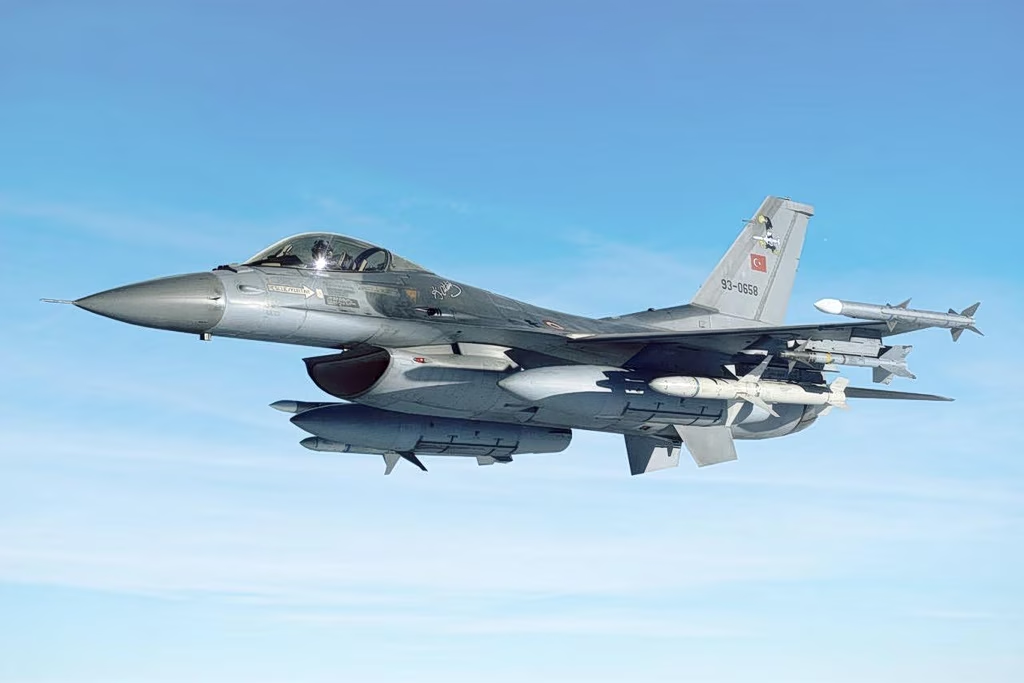
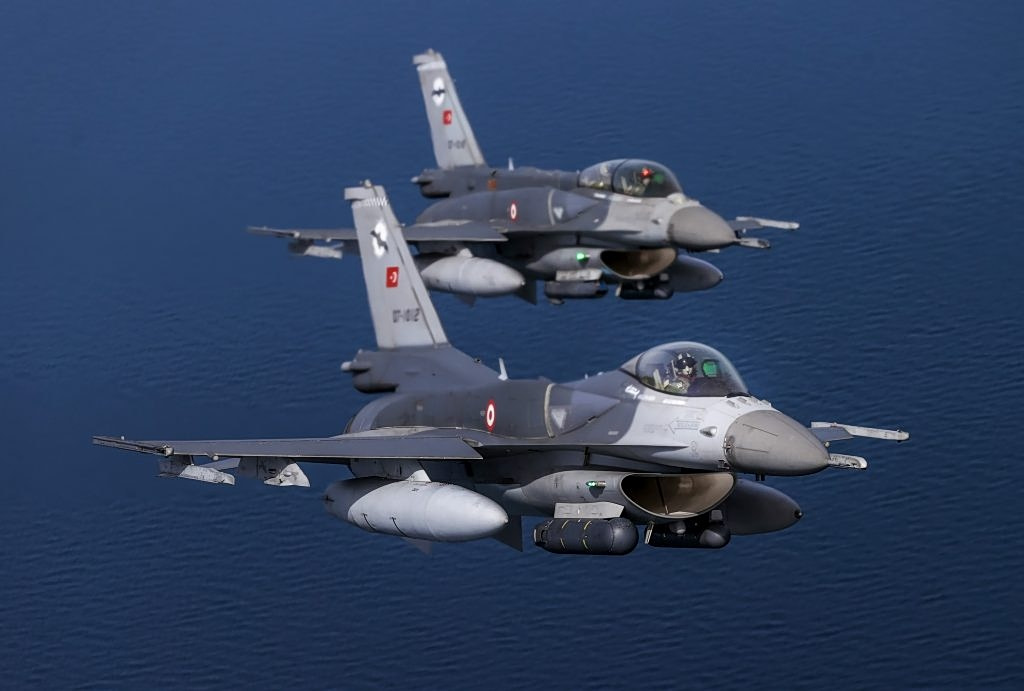
 A handful of Turkish aircraft carried out fresh violations of Greek airspace and breaches of the Athens Flight Information Region (FIR) on Wednesday, a day after armed Turkish F-16 fighter jets and unmanned aerial vehicles were reported to have conducted similar incursions over the eastern Aegean.
According to the Hellenic National Defense General Staff, three Turkish aircraft — two drones and an ATR-72 surveillance aircraft — were involved in seven airspace violations and five FIR infringements in the northeastern, central and southeastern Aegean. In all instances, Greek fighter jets intercepted the aircraft in accordance with international rules and standard procedures.
Scrutiny on Turkish landing craft buildup
The incidents came as Greek defense planners continue to monitor Turkey’s expanding amphibious warfare capabilities, which Athens views as a significant element of Ankara’s broader military modernization drive and its efforts to project power across the eastern Mediterranean and Aegean.
Particular attention has focused on Turkey’s program to build eight new-generation landing craft, known as the YLCT program. Two vessels have already entered service, with the remainder expected to be delivered by 2027. The craft are designed to rapidly transport armored vehicles, including Turkey’s Altay main battle tanks, as well as large numbers of troops directly onto shorelines.
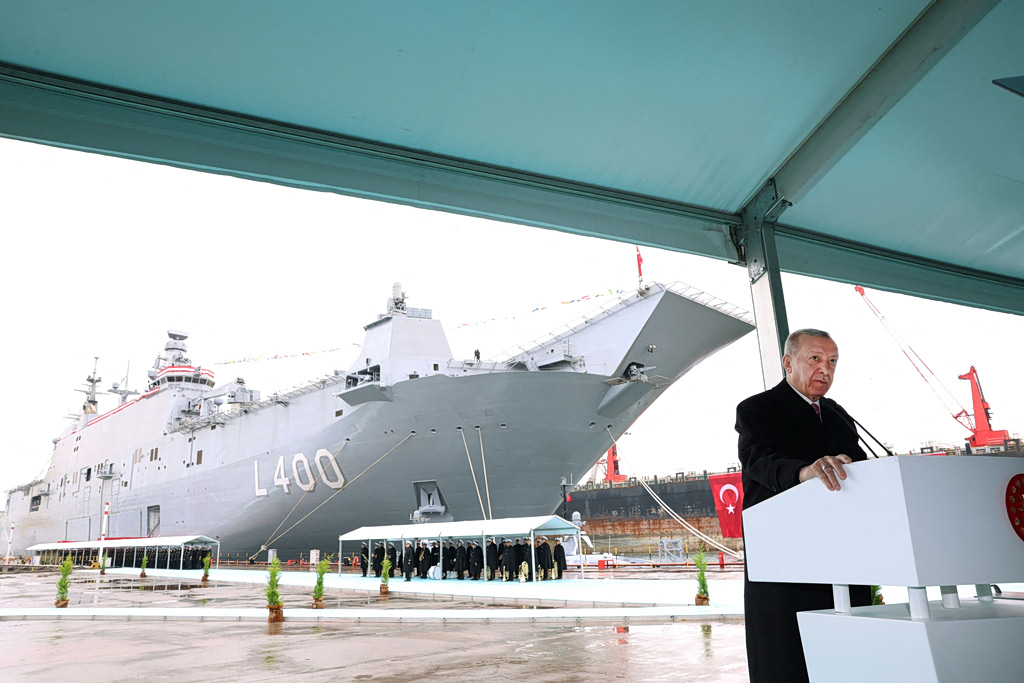
Turkey’s President Tayyip Erdogan addresses the audience during a ceremony for the launch of the amphibious assault ship TCG Anadolu, in Istanbul, Turkey, April 10, 2023. Murat Cetinmuhurdar/ handout via Reuters.
The expansion is complemented by the amphibious assault ship TCG Anadolu, which can supposedly carry a battalion-sized marine force, helicopters, landing craft and amphibious armored vehicles. Turkish naval planners have increasingly integrated the vessel into NATO exercises and amphibious command structures.
Turkey is also strengthening its heavy amphibious lift capacity through its Bayraktar-class landing ship tank vessels. Two such ships are currently in service, each capable of transporting hundreds of marines and up to 20 main battle tanks. Earlier this month, Ankara approved the construction of two additional Bayraktar-class ships, a move expected to significantly increase its sealift capacity.
The naval buildup has been accompanied by a reorganization of Turkish marine forces under a newly established amphibious corps headquartered in Canakkale, near the Dardanelles. Turkish marine brigades are now positioned to support operations in the Aegean, eastern Mediterranean and Cyprus, developments that Greek defense officials have been closely monitoring amid continuing tensions between the two neighboring countries.