 Μake us preferred on Google
 Swiss voters on Sunday firmly turned down a proposal to write a strict definition of neutrality into the country’s constitution, a change that would have forced Switzerland to scale back its cooperation with NATO and drop its sanctions against Russia.
Final results from the Federal Statistical Office showed that roughly 70% of voters and every one of the country’s cantons opposed the measure. The outcome matched a Swiss Broadcasting Corporation (SBC) poll earlier this month, in which 63% of respondents said they planned to vote no and 34% said they would vote yes.
The initiative was put forward by Pro Schweiz, a right-wing association with ties to the far-right Swiss People’s Party (SVP), which campaigned for it. The SVP was the only major political party to back the proposal. The defeat is expected to bring relief across Europe at a time when keeping the EU united on Russia sanctions has become increasingly difficult.
A Centuries-Old Principle
Switzerland’s neutrality was formally recognized at the end of the Napoleonic wars in 1815 and has been part of its constitution since 1848, though the constitution does not spell out exactly how the government should apply it. Critics of current policy argue that neutrality has been weakened since 2022, when Switzerland decided to follow EU sanctions against Russia after its full-scale invasion of Ukraine, and that the government has drifted too close to the EU and NATO.
The proposal asked voters to enshrine “perpetual and armed neutrality” in the constitution. Under its terms, Switzerland would have kept an army capable of defending the country, stayed out of conflicts between third parties and been barred from joining any military alliance unless it came under attack. It also would have been prohibited from imposing sanctions on countries at war unless the United Nations approved them.
SVP vice president Celine Amaudruz argued during a televised debate that the party’s aim was to promote peace, diplomacy and dialogue, and that Switzerland needed the credibility of perpetual armed neutrality to do so.
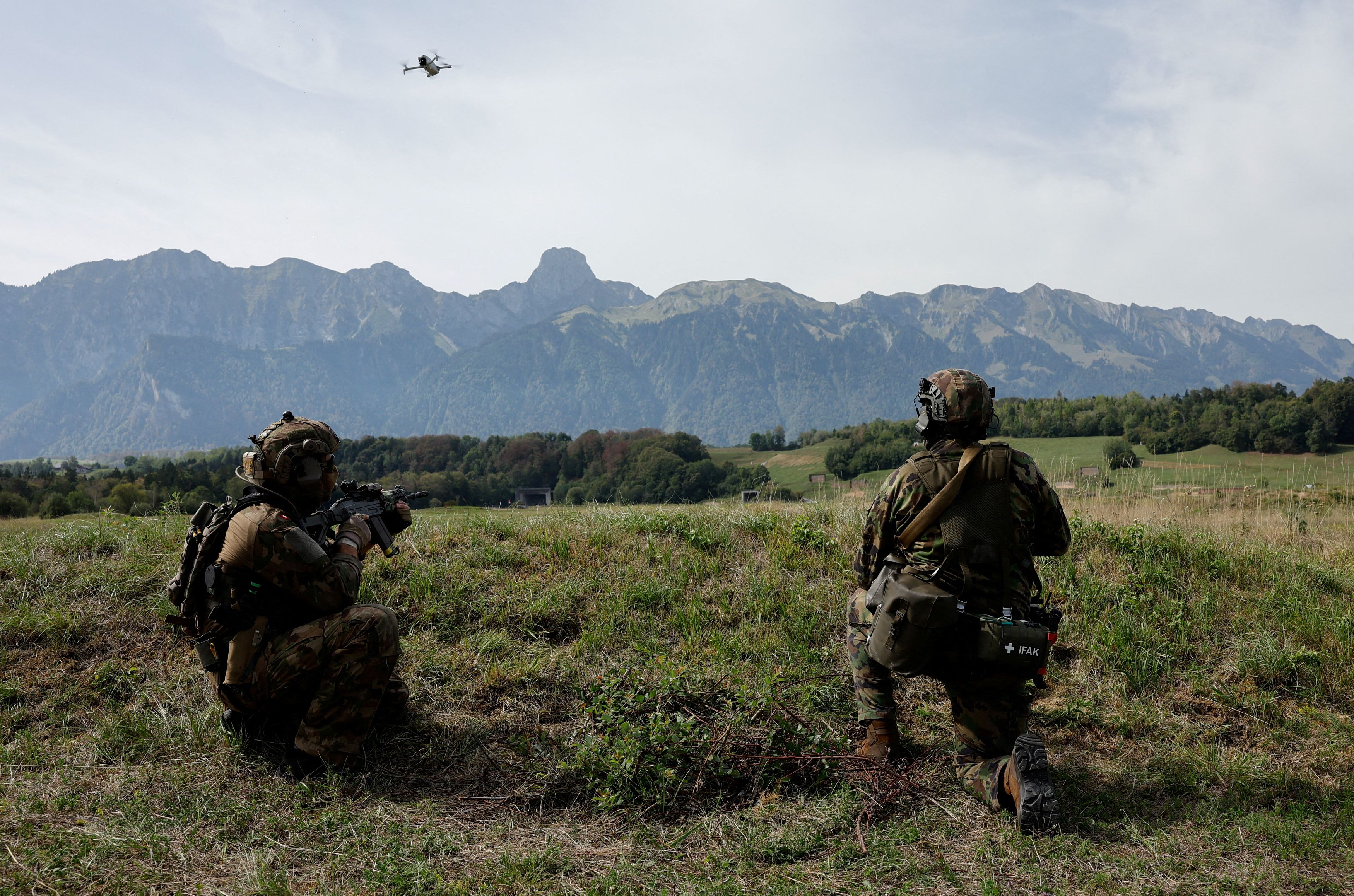
Swiss soldiers operate with a drone flying above them during a media visit and demonstration of drone operations in the Swiss Army in Thun, Switzerland, August 27, 2026. REUTERS/Stefan Wermuth
Government Warned of Security Risks
The Swiss government and most political parties opposed the initiative, warning that it would undermine Switzerland’s standing as a dependable partner on international security, leave the country more vulnerable in case of attack and severely limit its cooperation with NATO. Although Switzerland is not a NATO member, it has worked with the alliance for three decades.
Opponents also argued that in today’s world a country cannot use neutrality as cover to treat aggressors and victims the same way. Foreign Minister Ignazio Cassis said in a recent televised debate that neutrality has always been applied with “a degree of flexibility.”
The result is a major setback for Christoph Blocher, the billionaire SVP backer who championed the initiative and, according to Bloomberg, spent 2 million francs ($2.5 million) on the campaign.
Green party lawmaker Sibel Arslan welcomed the outcome, saying voters saw through the SVP’s aim of isolating Switzerland internationally and avoiding its responsibilities at a time when international law is being violated.
Analysts said the vote showed that the Swiss are satisfied with the government’s approach to neutrality. Katy Romy, a correspondent for SwissInfo, the online service of the SBC, wrote that voters accepted neutrality as a tool that can evolve, giving the government room to adjust how it applies it in response to geopolitical upheaval. She added that the yes campaign never managed to shake the perception that it was serving Russian interests.
Russia’s foreign ministry had praised the initiative, while criticizing Switzerland for adopting EU sanctions and accusing it of abandoning neutrality.
The SVP conceded defeat and said it had no plans for further action at this time.
Food Security Measure Also Rejected
Swiss voters also rejected a separate initiative on food security, which called for Switzerland to produce significantly more of its own food so the population would always have access to enough affordable, high-quality food. According to figures from state broadcaster SRF, 72% voted against it and 28% in favor.