President Trump’s penchant for grand buildings has followed him into the White House, from his plans for a new ballroom to calls for federal buildings to respect “ classical architectural heritage .” His recent focus has been on the John F. Kennedy Center for the Performing Arts .
Like many of his projects , however, Trump’s bids to put his name on the Modernist building, designed by Edward Durell Stone, have led to a series of court rulings blocking these efforts. Trump has also said he might demolish the 1971 building—a prospect that has alarmed architects and preservationists.
“I think it’s crazy, stupid and incredibly shortsighted,” said Carl Elefante , the former president of the American Institute of Architects.
Elefante lives in the D.C. area and sings in a chorus that annually performs at the Center. Its demolition wouldn’t only mean losing a piece of architectural history, he said, but also his local event space.
Despite concern for the building’s future, it has never been a favorite among architects, who said it isn’t a particularly distinguished example of Modernist architecture.
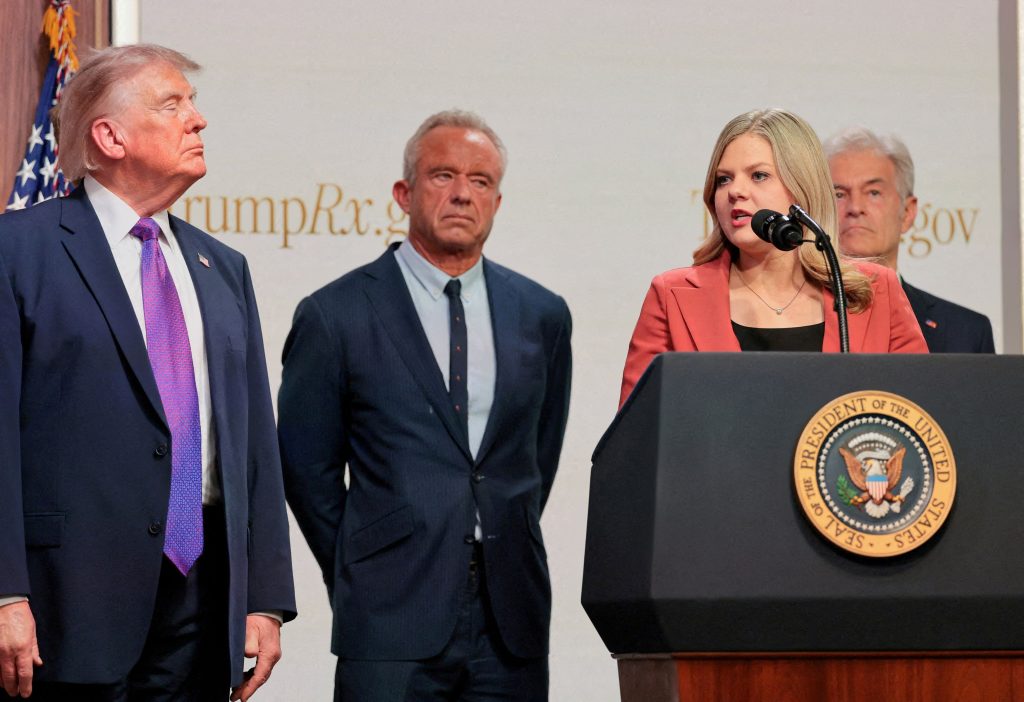
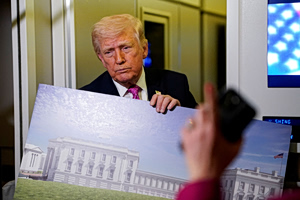
Center for Medicare & Medicaid Services Administrator Dr Mehmet Oz, U.S. Health and Human Services Secretary Robert F. Kennedy Jr., and U.S. President Donald Trump stand as Heidi Overton speaks during an event to deliver remarks about health care costs and affordability from an auditorium on the White House campus in Washington, D.C., U.S., May 18, 2026. REUTERS/Jonathan Ernst
“Maybe it’s not the best building—it doesn’t have very much natural light,” said architect Steven Holl, who designed the Kennedy Center’s $250 million expansion in 2019. “But I hope it’s not demolished.”
After spending years working to improve the Center, he has trouble even with the idea of the building’s demise. “I find the whole thing absurd,” he said.
White House spokesperson Liz Huston didn’t respond to questions about the Kennedy Center’s demolition, but said in a statement that without Trump’s intervention, “the Kennedy Center will inevitably continue to decline.”
A storied history
In 1958, President Dwight D. Eisenhower signed legislation to build a national cultural center in D.C., and President John F. Kennedy continued work on the project after moving into the White House. Following Kennedy’s 1963 assassination, the Center was named after the late president.
By then, Stone had been chosen to design the Center, which has a white-marble facade, thin columns and a somewhat simple box shape. A prominent architect during the mid-20th century, Stone is best known for co-designing the Museum of Modern Art and Radio City Music Hall in New York City.
He also designed homes including the Richard H. Mandel House, a Z-shaped International-style home, in Bedford Hills, N.Y., and the A. Conger Goodyear House on New York’s Long Island—which architecture critic Paul Goldberger called “one of the most important houses built in the United States between the two world wars.” Stone died at age 76 in 1978.
Last year, Congress allocated more than $250 million for renovations at the Center’s facilities. The dispute now focuses on the Trump-backed board’s push to recognize the president for his role in securing funds for the institution as part of the renovation.
The president, who had named himself chair of the Center’s board, set out to reshape its programming and rename the building last year. The name change was blocked by a federal-district court in D.C., and Trump’s attempted workaround—having the board rename the performance hall’s grounds and adorn the building with inscriptions recognizing him—was rebuked by the court, too.
The president has said if he doesn’t get the “recognition” he deserves for fixing it, “it’s going to close, it will end up being ripped down.” A representative of the Stone family declined to comment on the potential demolition, but members of the Kennedy family have criticized the plan, including Kerry Kennedy and Maria Shriver.
‘Like a president deciding to tear down the Lincoln Memorial’
After it was built, the Kennedy Center was derided by architecture critics.
Many said it resembled nothing more than a cold, large, marble-clad box. “There have always been people that have loved it, and there have been probably even many more people that thought it was kind of a one-liner,” Elefante said.
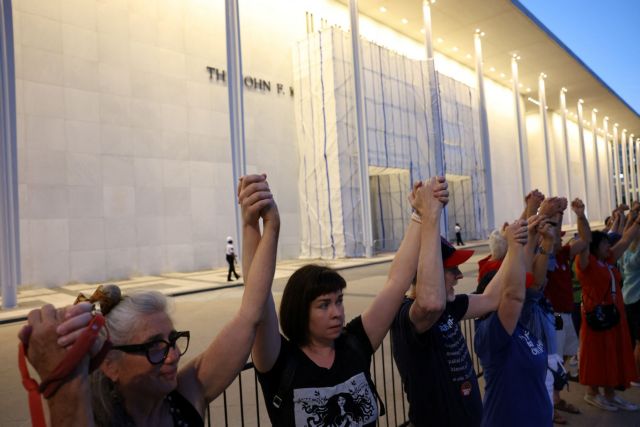
Cassandra Corcoran, Leslie Cook and other protestors hold hands as they denounce the Kennedy Center board’s vote to close one of the nation’s premier performing arts venues, outside the John F. Kennedy Memorial Center for the Performing Arts in Washington, D.C., US, September 18, 2026. REUTERS/Leah Millis
Florida-based architect Jeffrey Prescott worked for Stone in the 1970s. He said the Kennedy Center “isn’t of the same quality” as Stone’s other designs. “His early work, back in the ‘30s, when he designed the Museum of Modern Art, was much, much better work than what he did later on,” Prescott said.
In 2019, architect Elizabeth Diller and her colleagues at Diller Scofidio + Renfro completed a rehaul of the Museum of Modern Art. With the Kennedy Center, Diller said, “It’s not about the building being an exceptional example of Modernist architecture,” but she sees manifold reasons for the building’s historical importance: the memorial to Kennedy, the events it has hosted over the decades, Stone’s legacy.
“In medicine, when you have a patient that’s sick, you don’t kill them. You try to make them healthy,” Diller said. “That’s basically our responsibility to buildings, especially of that vintage and especially in D.C., where cultural diplomacy is so important.”
More than a dozen countries contributed to the Center’s construction, including marble from Italy, a silk stage curtain from Japan and art from Germany. If the building were to be demolished, Holl said, “what about those big chandeliers that were a gift from Sweden? What are they going to do with those?”
Many architects also think the building’s demolition would disrespect Kennedy’s legacy. “I don’t understand how a president can tear down a memorial to another president,” said David M. Schwarz, a D.C.-based architect best known for his civic work. “It would be like a president deciding to tear down the Lincoln Memorial.”
Prescott, too, said he would hate to see the building torn down. “I would rather they just put Trump’s name on the building,” he said. “And later on it can be removed.”