 Μake us preferred on Google
 Hours after gunfire erupted outside the White House Correspondents’ Dinner , Sen. Kevin Cramer called President Trump to check on him. But instead of dwelling on the apparent attempt on his life, Trump had something else on his mind: stonework.
“We’re fixing some things up at the White House,” Trump told the North Dakota Republican on Sunday, alluding to his many remodeling and building projects. Trump in recent days has overseen the installation of a new black granite walkway outside the West Wing.
Few things are more important to Trump than the construction projects that have absorbed much of his time and attention since he took office for a second time, according to advisers. Almost immediately after Saturday’s shooting, which unsettled much of official Washington, Trump began arguing that his $400 million White House ballroom was more essential than ever.
Inside the Oval Office Saturday night, he told aides that it was important to make the case for the ballroom in the aftermath of the shooting , according to people familiar with the matter. Then he walked into the press briefing room and did just that.
“It’s actually a larger room and it’s much more secure,” Trump, still wearing a tuxedo, told reporters, arguing that his ballroom would be a safer location for the dinner, which was held in a cavernous room at the Washington Hilton .
Trump allies amplified his message across social media in the hours and days after the shooting. Acting Attorney General Todd Blanche posted a letter online Sunday demanding a historical preservation group drop its lawsuit seeking to prevent the ballroom’s construction, though the group declined . A federal judge blocked construction of the ballroom in March, but an appeals court said the project could continue until at least early June while it considers the case.
The annual dinner is organized by the White House Correspondents’ Association, an independent group of journalists, not the White House.
As Trump contends with low approval ratings, a war in Iran and coming midterm elections, he has continued to focus on the ever-growing list of projects, from the ballroom to a proposed 250-foot arch near Arlington National Cemetery.
Last week, Trump posted photographs on Truth Social of workers painting the bottom of the reflecting pool in front of the Lincoln Memorial, taking credit for recommending his “pool guy” for the work. He interrupted an Oval Office event on prescription-drug prices to invite reporters to inspect the installation of the new granite walkway.
Critics have faulted Trump’s focus on these projects, calling them self-aggrandizing and wasteful. They have argued that the companies that are funding the ballroom—the project is being funded by private donations —are seeking favor from the administration in exchange. Some contracts for the ballroom have been given out without a competitive bidding process.
“Even if there’s a need for a bigger or more secure event space, it needn’t be this gilded monstrosity defacing the People’s House,” Sen. Richard Blumenthal (D., Conn.) wrote on social media. Democratic Sen. John Fetterman of Pennsylvania expressed support for the ballroom.
Trump’s defenders contend that the former real-estate developer is bringing a new era of grandeur to the nation’s capital. The president views the projects as central to his legacy, people who have spoken with him say. “He’s the builder-in-chief,” White House press secretary Karoline Leavitt said. Of the ballroom, she said: “This is not for him. He’ll be lucky if he gets a full year’s use out of it.”
Trump holds a weekly meeting—sometimes more often—about the ballroom that lasts a couple of hours and includes architects, the construction company and lawyers, administration officials said. No detail is too small, with Trump weighing in on the floor tile and the shape of the windows. As first proposed the cost was $200 million, but that has now doubled.
He pushes the team to do things faster and bigger, said a person familiar with the meetings. A couple of months ago, Trump got into an argument with Clark Construction, the Maryland company overseeing the work, over the number of columns that would be featured on the outside. Trump wanted more; the construction company had concerns about safety, the attendee said.
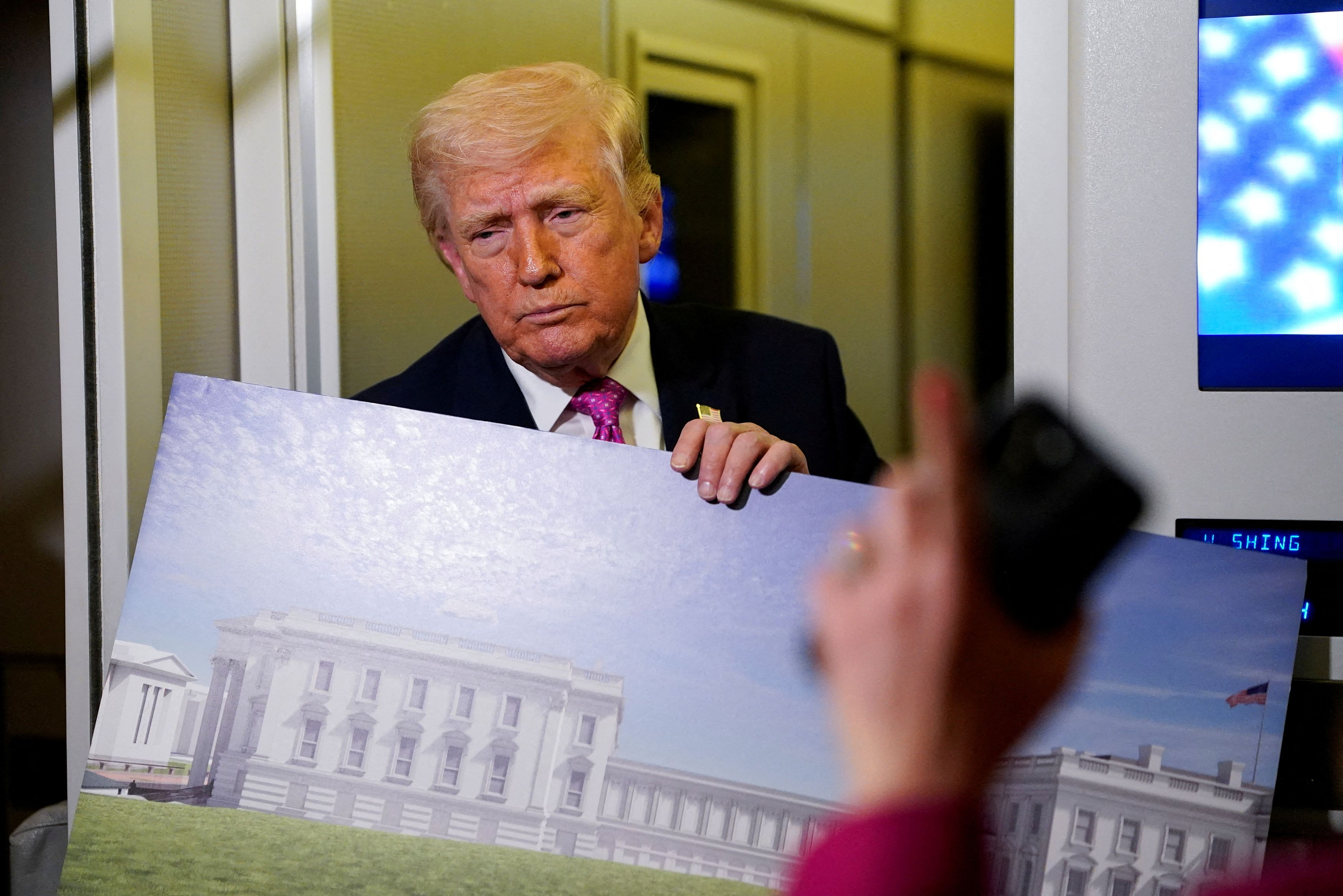
Throughout a given week, the president reviews and re-reviews construction plans, with maps and drawings frequently on hand. During a recent Oval Office visit with a guest, Trump began railing against the judge who halted work on the ballroom and predicted the White House would prevail. After the ruling, top aides had to calm him down by promising a quick appeal, a senior administration official said.
Trump has argued that the massive 90,000-square-foot construction project—almost double the size of the White House residence—is more than just an entertainment space and will have bulletproof glass and underground security features such as a bomb shelter and medical facilities.
Earlier this spring, just days before he launched attacks on Iran, Trump stopped midway through an economic briefing and led a guest outside to point out his renovations, calling attention to new golden lettering reading “The Rose Garden” and adding that the letters were 2-3 inches thick.
At a donor retreat in Florida over the weekend, Trump commented on the marble on the floor at Mar-a-Lago and how he might want to use it for the ballroom, an attendee said. He repeatedly returned to the marble, drawing laughs from the crowd.
He has complained to aides about particular contractors, growing irate this summer when he learned that one contractor had scraped up the property, and about the amount of plastic that is up around parts of the White House, senior administration officials said.
Public opinion polling before Saturday’s shooting showed a majority of Americans opposed the ballroom, and Democrats, feeling momentum in the coming midterm elections, have used his focus on the project to cast him as out of touch.
Before Saturday, some in the West Wing wished that Trump would stop talking so much about the project as the war slogs on, according to people familiar with the matter. But many of the president’s advisers said they recognized it would be nearly impossible to get him to shift focus from something they say brings him tremendous satisfaction.
Recently he has turned his attention to the arch, which would be twice as high as the Lincoln Memorial and is being challenged in court by a group of Vietnam War veterans, as well as a proposed makeover of Dulles International Airport that, if Republican lawmakers get their way, could one day bear the president’s name.
During his first days back at the White House last year, an administration official described how Trump walked around the complex pointing out features that needed to be changed or renovated. Within his first few days at the White House, Trump decided to pave over the Rose Garden for use as a patio. He then turned to the ballroom, abruptly demolishing the East Wing in October, after initially saying the wing wouldn’t be touched.
Several people close to the president said he uses construction and design as a way to unwind. “Churchill painted, POTUS builds,” a senior administration official said.
“For me, mowing the lawn is therapy. For him, probably walking the grounds, checking on updates on the White House,” said Cramer, the senator who called Trump on Sunday. “I don’t think he views that as work. I think he finds that relaxing.”
Write to Alex Leary at alex.leary@wsj.com , Josh Dawsey at Joshua.Dawsey@WSJ.com , Meridith McGraw at Meridith.McGraw@WSJ.com and Marianne LeVine at marianne.levine@wsj.com