
 Μake us preferred on Google
 After more than three months of bombing and blockades, the U.S. and Iran are back to square one, preparing for what promises to be difficult negotiations over limits to Tehran’s nuclear ambitions.
This time, the Iranians will come to the table armed with valuable knowledge: They can survive the worst the Americans can throw at them.
President Trump and Israeli Prime Minister Benjamin Netanyahu gambled that their fierce campaign of airstrikes, launched on Feb. 28 and lasting 40 days, would overthrow Iran’s theocratic regime, or at the very least force it to make major concessions.
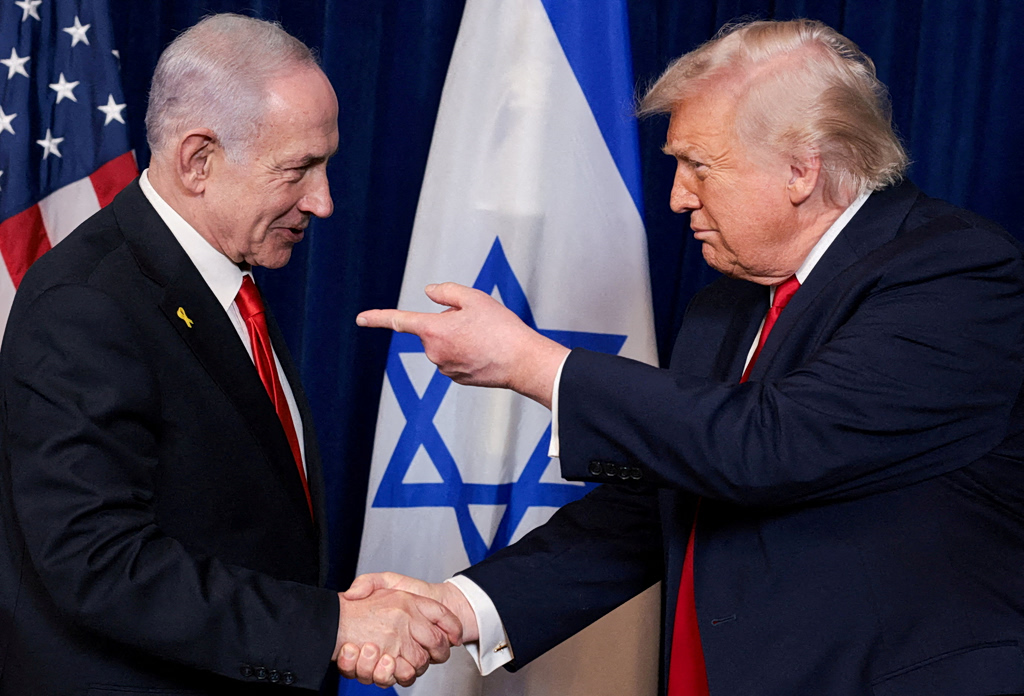
FILE PHOTO: U.S. President Donald Trump points his finger towards Israeli Prime Minister Benjamin Netanyahu as they shake hands during a press conference after meeting at Trump?s Mar-a-Lago club in Palm Beach, Florida, U.S., December 29, 2025. REUTERS/Jonathan Ernst/File Photo
None of that happened, despite the killing of much of Iran’s senior leadership, including Supreme Leader Ayatollah Ali Khamenei , and the decimation of the country’s navy, air force and other military assets.
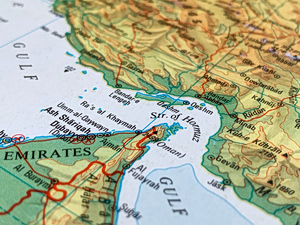
Instead, the Iranian regime has survived and consolidated, under new and perhaps even more radical commanders . It has also gained a new instrument with worldwide consequences through its control of the Strait of Hormuz, while the war has led to unprecedented American restrictions on the behavior of Israel’s military .
“Iran is leaving this war with a sense of euphoria. They are managing the Strait of Hormuz, nobody was able to force them to back down militarily,” said Meir Javedanfar, an Iran expert at Israel’s Reichman University. He predicted Iran will now see the Persian Gulf’s oil-rich monarchies as its own sphere of influence.
Meanwhile, the war—which consumed a large part of U.S. precision munitions and inflicted damage on key U.S. military facilities in the region—has also exposed the limits of American military power. This, in turn, has undermined Washington’s main argument in its attempts to wring future nuclear concessions from Tehran, which retains a stockpile of highly enriched uranium and has yet to agree to renewed international inspections.
“When it comes to nuclear negotiations, we are back at the prewar stage, but with the U.S. leverage removed,” said Dania Thafer, director of the Gulf International Forum think tank. “Pandora’s box has already been opened, everything has been tested, and Iran feels it doesn’t have much more to lose or to fear. The worst has already happened, from the Iranian perspective, and they have survived it.”
Ever since former President Barack Obama tried to negotiate with Iran more than a decade ago, the credible threat of American military force was indispensable for any progress, said Daniel Shapiro, who served as deputy assistant secretary of defense in the Biden administration and as U.S. ambassador to Israel from 2011 to 2017.
“Now, we are going into the nuclear talks, with Iran having already proven that it could take the United States’ and Israel’s best punch, survive, and land some very effective counterstrikes, imposing global economic chaos and economic and political harm to President Trump and the United States,” said Shapiro, currently a senior fellow at the Atlantic Council. “Iranians will view with great skepticism that they will face a significant military threat if these talks are not progressing. And so there is a high likelihood that these talks will be inconclusive.”
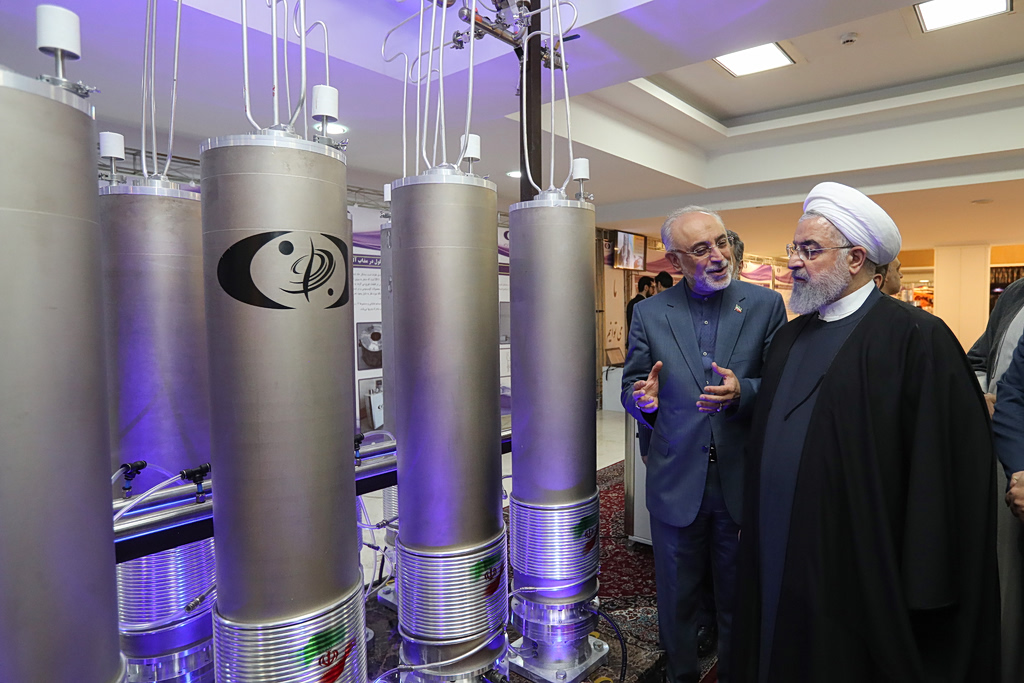
epa07554898 (FILE) – A handout file picture made available by the presidential office shows Iranian President Hassan Rouhani (R) and the head of Iran nuclear technology organization Ali Akbar Salehi inspecting nuclear technology on the occasion of Iran National Nuclear Technology Day in Tehran, Iran, 09 April 2019 (reissued 08 May 2019). State broadcaster IRIB reported on 08 May 2019 that President Hassan Rouhani announced Iran’s decision to pull out from part of a 2015 international nuclear deal, a year after US President Trump withdrew from the agreement. The move was formally conveyed to ambassadors to countries remaining inside the deal (Germany, France, Russia, Britain and China). According to reports, Rouhani said that after 60 days, the Islamic Republic would increase uranium enrichment level. EPA/IRANIAN PRESIDENCY OFFICE HANDOUT HANDOUT EDITORIAL USE ONLY/NO SALES
While Iran may no longer fear the American stick, the American carrot remains attractive. The Iranian economy was already in a tailspin before the latest round of fighting, with runaway inflation and a water crisis—some of the reasons for the mass protests that the regime met with a deadly crackdown in January. The U.S. and Israeli bombing campaign, which destroyed some of Iran’s most important industrial sites, has only compounded the damage.
“Iran is still in a vulnerable position, given the economic pressure that the country will face, and the incredible cost of undergoing reconstruction after this war,” said Esfandyar Batmanghelidj, chief executive of the Bourse & Bazaar Foundation think tank. “The deal ultimately just takes them to the status quo ante, but in the interim, the country has absorbed huge costs. Iran cannot undergo a full reconstruction after this war without broad sanctions relief. And so the incentive remains there to get a full agreement.”
Key figures in the Iranian regime, however, don’t believe that the U.S. will ever relax or remove sanctions, which is why it was so important for Tehran to secure payment up front as part of the deal due to be signed Friday, said Vali Nasr, a professor at Johns Hopkins University who has been involved in informal contacts with Iran.
“The carrot is extremely powerful and extremely important to them if they don’t want to face another January uprising in Iran,” he said. “But the issue is creating trust that the carrot is actually there. The main debate in Iran is really about this, between people who think that you should persevere and get to that carrot, and people who say ‘don’t fool yourself, there is no carrot.’”
Neither side has published the text of the memorandum of understanding that has been negotiated with Pakistani and Qatari mediation. Conflicting accounts still circulate on some of the key issues. It isn’t clear exactly how much money, when, and under what conditions Iran would receive it. It is also unclear whether and how Iran will be able to charge fees for maritime traffic through the Strait of Hormuz.
By its very nature of being tied to nuclear talks, the planned memorandum of understanding is tenuous and won’t necessarily hold in the long term—just as the truce ending Israel’s and America’s 12-day war with Iran last June ended up lasting only eight months.
“This is an extremely frail ceasefire. A lot of folks in Iran don’t think this is a done deal yet. They fundamentally think that regime change is still on the agenda, and that even if Trump wants to give up on it, the Israelis do not and may try to re-create some cause to go back to war,” said Alex Vatanka, Tehran-born senior fellow at the Middle East Institute and author of a recent book on the Iranian regime. “If you are Iranian, you have reasons to be very suspicious because you haven’t changed your ways, so why would you expect your enemy to be more willing to accept you today than they did before the 12-day war and the 40-day war?”
Nadim Koteich, an Emirati political adviser and media executive, said that he considers a resumption of hostilities the likeliest scenario unless Iran fundamentally changes its behavior. “The drivers of another round are still live. Tehran and Washington are already describing two different deals, and Israel never signed,” he said. “For this to hold, Iran has to betray itself—verifiable compliance, real International Atomic Energy Agency access, uranium stockpile moves, proxy restraint. I would bet on fraying before I bet on a settlement.”
Once the Iranians receive billions of dollars in cash as part of the agreement due to be signed on Friday, they may well create new obstacles to delay any future progress in the nuclear talks, said Zohar Palti, a former head of the Mossad intelligence directorate who is now a fellow at the Washington Institute for Near East Policy think tank. “From their perspective, the Americans gave them what they wanted, and perhaps even asked for too little,” he said. “Therefore, they see no reason to offer anything meaningful in return.”
Though negotiated by Iran and the U.S. without Israel, the planned memorandum commits the Jewish state not to fight Lebanon’s pro-Iranian Hezbollah militia—essentially establishing Iran’s right to target the Gulf if it does. The deal has already come under criticism from some parts of Israel’s governing coalition, and from leaders of the center-left opposition that hopes to unseat Netanyahu in elections this fall.
With Israel’s forces determined to remain in occupied parts of southern Lebanon, the potential for a flare-up is huge. “The whole pro-Iranian axis is emboldened now. Maybe it is hubris, maybe it is a false sense of superiority, but for the time being we will suffer from the consequences,” said Ksenia Svetlova, a former Israeli lawmaker from the center-left opposition and an analyst of the Middle East. “They know that Israel’s hands are tied.”
Gulf nations are in a bind, too. “They cannot forgo the American security architecture, because even if you want to build something parallel, that will take years,” said Kabir Taneja, executive director of the ORF Middle East think tank in Dubai. “In the interim, they are prisoners of geography. They don’t have too many options but to engage Iran. Iran is in the position where it knows that people will have to talk to it now.