 Μake us preferred on Google
 MADRID—The war in Iran hadn’t even begun, and Spain’s prime minister had resolved to oppose it.
In the nerve center of Spain’s government, housed in a leafy compound in Madrid, aides to Prime Minister Pedro Sánchez were reading intelligence reports last December, which assessed that President Trump was charting a course for war with Iran. As they analyzed the messy consequences for Europe’s energy supplies and economy, they already knew their boss would rail against it—loudly—whatever Trump’s reaction.
For the past year, most of Europe has walked on eggshells with Trump. Sánchez has been trialing an alternative tactic: the “Just Say No” theory of Trump diplomacy. He is betting the Western alliance will be healthier if America’s allies candidly air their disagreements with the president, rather than tiptoe around him.
As the U.S.-Israeli war with Iran spreads shock waves throughout the global economy, Sánchez, a telegenic 54-year-old Socialist, has adopted the simple slogan of “no a la guerra,” or “no to war.” Unlike others in Europe, he has refused to let the U.S. military use his country’s air bases for the war despite Trump’s anger.
Spain, rarely the center of gravity in European affairs, has become the standard-bearer for Europeans frustrated at the continent’s fear of standing up to a U.S. president. Trump’s threats on Greenland and the unpopularity of the Iran war with voters have brought more Europeans around to his position.
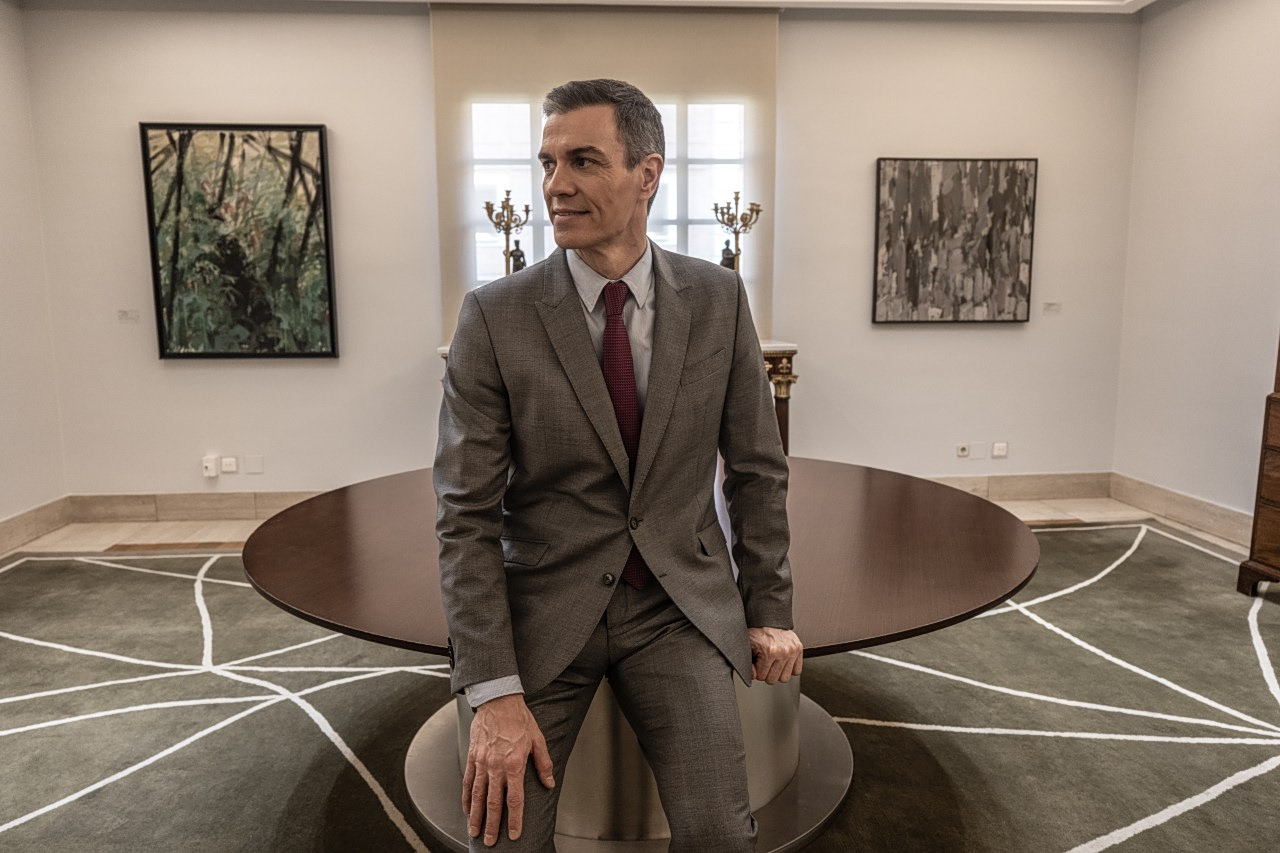
“Good allies are like good friends. We tell each other the truth no matter what,” Sánchez told The Wall Street Journal in an interview at La Moncloa, the government’s headquarters. “In my view, this war in Iran is a big mistake for the world and therefore for the U.S.”
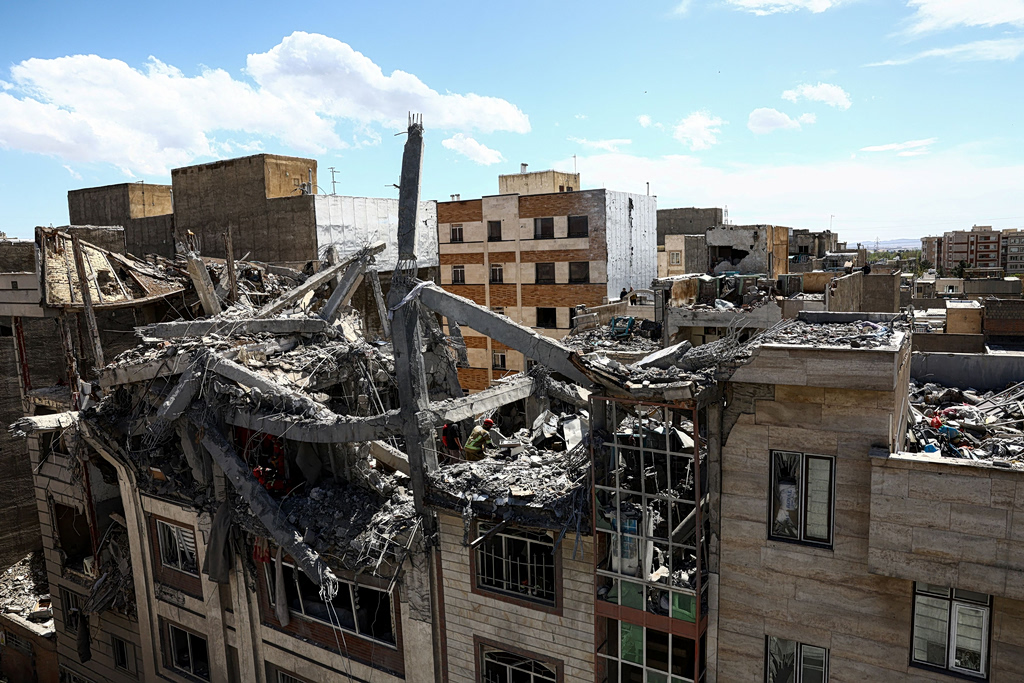
A view of a residential building damaged by a strike, amid the U.S.-Israeli conflict with Iran, in Tehran, Iran, March 27, 2026. Majid Asgaripour/WANA (West Asia News Agency) via REUTERS
“In this world where decisions are more and more driven by impulse, from Spain we offer the opposite: We offer predictability,” he said.
Most European leaders have spent the past year trying to win Trump’s ear through deference and flattery—only to find their concerns brushed aside as the White House makes decisions with heavy global consequences.
Their restraint appears to be one of the Iran war’s casualties. Some of them are now shuffling toward Sánchez’s approach, rejecting Trump’s pressure for NATO allies to help reopen the Strait of Hormuz .
“Germany is not part of this war, and we don’t want to become a part either,” German Chancellor Friedrich Merz said recently. “Italy is taking no part and doesn’t intend to,” said Italian Prime Minister Giorgia Meloni . Both conservative leaders are seen as among Trump’s closer friends in Europe.
Making nice with Trump is becoming evermore unpopular on the continent. A survey by Polling Europe released in February found 25% of Europeans now view the U.S. as a friendly power, down from 61% two years ago. In Spain, 77% of voters in a December YouGov survey disapproved of Trump, who threatened to embargo Spain if it didn’t raise defense spending.
“Spain has been terrible,” Trump told reporters at the White House in early March. “We’re going to cut off all trade with Spain. We don’t want anything to do with Spain.”
The dispute has been good for Sánchez, whose domestic popularity had otherwise slipped after eight years in office. Beyond Trump, he has tangled with Elon Musk , vowing to hold the X owner and other social-media leaders to account “if their algorithms poison our society.” He is one of Europe’s most outspoken critics of Israel’s wars in Gaza and Lebanon.
Spain first
Officials from several other European governments said privately last year that the Spaniard was being unhelpful, especially over his refusal to boost defense spending.
Spain was the only member of the North Atlantic Treaty Organization to reject Trump’s demand to raise defense spending to 5% of gross domestic product. In capitals including Berlin and Paris, officials said Sánchez was jeopardizing Europe’s painstaking efforts to avoid a clash with Trump that might provoke him into launching a trade war, abandoning Ukraine or blowing up NATO.
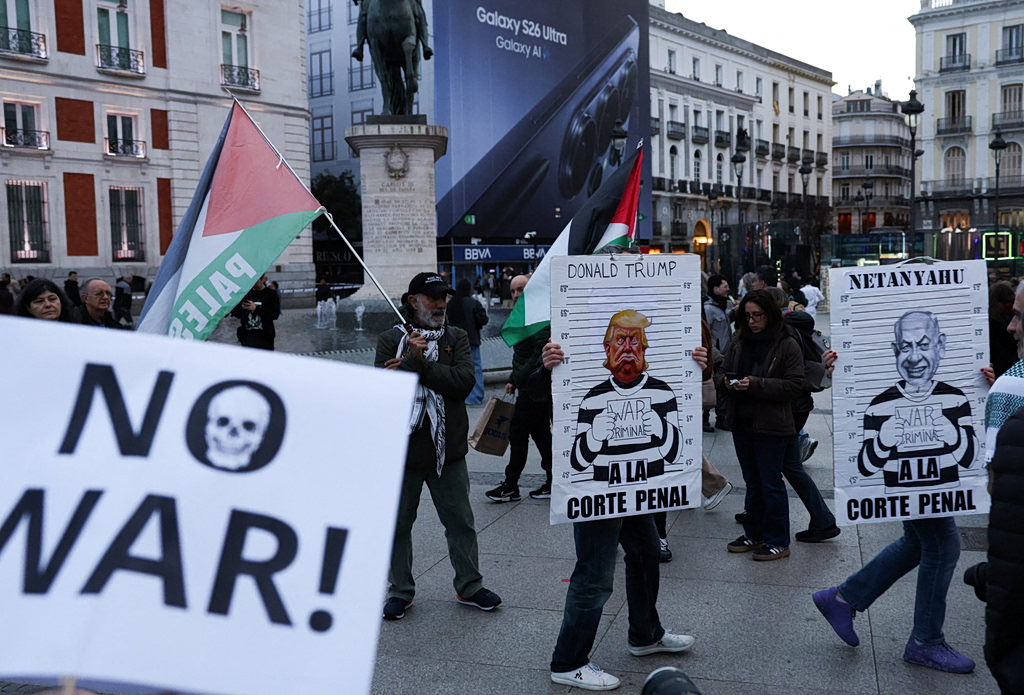
Protesters hold signs depicting U.S. President Donald Trump and Israeli Prime Minister Benjamin Netanyahu during a demonstration under the slogan “Down with Trump and Zionism”, amid the U.S.–Israeli conflict with Iran, in Madrid, Spain, March 21, 2026. REUTERS/Jon Nazca
Other European leaders excluded him from group chats where they discussed how to handle Trump during a series of ructions in trans-Atlantic relations, from Ukraine to Greenland.
Spanish officials have shrugged off Trump’s threat to punish the country, confident that he can’t impose an embargo on just one member of the European Union, which trades as a bloc. The feeling among the mostly millennial-age staff at La Moncloa is that Trump doesn’t hold as many cards as he thinks.
The U.S. exports more to Spain than it imports, Sánchez points out.
“We have a temporary disagreement, but I think that the relationship between the U.S. and Spain is closer than ever,” Sánchez told the Journal. “Americans love Spain.”
Indeed, Spain’s burgeoning population of American residents has roughly doubled on his watch. Some 80,000 natural-born Americans reside in Spain, a number that doesn’t fully count students, dual citizens, workers on short-term contracts or residents who believe they will return to the U.S. in the near future.
When the two heads of government met at a summit in Egypt last October, Trump was chummy, playfully ribbing the tall Spanish leader about which of them would prevail on defense spending.
The punchy simplicity of Sánchez’s political messaging has led some observers to describe him as a figure cut from the same cloth: a European Socialist version of Trump.
Such messaging led to a spat with Musk last month, after the world’s richest man balked at Spain’s vow to ban children under 16 from social-media sites such as X.
“Social media has become a failed state, a place where laws are ignored and crime is endured, where disinformation is worth more than truth,” Sánchez told a conference in Dubai in February.
“Dirty Sánchez is a tyrant and a traitor to the people of Spain,” Musk retorted on X, adding a poop emoji, in reference to a vulgar sex act. Afterward, X’s European arm asked to meet and smooth things over, but Sánchez’s office turned them down.
Sánchez told the Journal that his goal is “to make democracy great again. And that means somehow we need to regulate and to guarantee some accountability from these digital platforms across the world.” Online abuse of children, he argues, isn’t a free-speech issue.
Progressive friends
Some U.S. Democrats have reached out to applaud his efforts, say Spanish officials. When they met in Munich last month, California Gov. Gavin Newsom sought his views on curbing the addictive and deleterious effects of social media on children.
“My wife told me I should talk to you about this,” the California governor said, according to people present. “She thinks this is what our society needs.” The two agreed that Europe should show more backbone in dealing with Trump.
Sánchez is pushing to build a network of left-wing politicians around the world—mirroring the cross-border club that right-wing nationalists have built, from Hungary to Argentina, with support from the White House. His office is trying to bring Rep. Alexandria Ocasio-Cortez (D., N.Y.) to a summit of international progressives in Barcelona next month.
Spain’s far-right Vox party has a strong chance of entering government as a junior partner of Spanish conservatives after elections next year, opinion polls suggest—a first for Spain since fascism.
Critics say Sánchez’s tilt to the left on many policies—including on migration, where he is proposing legal residency for hundreds of thousands of irregular immigrants—has helped the far right grow. Sánchez’s advisers say it’s better to follow demonstrably left-wing policies than to govern with no clear program, which they say has pushed more voters to the populist fringes in other parts of Europe.
Some of his peers view Sánchez as a populist whose stances are driven by the weakness of his position in Spanish domestic politics. He has led Spain since 2018 despite a fragile grip on Parliament, surviving thanks to deals with small left-wing and regional parties.
Lacking enough votes to pass a budget since 2023, his popularity has been hit by corruption investigations into family members and Socialist party officials, who all deny wrongdoing.
On Iran, “I think his motivation is purely about throwing red meat to his left-wing coalition members and putting the right-wing opposition on the wrong side of the issue,” said Fabrice Pothier, chief executive of geopolitical consulting firm Rasmussen Global and a former NATO official.
Aides to Sánchez reject the accusation that he’s motivated by domestic politics, or that he’s using Trump’s broad unpopularity in Europe to distract from travails at home. The aides said they never even commissioned an opinion poll to gauge whether Spaniards would support another American-led intervention in the Middle East.
No to war
Four days into the war, Sánchez—who had already blocked the U.S. military from using Spanish bases—received a call from French President Emmanuel Macron . Would Spain be willing to send a frigate to help protect Cyprus, a fellow EU member? An Iranian drone had struck a British base there.
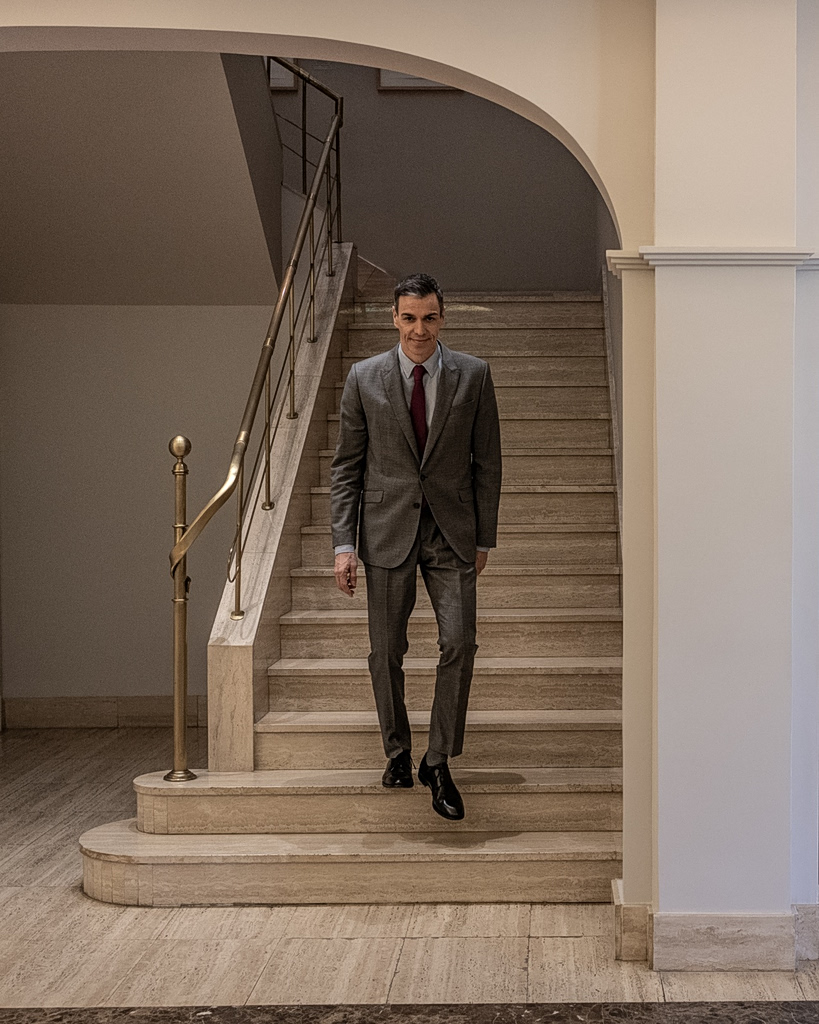
‘We have a temporary disagreement, but I think that the relationship between the U.S. and Spain is closer than ever,’ Sánchez said. Manu Brabo for WSJ
Sánchez agreed. Hours later, White House press secretary Karoline Leavitt announced Spain had “agreed to cooperate with the U.S. military.” Sánchez’s office responded with one word: “false.”
Spain has long been one of Europe’s more ambivalent countries when it comes to American power. Unlike countries occupied by Nazi or Soviet forces, Spain’s freedom and democracy owe little to America. The U.S. cooperated with Spanish dictator Francisco Franco, who offered military bases during the Cold War.
Spain’s 1,500-mile distance to the Russian border means few Spaniards feel the same sense of threat as nations to their east. Sánchez irritated European allies last year by saying Russian troops were unlikely to reach the Pyrenees.
“I do agree that this war in Ukraine is not only about Ukraine, but it’s also about how [Russian President Vladimir] Putin is trying to undermine and weaken the European project,” he told the Journal. He was hosting Ukrainian President Volodymyr Zelensky the next day, to discuss Spanish production of drones and air-defense lasers.
He continues to reject NATO’s 5%-of-GDP target for defense spending.
Write to Drew Hinshaw at drew.hinshaw@wsj.com , Marcus Walker at Marcus.Walker@wsj.com and Gordon Fairclough at Gordon.Fairclough@wsj.com