The U.S. and Saudi Arabia have reached a landmark agreement to provide the kingdom with a civilian nuclear program and potentially open the door to uranium enrichment on its territory, the Trump administration announced Wednesday.
The 30-year, multibillion-dollar deal gives American companies a central role in developing Saudi Arabia’s nuclear infrastructure while shutting out foreign competitors.
A key provision would have American companies build a uranium enrichment facility in Saudi Arabia if a joint U.S.-Saudi study determines such a step would be warranted. That stipulation gives the U.S. influence over the Saudi nuclear program and, Trump administration officials argue, a way to prevent it from being misused for military purposes.
The deal is expected to be submitted to Congress for review in the coming days. It is already proving controversial among many lawmakers who oppose the spread of nuclear technology in the volatile Middle East but will be difficult to block. Doing so would require a joint resolution and a two-thirds majority vote if needed to override a potential presidential veto.
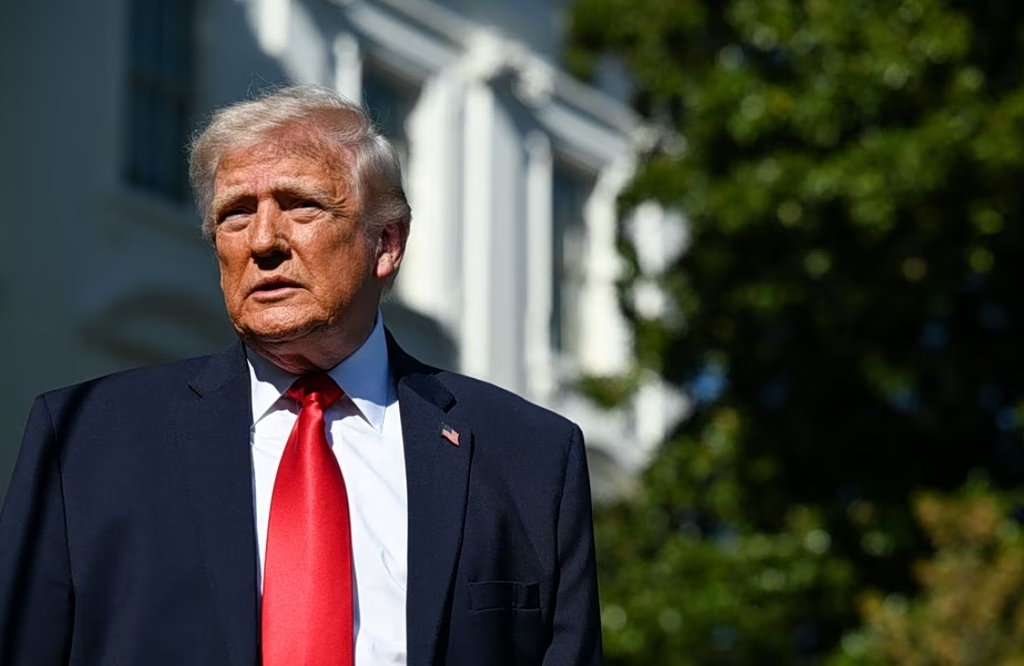
President Trump last week formally approved the deal, which includes an agreement on nuclear cooperation and a bilateral safeguards document. They were signed Wednesday by Energy Secretary Chris Wright , who discussed the deal during his first overseas trip to the region in April 2025 with his Saudi counterpart, Prince Abdulaziz bin Salman , who will also sign the deal.
“The agreement could help revitalize the U.S. nuclear industry, strengthen U.S.-Saudi ties, and deny Russia and China a strategically important role in the Saudi nuclear program,” said Robert Einhorn, a former longtime senior State Department official who advised both Republican and Democratic administrations on nonproliferation issues.
“But unless it contains adequate constraints, including on enrichment, it could increase nuclear proliferation risks in the Middle East and beyond,” Einhorn added.
Saudi officials have long argued that the deal is necessary to enable the kingdom to develop a nuclear industry, which would draw on unproven uranium ore deposits to try to meet energy needs at home. That would free up more of its oil production for export and boost revenues.
Saudi Arabia insists its intentions are peaceful, although Crown Prince Mohammed bin Salman , the country’s de facto leader, said in 2018 that if Iran ever develops a nuclear weapon his nation will follow suit.
Westinghouse Electric and its AP1000 reactor would be among the biggest beneficiaries of the deal. The AP1000 reactor produces about 1,100 megawatts of electricity—enough to power a midsize city or a major artificial-intelligence data center.
A focus by lawmakers will be whether the deal’s safeguards are adequate to shut the door on the development of a potential nuclear weapon at a time of war in the Middle East.
Rep. Brad Sherman (D., Calif.) said Congress should only approve the deal if Saudi Arabia commits not to enrich uranium or reprocess the spent fuel from a reactor, which could be used for a nuclear weapon.
“A President waging war to prevent nuclear proliferation in the Middle East should not facilitate proliferation just because U.S. companies stand to make a profit,” he wrote on social media.
Sen. Ed Markey (D., Mass.) accused the Trump administration of endangering the security of the U.S. and its Middle Eastern allies by potentially enabling nuclear proliferation in Saudi Arabia and igniting an arms race in the region. “This deal would make us all less safe,” he said in a statement.
Secretary of State Marco Rubio dismissed concerns about the deal, telling reporters “suffice it to say, the U.S. is not going to reach any agreement with any country in the world that leads to the risk of proliferation.”
Under the agreement, new power reactors and other nuclear technology would be provided by American companies with potentially a secondary role for some of the companies’ foreign suppliers.
As the reactor projects advance, U.S. and Saudi officials would also carry out a two-year study to examine the value of enrichment for Saudi Arabia, including whether it would be commercially viable to enrich uranium on Saudi soil instead of relying on imported fuel.
If the study concludes that indigenous enrichment is warranted, Americans would build the enrichment facility under a secretive “black box” arrangement that would preclude the transfer of sensitive enrichment technology to the Saudis.
Trump administration officials say that the American role would preclude the enriched uranium from being diverted for military purposes and would ensure that the spent fuel from the reactor couldn’t be reprocessed to make a bomb.
If the U.S. objects to proceeding with enrichment following the study, the kingdom wouldn’t be allowed to carry out enrichment on its own or with another foreign partner for 10 years.
Trump administration officials say the U.S. playing a central role in the Saudi nuclear program would ensure enrichment remains peaceful.
Critics argue that providing Saudi Arabia with a nuclear program, especially with a uranium enrichment or plutonium reprocessing capability, would encourage the spread of nuclear technology in the Middle East. In contrast to the United Arab Emirates, Saudi Arabia has rejected the so-called gold standard, a commitment never to enrich uranium at home or reprocess the spent fuel from a reactor.
“Whither goes Saudi Arabia, so goes the United Arab Emirates, Turkey and Egypt. The idea that this will have a happy ending is delusional,” said Henry Sokolski, executive director of the Nonproliferation Policy Education Center.
The debate around the Saudi nuclear deal has also been sharpened by a dispute over future inspections.
The Saudis rejected the “Additional Protocol,” an arrangement implemented by the International Atomic Energy Agency that would have provided more rigorous monitoring and inspections. Administration officials say a separate, bilateral verification agreement negotiated with the Saudis will still provide for adequate monitoring of the U.S.-provided sites. But critics say the plan will be inadequate to investigate suspected nuclear activities that don’t involve the U.S.
Trump’s new deal is controversial for foreign policy reasons as well.
The Biden administration was prepared to move ahead with nuclear cooperation with Riyadh but conditioned that deal on Saudi Arabia’s willingness to establish formal relations with Israel, which has an undeclared nuclear-weapons program. Prospects for normalization were sidetracked by Hamas’s October 2023 attack on Israel and the Israeli military’s subsequent intervention in Gaza.
While Trump has urged Saudi Arabia to recognize Israel, he is not insisting that Riyadh do so in order to purchase American nuclear technology and launch its civil nuclear program.
The Saudi deal also comes as the White House is still trying to pressure Iran to curtail its nuclear program and hand over its supply of highly enriched uranium.
Iran and Saudi Arabia are regional rivals, and critics say the agreement puts the Trump administration in the awkward position of insisting that Tehran agree to stringent limits on its nuclear efforts as it helps Saudi Arabia develop a civilian nuclear program. Trump officials say there is no contradiction if the Saudi program is subject to effective safeguards.
“Rest assured, these agreements uphold the highest standards of nuclear safety and nonproliferation, while relying on the world’s best nuclear technology and scientists, designed right here in the United States,” Wright said in a statement. “Thanks to President Trump, the American nuclear renaissance is underway and will deliver long-term benefits to the American and Saudi people.”
Democratic and Republican presidents have long resisted efforts by Middle Eastern countries to enrich uranium. But blocking the deal is likely to be an uphill battle for lawmakers who oppose it.
Some lawmakers have argued that a nuclear deal with Saudi Arabia is such a sensitive issue that it should face a tougher congressional standard. In 2018, a group of Democratic and Republican lawmakers sponsored an act that would block nuclear cooperation with Riyadh unless Congress affirmatively voted to approve it.
One of the senators who urged the higher hurdle was then Florida Republican Sen. Rubio, now Trump’s secretary of state. It was never brought to a vote.
Write to Michael R. Gordon at michael.gordon@wsj.com and Stephen Kalin at stephen.kalin@wsj.com