 Μake us preferred on Google
 More than 2,300 years after Aristotle is believed to have taught Alexander the Great and other young Macedonians here, the royal gymnasium of ancient Mieza is slowly emerging from the earth, with archaeologists uncovering a monumental complex whose scale is beginning to exceed expectations
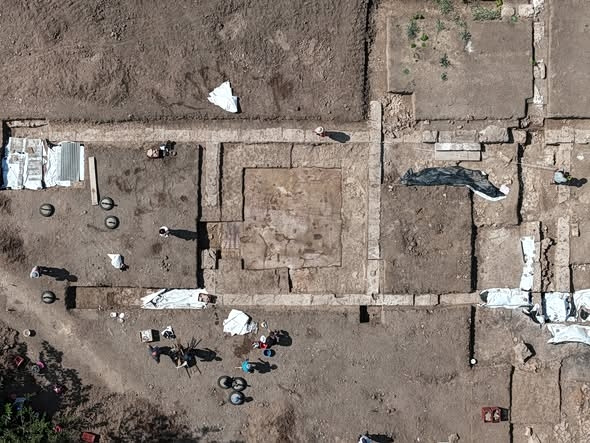
At the foot of Mount Vermio in northern Greece, archaeologists are bringing to light the Royal Gymnasium of ancient Mieza, an educational institution created during the reign of Philip II to educate the young men who would form the political and intellectual elite of the Macedonian kingdom.
Ancient literary sources associate Mieza with the education of Alexander the Great, who was taught by Aristotle before becoming one of antiquity’s most consequential rulers. The excavation is now providing a physical setting for that tradition, while offering a broader picture of education and daily life in the Macedonian kingdom.
Recent work has uncovered mosaic floors, halls and other architectural elements, including a monumental colonnade extending for about 200 meters. The findings are helping archaeologists reconstruct the scale and organization of the complex and have revealed architectural features comparable to those found at Aigai, the ancient Macedonian royal capital.
The identification of the site as Mieza’s royal gymnasium preceded the current systematic excavation, with a scholarly study documenting the identification providing the starting point for the project.
The excavation combines archaeological work with geophysical surveys and conservation. The field team includes archaeologists Maria Parziali and Dr. Tasos Kakamanoudis, while Dr. Anastasia Georgiadou and Prof. Panagiotis Iossif are part of the scientific research team. Emeritus Prof. Grigoris Tsokas and his team conduct geophysical surveys, while conservators Aggeliki Georgiadou and Stergios Pitoulias work to protect the finds as they emerge.