 Μake us preferred on Google
 Greece is a country of micro-traditions. The Epitaphios procession — in which a flower-covered wooden structure symbolizing Christ’s tomb is carried through local streets on Good Friday night — is observed in every parish across the country. But ask someone from Corfu how they mark the evening and it sounds nothing like what happens in Thrace or on a small Cycladic island. Each region has layered its own history, landscape and character onto the same ritual.
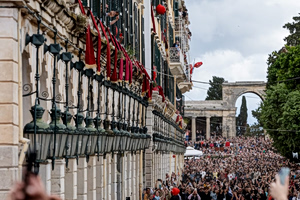
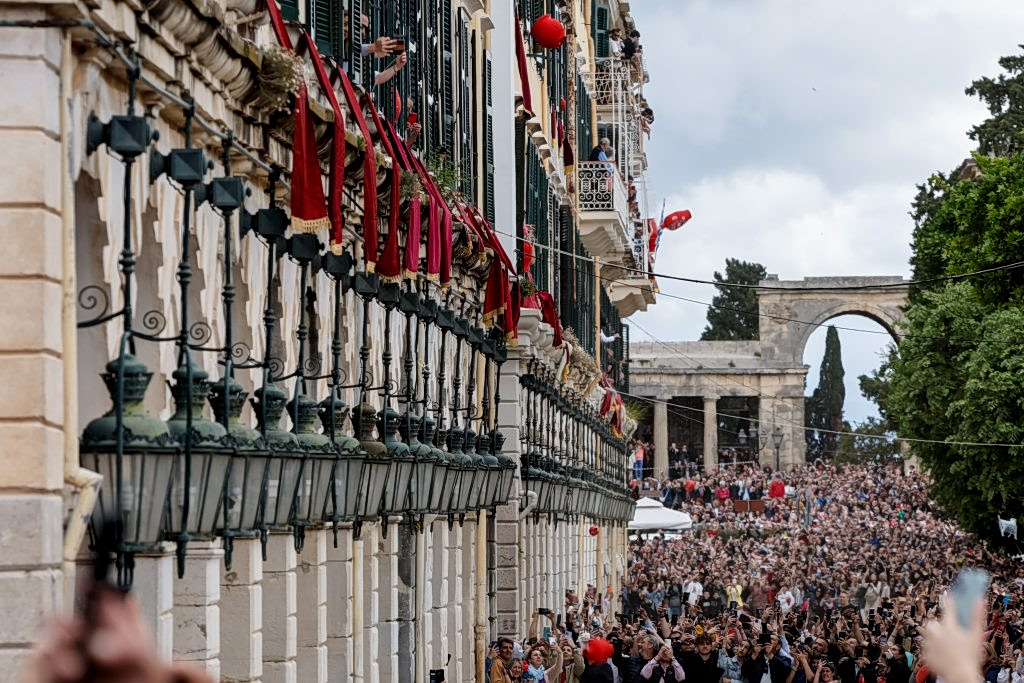
In Corfu, Good Friday is practically a festival of solemn music. The island’s famous philharmonic bands — there are dozens of them, and rivalry between them is fierce — each accompany a different church’s procession. The air fills with funeral marches, choral singing and the sound of hundreds of footsteps on stone streets. The island takes real pride in the spectacle, and crowds travel from across Greece to witness it.
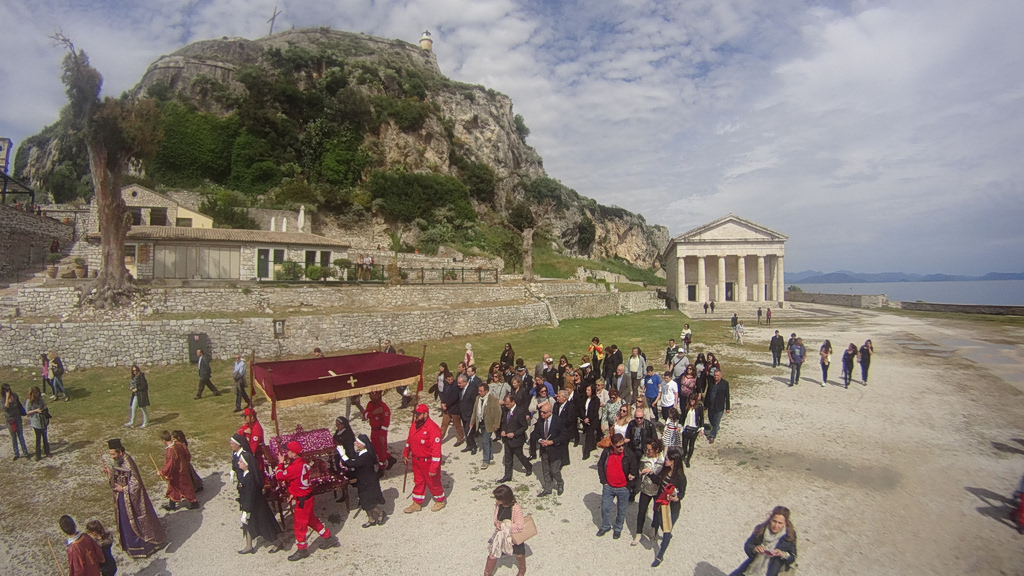
Corfu – Epitaphios procession at the Church of St. George in the Old Fortress. (EUROKINISSI/George Kontarinis)
Coastal towns have their own poetic tradition: the Epitaphios enters the sea. In Loutraki, Tolo and several villages along the Peloponnese coast, fishermen wait in their boats with flares and smoke signals as the flower-laden structure is carried into the water. On the island of Hydra, the service is read with the Epitaphios at the water’s edge. It’s an image that’s hard to forget.
In Thrace and parts of northern Greece, the night ends with the burning of a Judas effigy — a straw figure built by young people and set alight after the procession passes, symbolizing purification and the defeat of betrayal. In the town of Nea Peramos near Kavala, entire neighborhoods light their own fires simultaneously, so the whole town glows at once.
In Agrinio, in western Greece, a different kind of fire marks the occasion. After the procession, locals revive the tradition of the chalkounia — handmade explosive cylinders packed with gunpowder and lit by fuse. The custom dates to the Ottoman period, when the townspeople would set them off during the procession to drive away non-Christians. Today they’re part ceremony, part spectacle.
On Paros, the procession makes 15 stops, and at each one a hillside is illuminated where children dressed as Roman soldiers or disciples of Christ act out scenes from the Passion — the entry into Jerusalem, the prayer in the Garden of Gethsemane, the Crucifixion. In Pyrgos on Santorini, a figure called the Tantalos walks the village streets after the Descent from the Cross to announce the event, while women sprinkle rosewater on the procession from their balconies. On Amorgos, the women do the same with perfume. On Ios, young men play a traditional ball game with small iron spheres after the Apokathelosis, while women’s and girls’ choirs sing the funeral hymns during the procession itself.
On Syros — one of the few places in Greece where Catholic and Orthodox communities have coexisted side by side for centuries — Good Friday takes on a quietly remarkable character. Catholic Epitaphios processions from the island’s Latin churches and Orthodox ones from the Greek churches converge at the central Miaoulis Square, where a joint prayer is held and hymns are sung together. It’s a rare moment of shared grief across two traditions that have more in common on this day than on most.
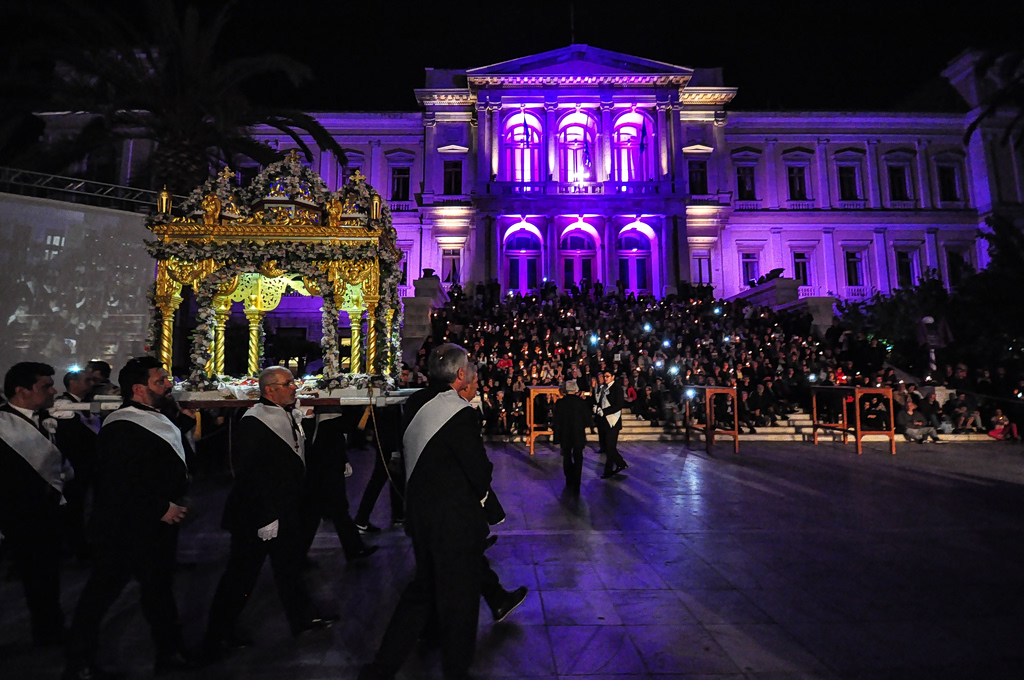
Epitaph procession at Ermoupolis, Syros, on Good Friday, Apr. 14, 2017 (SOOC)
In the village of Neo Souli in Serres, young people build decorative wooden arches — called gefyria, or “bridges” — covered in flowers and icons, and hang them over the road for the procession to pass beneath. They stay up for 40 days.