 Μake us preferred on Google
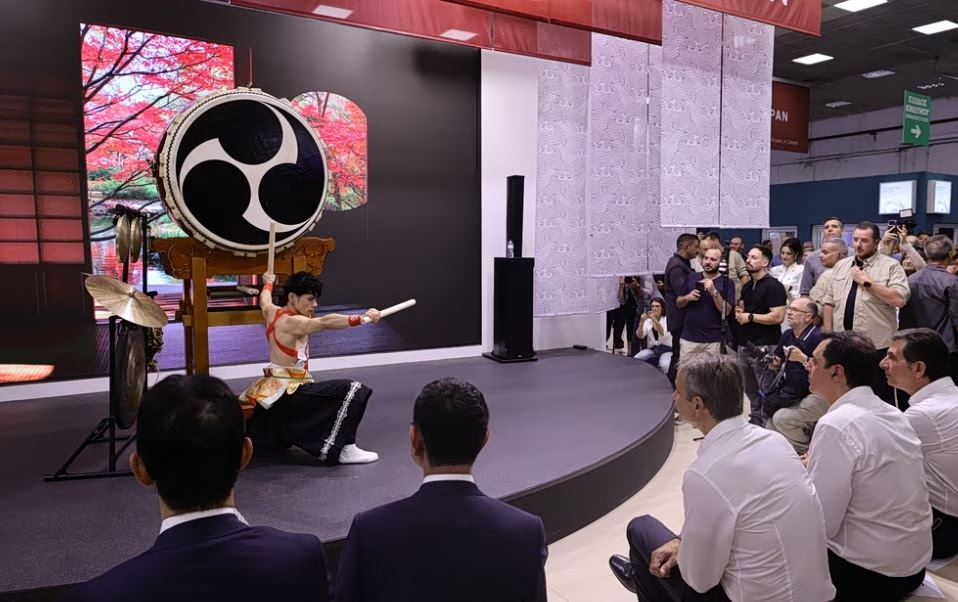
 A young man in a plain gray kimono, Japan‘s traditional national dress, waits patiently for the blessing ceremony marking the opening of the 90th Thessaloniki International Fair (TIF) to begin, watching the brief religious ritual with interest.
Fukuda Kosuke, a 36-year-old Japanese assistant professor, has a deep affection for Greek culture. He plays the Pontic lyra, dances Kotsari, and has translated works by Nikos Kazantzakis into Japanese. He is in Thessaloniki this week for the opening of TIF, where Japan is being honored as this year’s guest country. He will dance alongside fellow Japanese nationals as part of the fair’s events, and again next week at an event titled “From Kyoto to Toumba, one world, one dance,” organized by the Pontic Cultural Association of Kalamaria “Oi Mithrioi” together with Toumba’s “I Romiosyni” cultural association and the Cypriot Community of Northern Greece.
Kosuke, who currently teaches in the humanities department at Shujitsu University, first came to Thessaloniki in 2016 to complete his doctoral thesis at the Aristotle University School of Philosophy, focusing on the work of Nikos Kazantzakis.
While studying, he was introduced to Pontic dance in 2020 by Panagiotis Kyrmanidis, a member of the “Mithrioi” association, who became his dance teacher. In 2022, the association traveled to Japan, where 40 other Japanese students were introduced to Pontic dance for the first time.
“When I was living in Thessaloniki, I became very interested in Pontic culture, because I didn’t know what Pontic Greeks were — I thought they weren’t Greek,” Kosuke said. His favorite dance is Kotsari, though he notes that “Serra is a very difficult dance.” In a few days, his friends from Japan will also arrive in Thessaloniki to perform the traditional sword dance and meet with Pontic dancers.
His love of Greek culture also led him to translate major works by Greek writers and poets into Japanese, including works by Kazantzakis, for which he has received a literary award in Croatia.
“The work that was hardest to translate was Kazantzakis’s Askitiki — very poetic writing, with words that were difficult to render in Japanese,” Kosuke told To Vima. He has also translated The Symposium, the play “Protomastoras,” and “Traveling Japan-China.”