 Μake us preferred on Google
 Maritime shipping is fundamental to the global economy, transporting more than 80% of global trade by volume (UNCTAD, 2025). The industry requires a steady supply of new vessels and maintenance of the existing fleet. Yet shipbuilding has lagged behind other industries in adopting digital manufacturing technologies of Industry 4.0, due to the structure of that demand — with construction being engineer-to-order, low-volume, and non-repetitive (Calvache et al., 2026). Without repetitive, high-volume pain points, it can be very challenging to convince an industry to change. However, the maritime industry has shown it can adapt quickly when there is a clear need, with LNG-fueled fleet growing from 123 to 1188 ships between 2018 and 2024 (Tadros et al., 2026). A similar demand signal is now emerging for improved maritime manufacturing. The maritime industry faces several main challenges:
- The global fleet is aging, with over half of ships being older than 15 (UNCTAD, 2023). Vessels 15 years and older face limited availability of spare parts (Kandukuri et al., 2019).
- Traditionally manufactured replacements (casting or forging) can take months to procure (Seow, 2025).
- Shipyards are being pressured toward expensive modernization from decarbonization regulations (Tadros et al., 2026).
For instance, one day of unplanned downtime for a mid-sized container ship (5,000 TEU) costs an estimated €40,000 (Ziółkowski and Dyl, 2020). These accumulating challenges point toward the same need: faster and flexible maritime manufacturing, both in construction and maintenance/repair. Additive manufacturing (AM), a field of manufacturing that sequentially adds material to attain a desired geometry, is a promising candidate that could rise to the challenge.
AM is a digital fabrication method capable of fabricating complex geometries efficiently and can leverage many engineering materials including steels, Inconel alloys, and Nickel Aluminum Bronze (NAB). Because AM workflows are inherently digital, the technology integrates well with the industry shift toward automation and Industry 4.0 (Tadros et al., 2026). A unique advantage of AM that sets it apart from traditional manufacturing, is that it enables localized, on-demand part production near the point of use (Seow, 2025). Shipyards that adopt AM effectively restructure their supply chain dependency for certain components, which allows them to think in terms of digital files rather than physical inventory.
Probing the depths of AM
Two main types of AM have emerged for their utility to the maritime sector: Powder Bed Fusion (PBF) and Directed Energy Deposition (DED) (de Castro et al., 2025). PBF employs a laser to selectively melt metal powder in a powder bed, and enables the creation of small, high-precision components (Kokare et al., 2023). Conversely, DED uses focused energy sources (lasers, electron beams, or electric arc) to melt wire or powder feedstock to build large-scale parts, analogous to a form of three-dimensional welding (Kokare et al., 2023). The scale of DED has become tractable for fabricating and repairing large ship structures. A prominent type of DED is Wire Arc Additive Manufacturing (WAAM), which leverages existing weld technology to create cost-effective parts. In a life-cycle analysis of a scaled propeller geometry, WAAM was found to be less costly than CNC milling while also having a 2.5x lower environmental impact (Kokare et al., 2023).
Additive alloys in sea service
Several popular marine alloys have been researched and certified for field deployment. Some example cases are highlighted below:
Nickel Aluminum Bronze
Marine components like ship propellers, pump castings, valves, and heat exchanger components are fabricated using aluminum bronze alloys (Wharton et al., 2005). Nickel Aluminum Bronze (NAB) alloys are one of the most important groups of aluminum bronze alloys (Wharton et al., 2005) and have been used in the additive manufacturing of propeller components.
The first class-approved additively manufactured marine propeller was the WAAMpeller, fabricated by RAMLAB in collaboration with Damen Group, Bureau Veritas, Promarin, and Autodesk (Kokare et al., 2023). WAAM was used to manufacture a 400 kg NAB propeller with a 1,355 mm diameter (Kokare et al., 2023). In 2024, a collaboration between Kawasaki Heavy Industries and Pelagus 3D (thyssenkrupp-Wilhelmsen JV) resulted in the installation of a NAB thruster blade on a BW Epic Kosan vessel (Seow, 2025), shown in Figure 1.
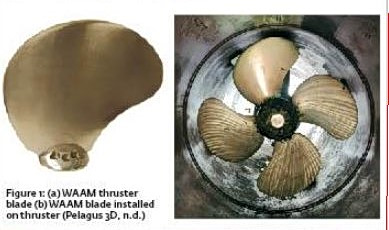
Figure 1: (a) WAAM thruster blade (b) WAAM blade installed on thruster (Pelagus 3D, n.d.).
The blade was qualified to DNV-ST-B203 AMC 2 with EN 10204 3.2 certification witnessed by DNV. The blade reportedly had approximately 40% higher strength than its cast counterpart and had been in service for two years without operational issues as of 2025. Pelagus indicated that the design-to-installation process required 4-8 weeks (Seow, 2025).
Steel
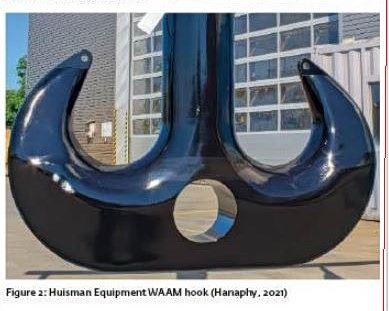
While NAB represents a specialized alloy for harsh environment applications, steel represents the volume material of shipbuilding. AM of steel for marine applications has thus been explored for large structure fabrication. Huisman Equipment has evolved WAAM crane hook production over several years, starting with a 1,000 kg high-grade tensile steel prototype in 2018 and scaling to a 36,000 kg WAAM hook on the OOS Serooskerke in 2019, certified by ABS (Colyer, 2019; Hanaphy, 2021), shown in Figure 2.
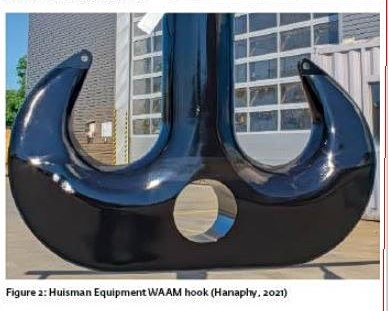
Figure 2: Huisman Equipment WAAM hook (Hanaphy, 2021).
Another prominent example highlighting maritime AM of steel is a deck mounted Panama Chock, which is the world’s largest additively manufactured shipboard fitting to receive verification from DNV. The project was the result of collaboration between AML3D, Keppel Technology & Innovation, and DNV, and used ER70s-6 welding wire to fabricate a 1,450 kg shipboard fitting (AML3D Limited, 2021).
Inconel
Inconel is a nickel-based superalloy and represents the second most-studied material in additive manufacturing, motivated by its performance at high temperatures and its high fabrication cost with traditional manufacturing methods (Wu et al., 2018). A joint project between SHI, InssTek, KOS GLOBAL, PK Valve, KIMS, KAERI, and DNV resulted in a cryogenic valve body made of SUS316L stainless steel with the inside lined with corrosion-resistant Inconel 625. This laser and blown-powder DED technique allowed for a reduced fabrication cost because Inconel was only deposited where it was functionally needed, allowing for the rest of the body to be made with more affordable stainless steel (DNV, 2022).
Qualification and classification frameworks
As AM transitions from demonstration pieces to deployed hardware, qualification and classification frameworks become critical for ensuring reliability and regulatory compliance. As such, the regulatory environment has developed significantly in recent years. In 2025, the International Association of Classification Societies (IACS) established a harmonized framework for qualification and certification of AM metallic parts for marine and offshore applications (International Association of Classification Societies, 2025). Within this framework, DNV provides a comprehensive, data-driven standard covering major AM processes, recently adding polymers in addition to metals and introducing carbon-footprint metrics (DNV AS, 2025). ABS establishes requirements for each stage, which cover design, feedstock, build, post-processing, and inspection (American Bureau of Shipping, 2022). Bureau Veritas provides process-specific documentation focused on WAAM with approval for combinations of wire and shielding gas (Bureau Veritas, 2019).
LR focuses on modularity throughout the supply chain, with separate goal-based guidance notes for metallic parts, polymer parts, and feedstock, allowing independent certification at each stage (Lloyd’s Register, 2024). Among these certification frameworks, empirical qualification of new AM materials remains slow, with DNV noting it can require thousands of tests and several years (DNV AS, 2021). Newer pathways such as model-based qualification, which DNV indicates requires less physical testing for verifying computational model performance (DNV AS, 2021), could reduce the timeline and cost for qualifying AM components.
Some of the challenges that are involved with DED include mechanical properties and processing. The repeated thermal cycle inherent to the layer-by-layer deposition process yields undesirable microstructure, anisotropic mechanical properties, and residual stresses which must be managed as they can hinder component performance and lifetime (de Castro et al., 2025; Seow, 2025). Ongoing research at MIT, supported by the MIT Maritime Consortium, is exploring how to improve the microstructure and mechanical properties achieved by robotic WAAM for materials such as Nickel Aluminum Bronze and Inconel 625, toward eventual data-based qualification and field deployment.
Workforce and digital integration
Deployment of AM necessitates a workforce with knowledge spanning digital design, process control, materials science, and qualification — a combination that is not traditionally taught (Alefeld, 2026). These skills allow operators and engineers to reason across the full production pipeline and understand how process parameters and post-processing determine component quality and certification.
Maritime manufacturing initiatives are increasingly working to address this workforce gap. For example, the BuildSubmarines program targets fields such as AM, CNC machining, metrology, and welding to strengthen the submarine industrial base (BuildSubmarines.com, 2026). Similarly, federally funded programs such as MIT’s Technologist Advanced Manufacturing Program (TechAMP) prepare technicians for roles in AM, with a focus on digital manufacturing, mechatronics, and machining (Massachusetts Institute of Technology, 2025). Partnerships with technology providers, such as the EOS Additive Minds Academy, further close this gap by training suppliers within the maritime industrial base (EOS GmbH, 2025).
The voyage ahead
The full value of AM emerges when positioned within the maritime industry’s shift toward digitally integrated manufacturing. This ’Shipbuilding 4.0’ movement is transforming vessel construction by employing robotic welding, modular construction, and digital twins – leveraging digital integration to link design directly to construction (Tadros et al., 2026). AM systems allow for advanced sensing that monitors thermal history, deposition behavior, and process stability (Arjomandi et al., 2026; Xia et al., 2020) and integrates with the digital twins and in-situ monitoring of Shipbuilding 4.0. Moreover, qualification pathways such as model-based qualification (DNV AS, 2021) become increasingly feasible when combined with in-situ monitoring and real-time process control (Xia et al., 2020).
Beyond the additive step of the process, AM also requires and enables integration with end-to-end digital manufacturing chains. This integration connects design, fabrication, machining, and inspection — forming a digital thread (Bonnard et al., 2018). In these workflows, manufacturing data, inspection results, and process parameters remain linked throughout the component lifecycle, which enables bidirectional traceability and process control loops (Bonnard et al., 2018). These manufacturing digital threads are central to automated shipbuilding and repair workflows (Tadros et al., 2026; Bonnard et al., 2018), and emerging technologies are beginning to incorporate them into modern shipyard operations. Companies such as Valstad, which develops AI-enabled systems for distributed shipbuilding and repair (Valstad, 2026), and Path Robotics, which develops autonomous welding systems (Path Robotics, 2026), demonstrate an industry shift toward sensor-driven, adaptive manufacturing systems.
The case studies presented in this article illustrate how this technology has been proven and certified across several marine applications. The challenge moving forward will be scaling this proven technology for fleet-wide deployment. The maritime industry has already proven it can adapt quickly when the need is clear – scaling LNG capacity nearly tenfold in six years (Tadros et al., 2026). Shipowners, designers, shipyards, OEMs, and classification societies must continue collaborating to mature qualification pathways and implement digital manufacturing infrastructure for maritime AM.
Maxwell Bauer is a Ph.D. student at the Massachusetts Institute of Technology (MIT).
John Hart is a Professor of Mechanical Engineering at the Massachusetts Institute of Technology (MIT).