 Μake us preferred on Google
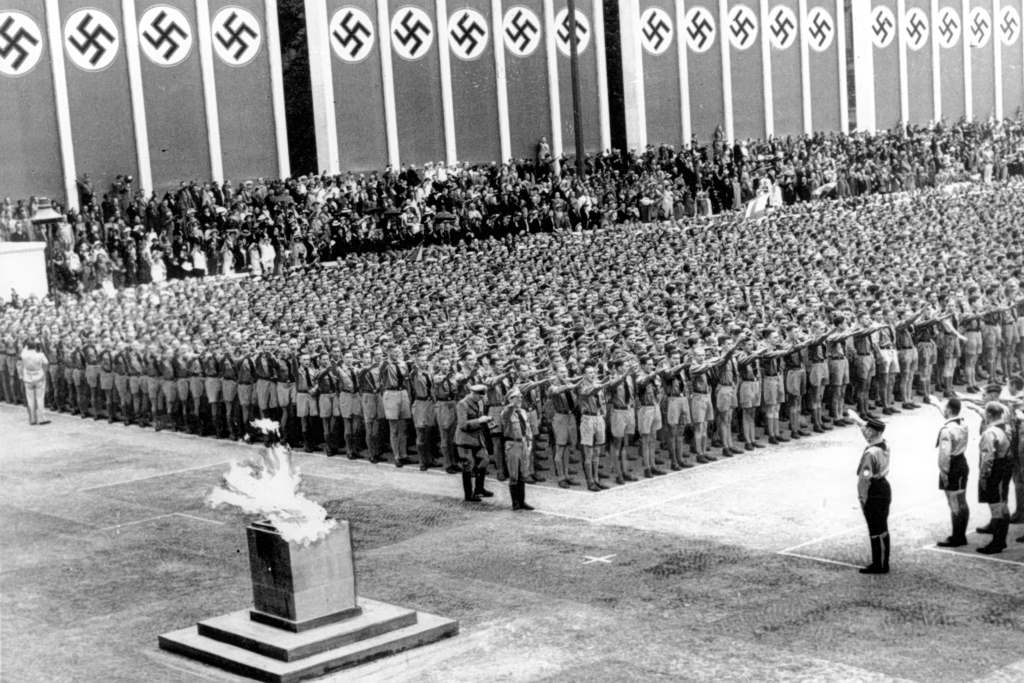
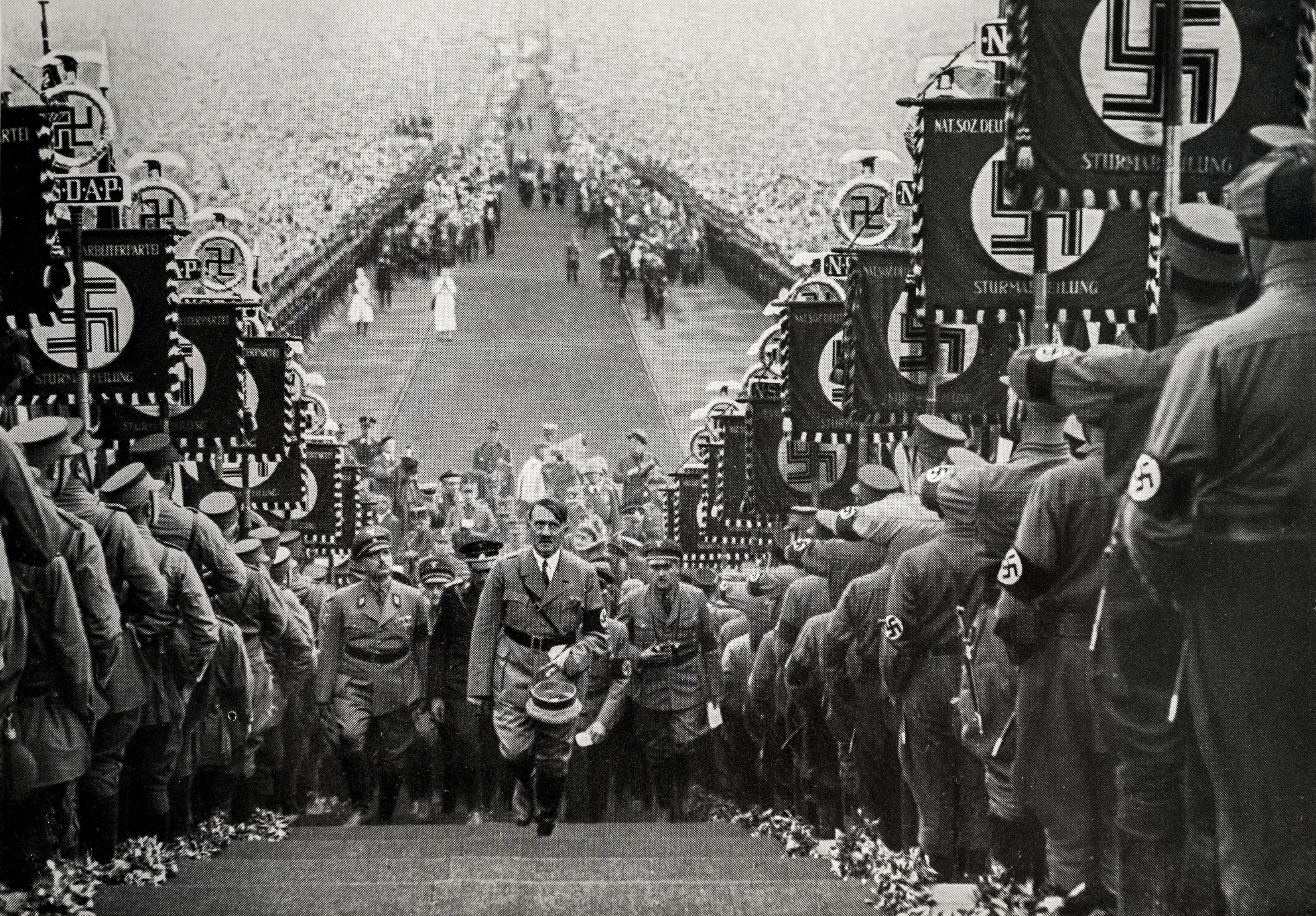
 In August 2026, ninety years will have passed since the 1936 Berlin Olympic Games. Those Games have gone down in history because they were organized by Adolf Hitler’s Nazi Germany, which presented a peaceful façade while simultaneously preparing its imperialist ambitions.
The spotlight of global attention turned to Berlin, and the National Socialist regime seized the opportunity to polish its international image and counter those who warned of its militaristic intentions. This, of course, does not mean that the National Socialists refrained from publicly displaying their ideology. For that reason, whenever German athletes stepped onto the winners’ podium, they gave the Nazi salute.
The Stadium and Its Architectural Symbolism
The 1936 Olympic Games were held in Berlin’s imposing and monumental Olympic Stadium, which is still used today as the home stadium of the football club Hertha Berlin.
It belongs to the category of massive buildings that constituted a common characteristic of dictatorial regimes, from Nazi Germany and Fascist Italy to the Stalinist Soviet Union. Such buildings conveyed the message that state authority in dictatorial regimes stood above the individual citizen. Their enormous public buildings inspired both awe and fear.
NEWSLETTER TABLE TALK
Never miss a story.
Subscribe now.
The most important news & topics every week in your inbox.
Another characteristic of Berlin’s Olympic Stadium is its classical appearance. This, too, is linked to another hallmark of dictatorial regimes: an obsession with the past and the arbitrary construction of an imaginary line connecting the present to the “glorious” antiquity.
Because dictatorships lack popular legitimacy, they seek other ways to “legitimize” themselves and secure public support. One such method is to associate themselves with “glorious” periods of the past, thereby creating in the public mind the image of a leader who continues a heroic historical tradition.
Within this context, Werner March, the architect of Berlin’s Olympic Stadium, declared during his visit to Greece in November 1936: “The concentration and integration of all ceremonial grounds and stadiums into a single complex, and their artistic formation into one harmonious whole, is due above all to the leader of the German state, Adolf Hitler, who thus presented the capital of the Reich with a ceremonial complex whose significance will always remain considerable for Germany. In these buildings one finds a subtle echo of the ancient ceremonial sites and, at the same time, the highest development of modern Olympic architecture… Within the saturated atmosphere of the modern age, after the Renaissance and Classicism, the Apollonian ideal of ancient Greece appears for the third time.”
Indeed, this architectural philosophy of Nazi Germany was also intended to be “exported” to Greece.
In 1936, the journal of the Technical Chamber of Greece, Technical Chronicles, published “an article by the German professor Fischer, which provides an interesting idea of the fundamental principles currently followed by a significant group of architects in Hitler’s Germany.”
Among other things, the article stated: “We must clearly understand that today architecture is not concerned with shaping each individual building, but with elevating everything that surrounds us into a regular and disciplined harmony… Architecture concerns itself with the ‘totality of vision’ (Totalität des Schauens), that is, with a way of seeing and perceiving based on entirely simple forms… None of us is struggling to construct this or that building in this or that manner. Today we are fighting for the outward form of the whole, so that our architecture may also become a symbol of the new form of the state. We are fighting for the architectural affirmation of the principle: ‘The common good comes before private interest.’… Ultimately, it is not essential for a building to be a work of art upon which art historians may write. What is essential is that everything around us be orderly and not disturbed daily by disorder or vulgarity.”
Fischer continued: “An architectural style cannot be invented; one can only create the foundations for a common, living style of the people. This is what the German state seeks today. The new state has established the following principle, and it is magnificent and full of promise for our efforts: ‘The common good comes before every individual interest.'”
The culmination of this architectural philosophy was, of course, Nazi Germany’s Germania project, designed by Albert Speer, whose largest planned structure was the Volkshalle, intended to serve as the symbol of the National Socialist regime and to stand at one end of Berlin’s central boulevard.
Berlin’s Olympic Stadium stands in complete contrast to the Munich Olympic Stadium, which hosted the 1972 Olympic Games. Its architect was Günter Behnisch, who, despite having served during the Second World War as one of Germany’s youngest submarine commanders, managed through the design of the Munich Olympic Stadium to symbolize a decisive break with the architecture of the National Socialist regime.
Unlike the Berlin example, Behnisch—together with architect Frei Otto—designed a stadium with original features and an entirely different symbolism: low in profile, adapted to the natural contours of the landscape, cheerful in appearance, and covered with acrylic glass canopies that evoked the Alps.
The Iconic Victories of Jesse Owens
The protagonist of the 1936 Olympic Games, however, was not Hitler and his National Socialist regime, but a leading African American athlete, Jesse Owens.
Against the racist belief in the “superiority” of the Aryan race and the “inferiority” of those who did not have white skin, Owens won four gold medals at the Berlin Olympic Games.
From the perspective of symbolism, Owens’ most important victory was his win in the long jump. There, he competed for first place against the German athlete, winning the gold medal with his final attempt.
Even today, it is worth searching online for the newsreel footage of the era and watching Hitler passionately follow the “duel” between the American and German athletes.
The outcome was not simply an Owens victory, but a triumph of humanism: an African American athlete defeated those who believed in “superior” and “inferior” human beings—and he did so inside their own “home ground,” in the presence of Hitler himself.
The Olympic Games Back in Berlin 100 Years Later?
History, however, does not concern only the past. In many cases, it “pursues” the present and the future as well.
Because one of the most difficult things is dealing with the past.
Recently, the city of Berlin decided to submit a bid to host the 2036 Olympic Games, exactly one hundred years after the Olympic Games held in the same city under the Nazi regime.
The proposal was approved by the Christian Democrats, the Social Democrats, and the Alternative for Germany, while it was rejected by the Greens and The Left.
This is precisely where the questions begin:
What is the best way to distance oneself from the past?
By hosting the Olympic Games exactly one hundred years after the Games held in the same city under Hitler?
Does this, then, constitute an indication of arrogance and a lack of empathy, or, on the contrary, could it be interpreted as a rejection of the past and an opportunity to reflect on the suffering accumulated by Nazi Germany?
The answer to this question is by no means easy.
The only certainty is that history continues to “torment” us with its dilemmas.
Mr. Spyros Vlahopoulos is Professor at the School of Law of the National and Kapodistrian University of Athens.