 Μake us preferred on Google
 On 9 September 1976, Mao Zedong died. The date marks one of the great turning points in modern China. Mao had sought to transform society through ideology and revolutionary mobilization. Within two years, China was moving towards a very different conception of progress: economic reform, openness and material development under Deng Xiaoping.
China’s post-1978 transformation necessarily began with material development. A poor country needed factories, infrastructure, housing, education, technology and higher incomes. Deng’s
reforms created the foundations on which greater human capabilities could develop.
But China’s transformation also depended on something less tangible: trust.
Recent research drawing on Chinese social surveys and the World Values Survey finds high and relatively stable levels of general social trust in China over several decades. Institutional trust is also relatively high: the 2026 Edelman Trust Barometer gives China a Trust Index of 80, among the highest of the countries surveyed.
These are not the same thing. Social trust concerns confidence in other people and society; institutional trust concerns confidence in organizations and institutions. Nor does trust mean universal confidence or simple obedience. Its economic importance lies in its capacity to support cooperation when people believe others will reciprocate and institutions can deliver.
This matters because development on China’s scale requires long time horizons. Families invest heavily in education; students accept demanding educational pathways; firms invest for the future; institutions coordinate resources; and citizens participate in systems whose benefits may take years to materialize.
In China, these relationships are also shaped by guanxi—networks of relationship, reciprocity and mutual obligation through which people build confidence and sustain cooperation. At its most constructive, guanxi provides a social infrastructure through which trust is translated into durable relationships and reciprocal commitments.
The results are now visible not only in China’s physical transformation but also in its human capabilities.
The OECD’s 2025 PISA results placed B-S-J-Z—Beijing, Shanghai, Jiangsu and Zhejiang—among the world’s highest-performing education systems. Their students scored 597 in science and 612 in mathematics, against OECD averages of 482 and 463. These results do not represent China as a whole, but they illustrate how China’s material development has been accompanied by an extraordinary expansion of educational capability.
The next step is knowledge creation.
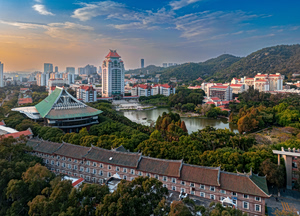
In the 2026 global university rankings, Tsinghua and Peking were among the world’s top 15 universities, while Chinese universities continued to expand their presence among the global elite. ShanghaiRanking placed 16 Chinese universities in the global top 100, up from 13 the previous year. Rankings are imperfect measures of knowledge creation, but the direction is difficult to ignore: China’s universities are acquiring a growing capacity to produce internationally recognized research and advanced knowledge.
The progression is striking: Deng created material capacity. Trust and relationships supported coordination. PISA reveals human capability. Chinese universities increasingly demonstrate knowledge creation.
The deeper question is: what is all this capability for?
China’s official vision of modernization now goes beyond economic growth to include common prosperity, cultural and ethical development, harmony with nature and a path suited to its own circumstances. Whether these ambitions are fully realized is another question. What matters is that China’s conception of modernization increasingly extends beyond simply producing more.
There is an intriguing historical echo. Writing in The Problem of China in 1922, Bertrand Russell observed that Chinese students were eager to acquire Western knowledge without necessarily wanting to reproduce Western society. They wanted to learn from its science and education without simply importing what they regarded as its vices. Russell saw in this a different hierarchy of values: a willingness to regard wisdom as more precious than wealth or power.
A century later, that observation acquires a new significance. China has acquired much of the material and technological capacity that Russell believed China needed for national independence. It has also developed extraordinary educational and research capabilities. The question is no longer whether China can acquire the capabilities of modernity, but what kind of modernity it will construct with them.
Confucian ideas provide part of the intellectual background to this question. Education, self-cultivation, responsibility and social harmony have long been central to Chinese thought. They suggest that development is not only about what a society produces, but about the capabilities, responsibilities and relationships that development makes possible.
China’s trajectory can therefore be reduced to three questions:
- Mao asked how society could be transformed. Deng asked how society could become prosperous. The emerging question is what prosperity makes possible.
- China has spent decades learning how to produce wealth. PISA provides evidence of extraordinary human capability. Its universities increasingly suggest that this capability is becoming knowledge.
- China’s historical achievement was to build, at extraordinary scale, the material and human capabilities of a modern society. Its emerging challenge is to decide what those capabilities are ultimately for.