 Μake us preferred on Google
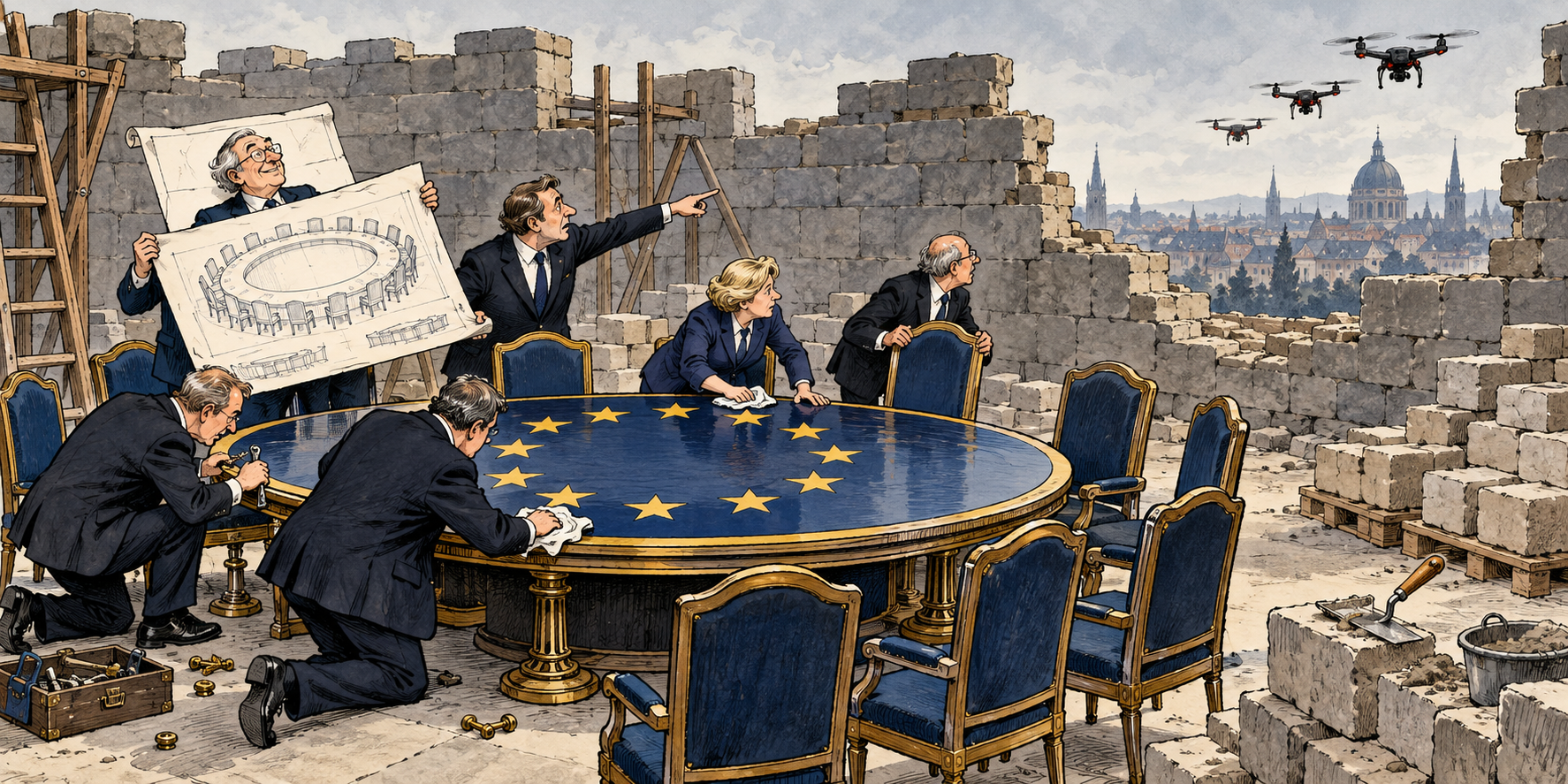
During the annual debate on the State of the European Union, the President of the European Commission, Ursula von der Leyen, presented her idea for creating a European Security Council as part of the discussion on the EU’s defence capabilities. The initiative follows the increased threat of Russian hybrid attacks and calls from many Member States for a Europe that is prepared to respond to security emergencies. According to the President, the Council will provide “high-level political guidance on critical security challenges affecting not only the European Union but also the wider Europe”. The reference is deliberately to a ‘vigilant Europe’ rather than the Union, as von der Leyen’s plan also relies on support from partners such as Canada, Norway, Ukraine and the United Kingdom.
The most significant aspect of the proposed package is not the Council itself, but the accompanying measures. Hybrid attacks exist in a grey zone between peace and war. NATO’s collective-defence clause was not intended to address incidents such as drone activity over airports, and the EU’s mutual-assistance clause applies to armed aggression rather than sabotage. To address this gap, the President proposed an Emergency Security Protocol, modelled on NATO’s Article 4, that would let any member state experiencing a hybrid incident convene the others and coordinate a response. In practice, this mechanism may prove more consequential than the Council, as it addresses a current challenge for Europe: when a serious incident occurs that does not amount to war, there is no established procedure for determining the appropriate response.
The timing of the proposal to redesign the security framework is no accident, as it coincides with multiple events across the continent. On 4 August, authorities discovered an explosive-laden drone at Leipzig/Halle airport near a Ukrainian cargo aircraft. On 1 September, the German government formally attributed responsibility to Russia, announced the closure of the Russian consulate in Bonn, and indicated expectations of further hybrid attacks. Moscow denies any involvement in the interim. The conflict-monitoring group ACLED recorded 82 suspected Russian-linked incidents in Western Europe in 2025, including 35 in Germany. The escalation of similar-type incidents of sabotage and malign activity attributed to Russia has kept increasing since its invasion of Ukraine. At the same time, the continent’s security is being called into question, and the US’s ambivalent stance towards NATO is forcing the Union to seek faster, more effective and alternative responses to successive crises.
The idea itself is far from new. Various versions of a European Security Council have resurfaced periodically in debate since the 1980s, but none gained traction. The proposal resurfaced following the EU’s split over the Iraq War in 2003 and received fresh impetus in 2017 from former European Commission President Jean-Claude Juncker and French President Emmanuel Macron, but it failed due to the UK’s reluctance. French President Emmanuel Macron presented it during his 2017 election campaign, and it received official backing the following year in the Franco-German Meseberg Declaration. More recently, the initiative took a step forward when the Commissioner for Defence, Andrius Kubilius, highlighted the need to establish the Council in a speech in Sweden earlier this year. He suggested that it could begin as an intergovernmental body comprising interested countries and later acquire a formal legal framework, estimating that around 12 key countries could participate.
Proponents of the Council present a compelling argument based on its intrinsic merits. Leaders such as Volodymyr Zelenskyy already participate in European Council meetings, indicating that the proposed format would formalise an existing practice rather than introduce a novel one. The inclusion of the United Kingdom, a nuclear power and one of Europe’s principal military actors, would provide a permanent framework for post-Brexit security cooperation. Norway has expressed support for the EU’s initiative to involve non-member states in these discussions. Nathalie Tocci of the Istituto Affari Internazionali has characterised the Council as “no panacea,” noting that consensus would likely remain necessary. However, she contends that a smaller group with a shared perception of security threats could foster greater trust than the full European Council currently achieves. The Council does not need to be fully developed at its inception. Defence Commissioner Andrius Kubilius proposed in January that it could initially function as an intergovernmental body comprising ten to twelve interested countries, with a legal framework to be established subsequently. This incremental approach has characterised much of European integration, and insisting on unanimous agreement among all 27 governments before proceeding could result in indefinite delays.
However, enthusiasm alone does not constitute a comprehensive plan, and the current proposal lacks substantive detail. The President has not set a start date or specified tangible outcomes, and the Commission has not clarified whether the body would have formal powers or would function solely as a coordination forum. The fundamental question concerns the decision-making process. Creating an intergovernmental structure outside the EU framework would mean operating outside the Treaties and institutions and relying instead on agreements between participating governments. This, of course, raises yet another issue: it remains unclear whether such an arrangement would be subject to the principle of unanimity, with each participating country retaining a right of veto, or whether decisions would be taken by majority vote. If each participant retains a veto, the Council risks replicating the inefficiencies it was designed to overcome. Conversely, if decisions are made by majority, member governments must accept the possibility of being outvoted on critical issues such as war and peace, a step Angela Merkel advocated in 2018 but Europe never adopted. The discomfort associated with both options may explain the absence of a definitive answer.
Another challenge is the complex institutional environment in which the Council would operate. Currently, twenty-three of the European Union’s twenty-seven member states are NATO allies, and the Coalition of the Willing has emerged as a significant framework for supporting Ukraine. Europe does not realistically suffer from a shortage of places to discuss security and defence topics. Instead, it lacks decisive action, operational capabilities, and political will, and establishing a new body provides none of these.
Oana Lungescu, a former NATO spokesperson, has endorsed enhanced cooperation between the EU and NATO, while also noting that both organisations already possess established protocols and operational frameworks. The Council can justify its existence only by fulfilling roles NATO cannot, specifically by integrating the instruments under EU control, such as sanctions, trade measures, infrastructure regulations, and cyber policy, and aligning them with high-level political decisions. An entity that merely replicates NATO’s consultative processes would create institutional confusion rather than increase effectiveness.
There is also the question of who sits at the table. Four EU members, Austria, Cyprus, Ireland and Malta, are outside NATO. A club of a dozen countries that in practice mirrors the Alliance would leave them on the margins, and a hierarchy of members is the last thing the Union needs.
For readers in Greece, these issues are immediate and tangible. Earlier this year, a drone allegedly launched by Hezbollah targeted a British airbase in Cyprus, an EU member state outside NATO. This incident reignited debate regarding the Union’s mutual-assistance clause, prompting EU ambassadors to conduct a war-gaming exercise to assess the practical implications of invoking it. This episode underscores the importance of institutional design. A mechanism that benefits only central countries would neglect states on the Union’s periphery. Greece and Cyprus have a vested interest in ensuring that the new security architecture fully includes peripheral states. The critical test is not only whether we are invited to the Council, but also whether we possess the ability to activate the Protocol when necessary.
Europe’s primary weakness has seldom been a lack of ideas; rather, it lies in the disparity between leaders’ announcements and governments’ actual commitments. The European Security Council could become a substantive institution if it compels governments to clearly articulate their joint actions, or it could devolve into another forum for issuing communiqués. The forthcoming EU security strategy should clarify which direction Europe intends to pursue.
Filippos Frank Arantza is an intern at Europe Direct ELIAMEP Attikis