 Μake us preferred on Google
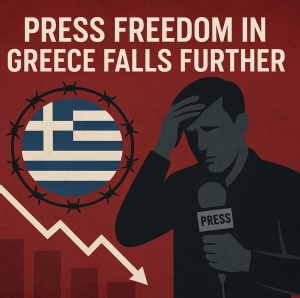
 Two landmark rulings—one by the Athens Court of First Instance and the other by the European Court of Human Rights (ECHR) in Strasbourg—have this summer drawn a defining line between state power and the citizen. Together, they identify the guardian of that boundary: free, responsible journalism upheld by an independent judiciary.
Both judgments are significant and mutually reinforcing in their affirmation of the rule of law and freedom of the press. They strike at the heart of democracy itself: the citizen’s right to know and the judge’s duty to remain free from pressure.
The Cases
In the case of Marinakis v. Greece (Applications Nos. 25916/18 and 37429/18, judgment of June 23, 2026), the Third Section of the European Court of Human Rights found that Greece had violated the presumption of innocence under Article 6 §2 of the European Convention on Human Rights.
The Court condemned the use of unofficial government “non-papers” issued by the press office of the then Prime Minister, as well as defamatory public statements made by ministers against a private citizen while criminal proceedings were still pending. Those proceedings ultimately ended in the individual’s complete acquittal after what the author describes as an unjustifiable seven-year legal ordeal.
Crucially, for the integrity of the judiciary, the Court also held that references made by the then Minister of Justice to his disciplinary authority over senior judges could reasonably be perceived as pressure on the judiciary.
The ECHR further rejected the argument that the injured party’s access to public platforms, as the owner of media outlets, diminished the harm caused. In doing so, the Court protected not only the individual concerned but also, indirectly, the editorial independence of his media organizations from state manipulation of information.
Separately, in Judgment No. 1798/2026, the Athens Multi-Member Court of First Instance dismissed a €250,000 damages claim brought by a former Secretary General to the Prime Minister against a newspaper over its reporting on Greece’s wiretapping scandal.
The court carefully balanced competing constitutional rights, giving precedence to freedom of the press under Article 14 of the Greek Constitution and Article 10 of the European Convention on Human Rights over the claimant’s personality rights. Applying the constitutional principle of proportionality under Article 25 §1, it concluded that the publication served the public interest by informing citizens about a matter of exceptional institutional importance that was already under scrutiny by both the Greek Parliament and European institutions.
The court also found that the claimant—who had publicly described himself as the Prime Minister’s alter ego and occupied a position of considerable de facto influence—had become a figure of legitimate public debate. It therefore upheld the defence of justified public interest under Article 367 §1 of the Greek Penal Code.
This, the author argues, reveals the deeper significance of the ruling. Balancing competing fundamental rights is not merely a legal technique but the essence of justice itself. Justice lies in identifying the proper measure where constitutional rights collide. That methodology, based on the specific facts of each case, mirrors the approach consistently adopted by the Strasbourg Court, weighing factors such as the contribution to public debate, the public status of the person concerned and the standards of responsible journalism.
What Is at Stake
The common denominator in both judgments is the protection of the rule of law. Each defends the same constitutional principle: safeguarding independent, investigative journalism as a public institution capable of holding power to account.
In one case, the state sought to silence journalists through litigation. In the other, public officials themselves engaged in what the author describes as the character assassination of a citizen who owned media outlets, in an effort to influence editorial independence. The Strasbourg Court’s message is unequivocal: malicious information becomes particularly dangerous when it originates from those exercising state authority.
Holding public office inevitably comes with greater public scrutiny. Those entrusted with power accept that transparency must outweigh aspects of personal privacy, since democratic accountability depends upon public visibility. Disclosure is the mechanism through which accountability is achieved.
This, the author argues, defines journalism’s constitutional role. Genuine investigative journalism must remain independent, fair and fearless, exposing wrongdoing and illuminating matters of public concern. In that sense, journalism is not merely a profession but a public service, and journalists bear a profound responsibility as partners in the functioning of democracy.
Institutional journalism also has another duty: to distinguish itself from the flood of misinformation that circulates freely online. Citizens must be able to differentiate verified reporting from deliberate insults, anonymous smear campaigns, orchestrated character assassination and fake news, which continue to erode public discourse.
The Strasbourg Court itself has drawn that line. Public statements that encourage citizens to believe someone is guilty before judicial proceedings have concluded do not constitute an exercise of free expression—they undermine it.
This also highlights the enduring value of established news organizations. They operate with editorial standards, internal safeguards and professional ethics. As leaders within the international journalism community have observed, their future lies precisely in delivering calm, verified and fair reporting. Journalism grounded in the pursuit of truth strengthens both citizens and democracy against the corrosive effects of abuse, anonymity, hatred and intimidation.
The Lesson and the Duty
The only command a judge should heed, the author concludes, is the one traditionally attributed to Eleftherios Venizelos in his advice to Konstantinos Raktivan, his friend and the first President of Greece’s Council of State: seek justice in both the spirit of the people and the law, resist pressure from the powerful and safeguard the dignity of the judiciary.
The author also welcomes recent legislative initiatives aimed at combating abusive Strategic Lawsuits Against Public Participation (SLAPPs), whose purpose is not to secure justice but to impose financial ruin and silence critical voices.
Ultimately, the greatest constitutional imperative in today’s democracy is to “guard the guardians.” That responsibility belongs collectively to judges, politicians and citizens alike. Resistance to arbitrariness, authoritarianism and the erosion of democratic institutions requires courage. An independent judiciary alone is not enough, nor are principled journalists—even modern-day Émile Zolas. Democracy also depends on informed, responsible and active citizens.
In the author’s view, these two rulings represent a victory for those who safeguard democratic institutions over the arbitrary exercise of power. They are victories for press freedom, journalism, judicial independence, democracy and accountability. They affirm dignity, equality before the law and hope for a stronger rule of law.
Their message is unmistakable: in a state governed by the rule of law, freedom of the press can neither be intimidated nor coerced.
Haris P. Pamboukis is Emeritus Professor of Private International Law at the Law School of the National and Kapodistrian University of Athens (NKUA).