
 Μake us preferred on Google
 Greece has been making a calculated bid to recast itself as a “strategic energy bridge” between Europe and the US, a strategy laid out by Environment and Energy Minister Stavros Papastavrou in an essay published as part of the Atlantic Council’s 2026 Global Energy Agenda.
At the core of Papastavrou’s argument is the concept of “energy realism” that he claims Greece has embraced. The environment and energy minister is trying to tread the fine line of not dismissing outright environmental concerns but rather frame them in the context of a just and equitable transition. “Sustainability must go hand in hand with security of supply and affordable energy,” he tells his audience.
He points to shipping, a politically sensitive sector for Greece given the size of its merchant fleet, as a cautionary example, noting that the industry faces what he describes as disproportionately high regulatory costs despite accounting for less than 3 percent of global emissions. The framing reflects Greece’s recent position at the International Maritime Organization, where Athens lined up with the United States and Saudi Arabia earlier this year to help block the proposed net-zero framework for shipping.
Four tracks, one strategy
The minister sets out four initiatives that together form the architecture of Greek energy policy.
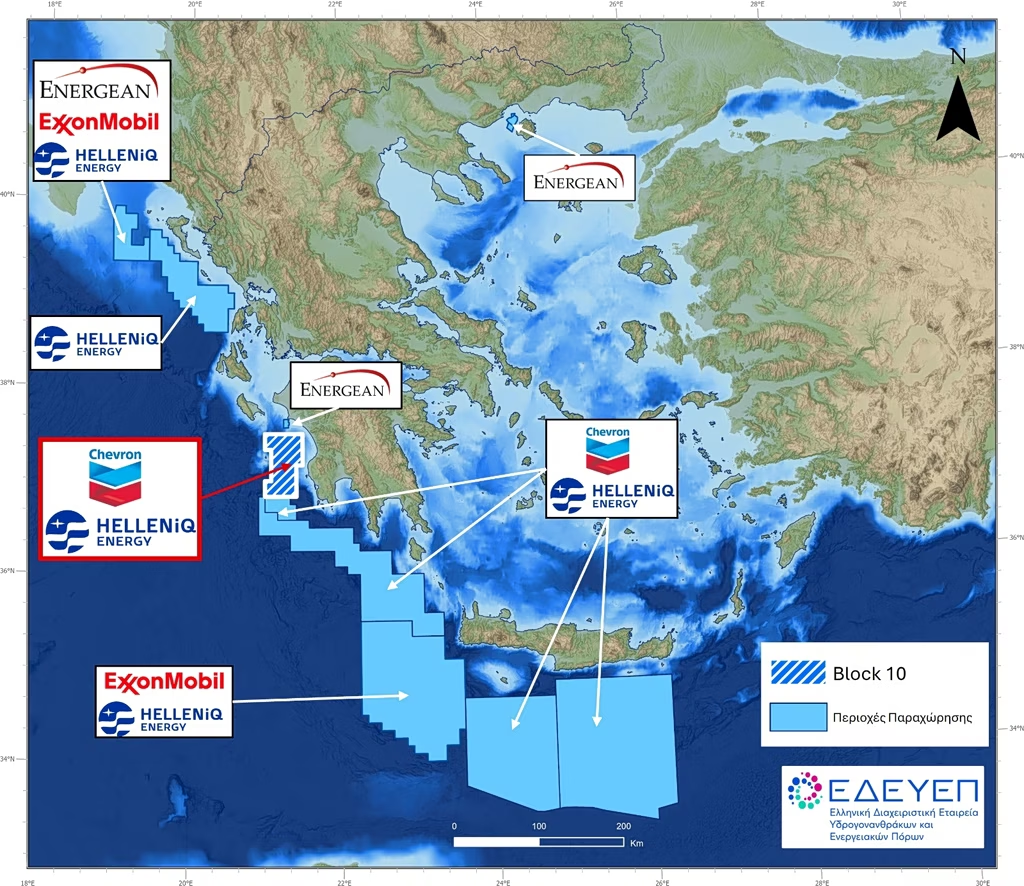
The first is the revival of the country’s hydrocarbons sector after nearly half a century of dormancy. In April, Energean, acting as operator of a consortium that also includes ExxonMobil and HELLENiQ ENERGY, signed a drilling contract with Stena Drilling for Block 2 in the Northwestern Ionian Sea. The ceremony was attended by the US and Swedish ambassadors, a detail Papastavrou flags as part of the broader transatlantic dimension. Exploratory drilling is scheduled to begin in February 2027, with new seismic surveys also planned south of Crete. Chevron is named alongside ExxonMobil as part of the international participation.
The second track is the transformation of the domestic energy mix. Lignite, once the backbone of Greek power generation, has been steadily pushed out. Renewables now account for more than 50 percent of electricity production, paired with natural gas, storage, and grid investment to maintain system stability.
The third is the Vertical Corridor, the infrastructure project Athens is positioning as its most consequential contribution to European energy security. The corridor is designed to channel US liquefied natural gas northward into Southeast Europe, supporting the EU’s effort to wean itself off Russian gas. Papastavrou frames it not merely as a pipeline network but as a “strategic artery.”
The fourth is the 3+1 framework linking Greece, Cyprus, Israel, and the United States, which Papastavrou describes as a model of energy cooperation in a volatile region. The format was reaffirmed during the recent Partnership for Transatlantic Energy Cooperation (P-TEC) meeting in Athens.
A pitch aimed at Washington
Papastavrou’s pitch to Washington is not exactly subtle. The energy minister eagerly notes the recognition Greece’s strategy has received from the US president. “Recent attention in Washington, including President Donald Trump’s repost of remarks on Greece’s energy strategy and transatlantic energy cooperation, reflects the growing recognition of our country as a reliable partner in the new energy map of Europe and the Eastern Mediterranean,” he writes.
The minister attributes the strategy to Prime Minister Kyriakos Mitsotakis personally, crediting him with rejecting what Papastavrou calls the false dilemma between renewables and hydrocarbons. The choice, he writes, is to pursue both. It is a familiar posture for Athens, which has spent the past year trying to keep one foot in Washington and one in Brussels, even as the two capitals drift further apart.