

 Μake us preferred on Google
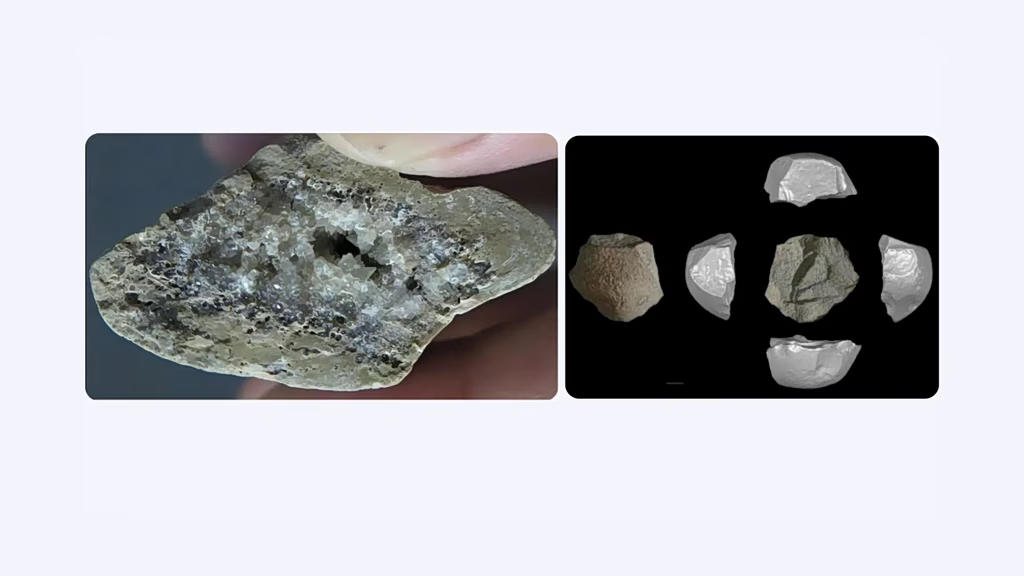
 An archaeological discovery in central China is bringing new evidence to light about the course of human evolution. Stone tools unearthed at the Lingjing archaeological site have been dated to 146,000 years ago, approximately 20,000 years earlier than previously believed, according to an announcement by the Field Museum in Chicago.
The new dating was made possible through uranium-thorium analysis of calcite crystals found inside animal bones recovered alongside the tools. The natural decay of uranium into thorium acts as a kind of built-in clock, allowing researchers to determine the age of the finds with considerable precision.
The tools are attributed to Homo juluensis, an extinct human relative previously thought to have had limited technological capabilities. However, analysis of the disc-shaped stone cores reveals that the production process was highly organized, requiring detailed knowledge of stone properties and fracture mechanics.
“People often imagine creativity as something that flourishes in good times,” said Yuchao Zhao of the Field Museum. “The fact that these stone tools were made during a harsh Ice Age tells a different story. Hard times can force us to adapt.”
Zhao added that this was not random flake production, but a technology that required planning, precision, and understanding. Taken as a whole, the research reveals a far richer history of innovation, intelligence, and human evolution in East Asia than had been assumed.