 Μake us preferred on Google
 In Ibiza, Spain’s famous summer resort, the August light seems to gild everything it touches. It falls on the white buildings, the dry earth, the sea and the bodies like a shimmering dust that turns the landscape into something almost magical. This golden quality may be one of the reasons the Mediterranean island never became just another tourist destination, but instead the embodiment of a very specific lifestyle: pleasure, excess, freedom, music and summer intoxication.
It’s an image so powerful that it often seems to swallow up any other characterization or story that could form around the island. But there’s another side to Ibiza, quieter, more inward and perhaps more austere. On this side, light doesn’t function as a vehicle for pleasure, but as material for thought.
This is exactly the side of the island one encounters in “Cel d’or,” the exhibit by visual artist Stefan Bruggemann, on view at the Museu d’Art Contemporani d’Eivissa (MACE), Ibiza’s contemporary art museum, through November 15. Inside the museum’s specially arranged Sala d’Armes, the island’s gold seems to enter into a creative dialogue with the artist, functioning as reflection and pause rather than an empty display of wealth. It’s as though the light outside the museum has been pulled from the landscape and carried into the space, broken down into its basic components and reexamined for what it means in human experience.
The Truth of Light
Visitors sense this the moment they step into “Cel d’or”: it isn’t an exhibit that asks them to stand apart from the works at a safe distance. Instead, it places them inside them.
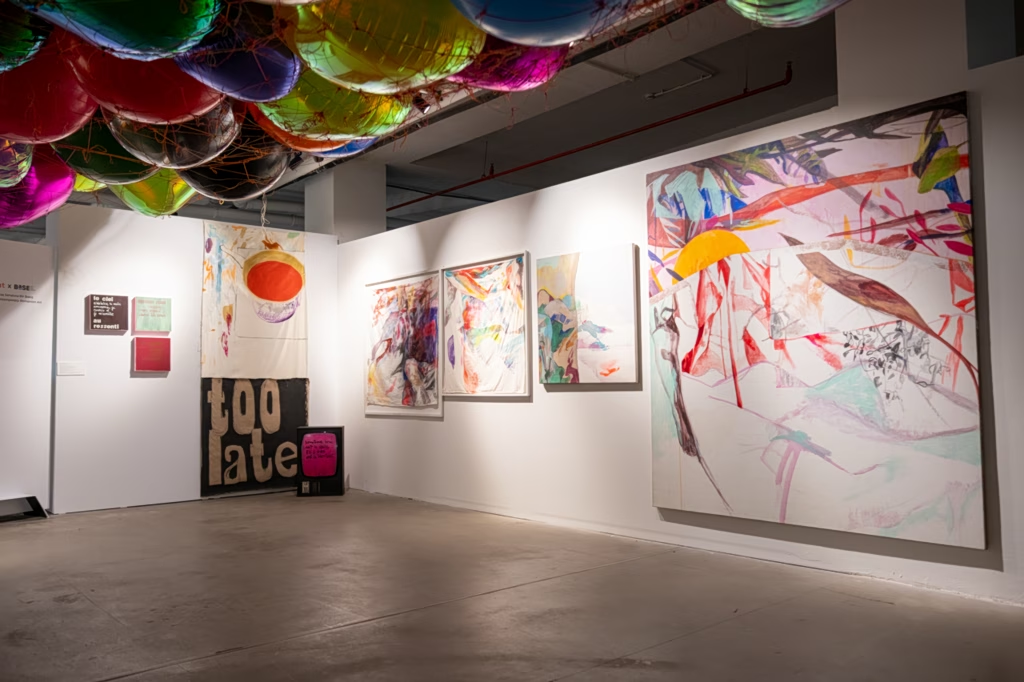
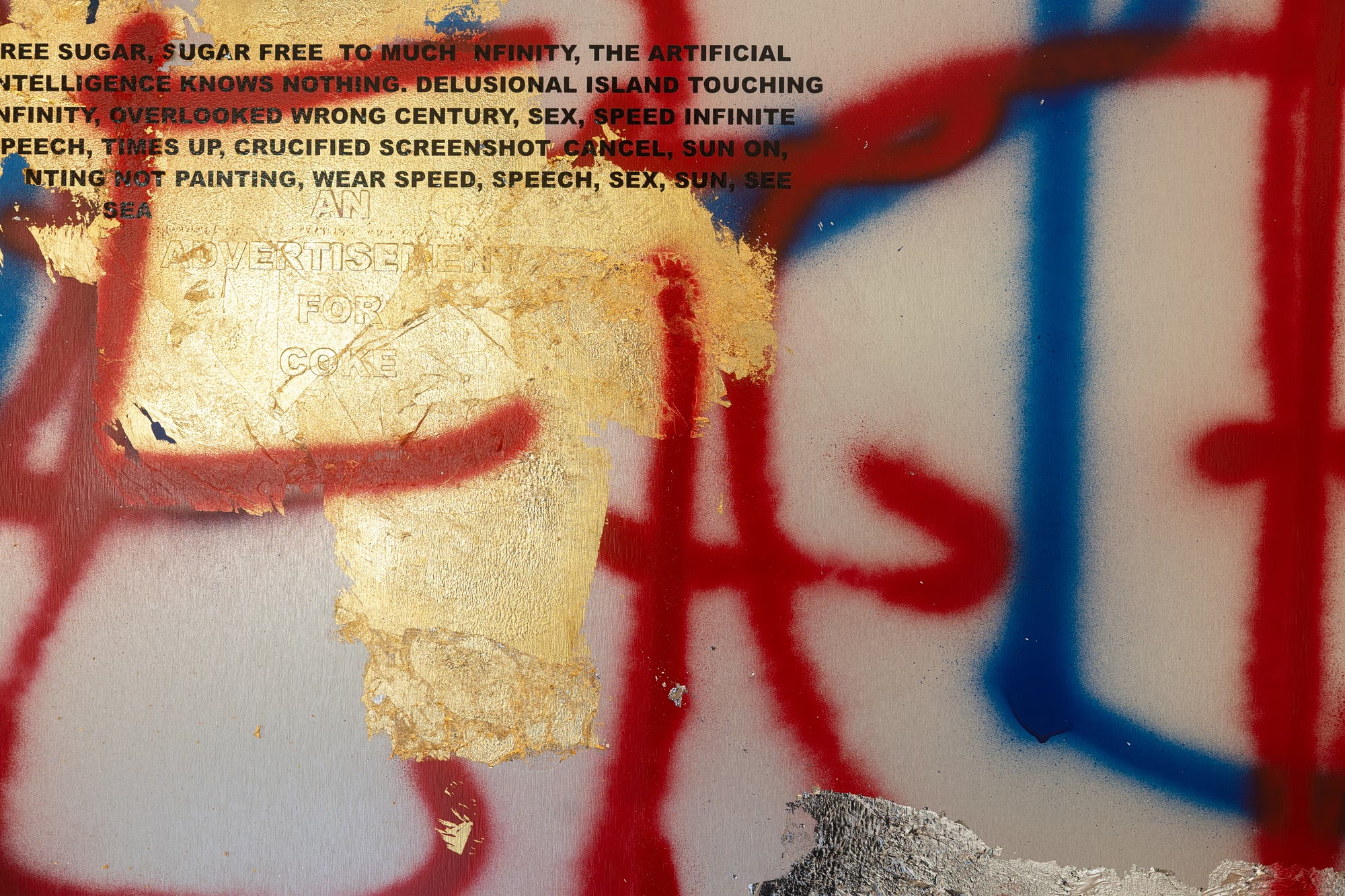
The first experience is visual, almost physical, with the space treated as a living organism rather than a standard “white room” simply housing artworks. Here, the walls, windows and natural light coexist to tell the same story. Gold appears everywhere and shifts with the light: it spreads across the architecture, gets cut by bold red lines, and interacts with shadows, wooden beams and openings to the outdoors. Letters and words appear and vanish within the surfaces.
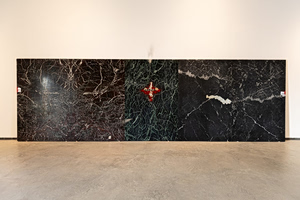
Photo Stefan Bruggemann
The eye tries to hold onto something, but the meaning keeps shifting. Elsewhere, dark marble or marble-like surfaces carry traces of text and fragments of gold and silver, resembling small constellations in a universe with different rules. Bruggemann’s creations break away from the conventional idea of the artwork as a standalone object.
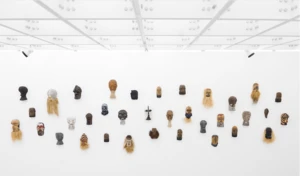
By combining canvases, sculptures, entire walls and interventions built into the structure itself, the artist appears to use every available material to carry meaning to the viewer. The painted surfaces and sculptural interventions don’t seem to weigh down the space, but instead become the space itself. Nothing shouts, yet everything reflects the light.
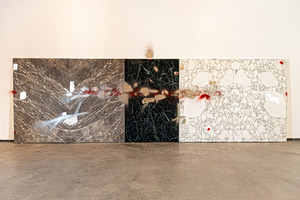
Photo Xavi Palleja
The exhibit’s title works as a key: Cel d’or, golden sky, or perhaps sky made of gold. It’s clearly no random choice, especially on an island where sky and sun shape nearly every experience. Bruggemann takes the blinding golden light of the Mediterranean summer and condenses it into a single space.
Gold, in turn, doesn’t just tell a story of beauty and luxury. It’s revealed as a material carrying centuries of symbolism, from religion and alchemy to opulence and commerce. In the artist’s hands, this shine isn’t one-dimensional. Instead, it opens a “crack” in gold’s surface, through which the material reveals its own vulnerability.
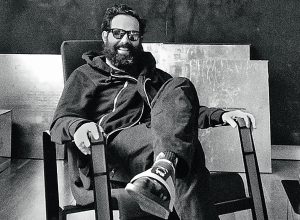
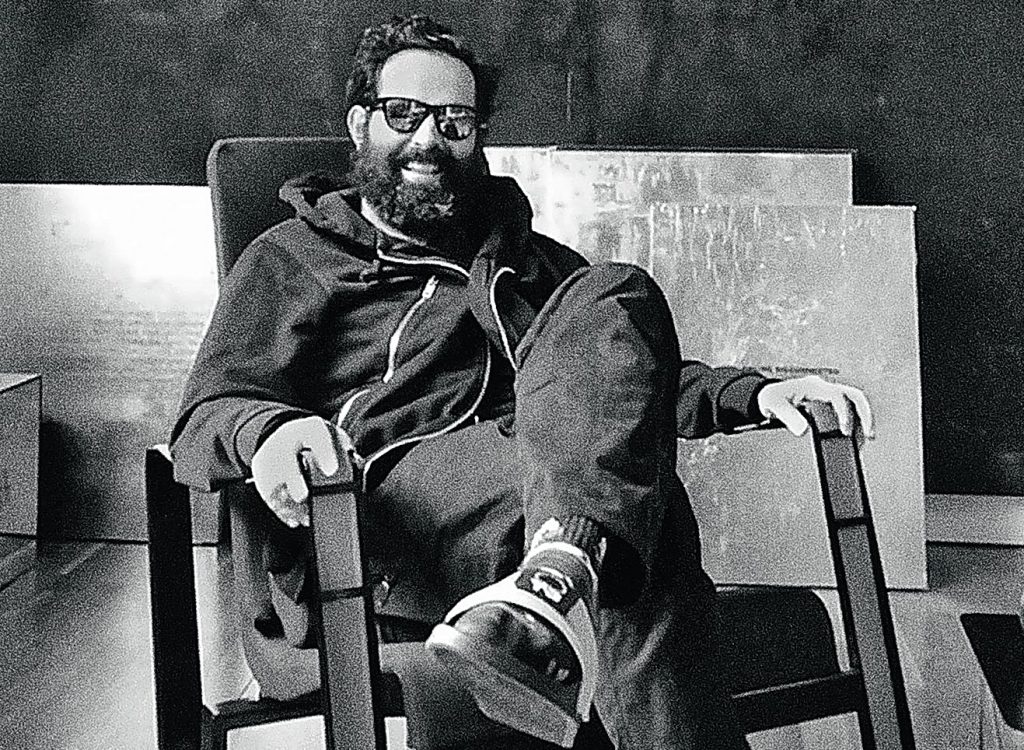
The complexity of the exhibit is, of course, no accident, especially considering who created it. Stefan Bruggemann was born in Mexico City in 1975 and now lives and works between Ibiza, London and Mexico, represented by the Swiss gallery Hauser & Wirth.
His practice spans painting, sculpture, video, drawing and installation, but the core of his aesthetic lies in language and how it can be turned into image, material and gesture. In his work, words become matter. At times they function as rhythm or irony, at times they take the form of graffiti, and at times they brush against philosophy. Drawing on the strategies of conceptual and post-conceptual art, the artist uses words, phrases and linguistic constructions to destabilize the certainty of meaning and force us to rethink reality itself.
The Artist’s Work
In the art world, the literal use of words within artworks often provokes divided reactions, with some remaining devoted fans and others finding it nearly off-putting. That doesn’t mean Bruggemann is simply a “text artist,” since such a label would be far too limiting for his overall practice, which unfolds across many mediums, materials and approaches.
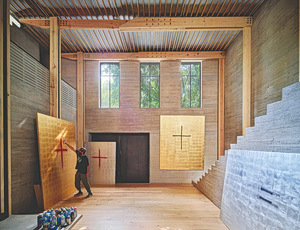
Photo Daniel Schaefer Studio
As an artist, he uses words to show how unstable certainty can be, while showing little interest in language as something literal or academic. Instead, he explores it as we experience it today: fragmented, dynamic, fast-moving, political, ironic, often even empty, a condition that seems evident in the society around him. We live among social media posts, slogans, hashtags, ads, political phrases, memes and small bits of information that constantly ask us to believe them. Bruggemann takes this condition and turns it into art.
The distinctiveness of his work lies exactly in its contrasts. His work carries meaning, but it isn’t dry. It’s minimalist, but not cold. It’s beautiful, but not innocent. As an artist, he may use gold leaf and marble, but he also works with neon, spray paint and more contemporary materials. The result always carries the tension he’s known for, linking an almost luxury aesthetic with a sharper, nearly punk edge. Behind this tension lies his refusal to let the image stay comfortable.
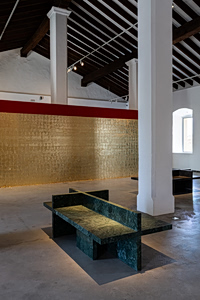
Photo Vicent Mari
A single work can draw us in with its shine while, at the same time, make us question what we’re looking at. Beauty doesn’t cancel out critique, it carries it more subtly, more elegantly, more effectively.
That’s precisely his strength. Within art history, Stefan Bruggemann converses with the great tradition of artists who made language the central material of their work: Joseph Kosuth, Lawrence Weiner, Jenny Holzer, Barbara Kruger and Bruce Nauman.
Yet he doesn’t choose to simply extend that movement. If the conceptual art generation of the 1960s and 1970s showed that idea could outweigh object, Bruggemann belongs to a later, more complex and perhaps more interesting moment: his work doesn’t carry the cold clarity of a philosophical movement, but the pulse of our world.
The era he creates in helps with this too, a world where language has permeated everything through media, advertising, pop culture and digital excess. It’s no coincidence, then, that he has previously collaborated with rock icon Iggy Pop, who lent his voice to Bruggemann’s works for the “HYPER-PALIMPSEST” exhibit in London.
That creative collaboration revealed something essential about the artist’s practice: his “language” seems to carry rhythm even when it sits on the surface of a painting or sculpture. It can be heard, repeated, turned into pulse and slogan. This may be exactly why his work feels so relevant, since it treats matter and language as equally alive, dynamic and constantly shifting.
Beyond the Shine
Back in Ibiza, this perspective takes on particular weight. Unlike those who treat the Spanish island as a seasonal destination, Stefan Bruggemann isn’t just passing through for the summer season.
He lives and works there, and his home studio, designed by Mexican architect Alberto Kalach, seems to extend his artistic thinking into the architecture of daily life. Set within the Ibiza landscape, the studio has been described as a space where the different facets of the artist’s life meet in harmony.
The same philosophy guides his current exhibit, “Cel d’or.” Bruggemann doesn’t see the space as a backdrop, but as a conversation partner, something that can change, reflect daily life and become a mirror of thought. But this particular exhibit also fits into a broader shift in Ibiza toward contemporary art.
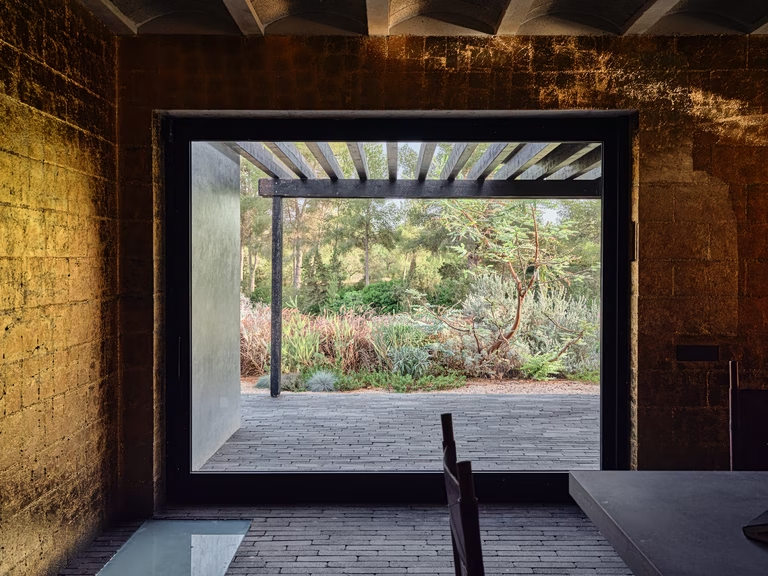
Photo Daniel Schaefer Studio
Beyond the clubs, beach bars and nightlife, the island has spent recent years shaping a different, more refined identity. Spaces like the MACE and the Gathering Ibiza gallery, along with the presence of artists, collectors and ambitious architectural projects, show that Ibiza can also function as a site of contemporary cultural production.
In 2024, the exhibit “Painting Not Painting” at Gathering Ibiza brought Stefan Bruggemann into “conversation” with Bruce Nauman, one of the most important artists in contemporary art, also known for using language and the body in his work. That creative dialogue seemed to add something new to the island’s atmosphere, a quieter, more austere, yet equally powerful cultural energy that the artist continues to explore into 2026.
So “Cel d’or” reveals itself as something far more complex and substantial than a beautiful collection of works in an idyllic destination. It functions as an argument for a different reading of Ibiza.
Both the artist and the Spanish island itself treat the place as a field where light, architecture, history and contemporary visual language enter into constant dialogue. As one of the must-see cultural picks of this summer, the exhibit doesn’t try to compete with the golden shine around it. Instead, it breaks that shine down, carries it inside the museum, and lets us understand it differently.
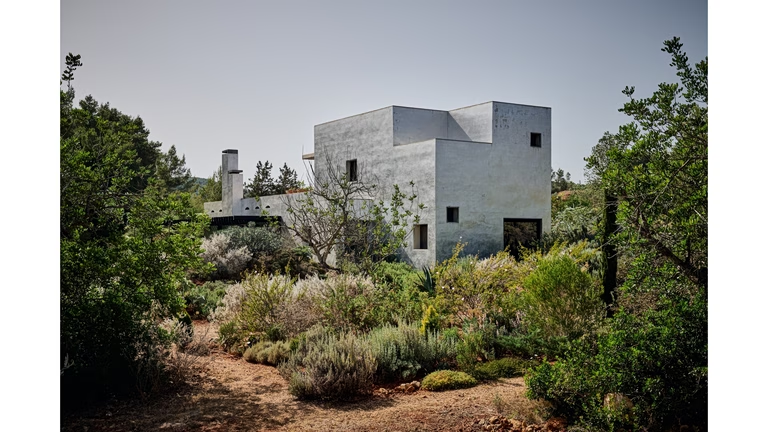
Photo Stefan Bruggemann
In a place where everything seems designed for quick consumption, Stefan Bruggemann proposes a slower, deeply human experience. Gold isn’t approached as a symbol of luxury or merely as material, but as the light that truly exists everywhere. That seems to be the secret ingredient behind the exhibit’s success: the truth of light.
Stepping out of MACE into Ibiza’s blinding summer, the sun feels like a continuation of the exhibit. Its golden rays are everywhere: in the museum’s Sala d’Armes, in the sky, even in the etymology of words. They’re present in everything we think we see clearly, until someone reveals to us that it can mean something different.
INFO
“Cel d’or”: Museu d’Art Contemporani d’Eivissa (MACE), Ibiza, through November 15.