On September 10, 1977, Hamida Djandoubi was led to the guillotine inside Baumettes prison in Marseille.
The 27 year old Tunisian immigrant to France had been sentenced to death in February 1977 for the murder of 21 year old Elisabeth Bousquet, whom he had tortured before killing her, as well as for other crimes including rape and violent assault.
No one knew at the time that the blade taking Djandoubi’s life would be the last one the French state would ever use.
This execution would go down in history as the last application of the death penalty in France and the last guillotine execution.
Four years later
It took four more years for this chapter to close legally as well.
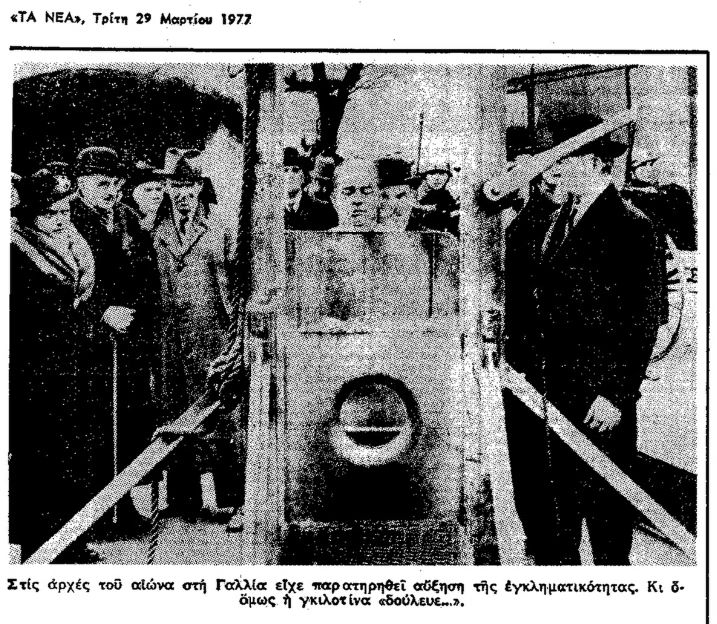
Caption reads: “At the beginning of the century, a rise in criminality had been reported in France. Nethertheless, the guillotine worked…”. “TA NEA,” 3.29.1977, Historical Archive “TO VIMA” | “TA NEA”
On October 9, 1981, law 81-908 abolishing the death penalty was enacted. Its first article stated:
“La peine de mort est abolie.” (“The death penalty is abolished.”)
Debate over the death penalty had already intensified in France, and after Francois Mitterrand’s election to the presidency, abolishing it became government policy.
A few weeks earlier, on August 27, 1981, “TA NEA” reported the French government’s decision to Greek readers:
“The death penalty is being abolished in France as well, through a bill approved yesterday by the French government.”
This was followed by a statement from Pierre Beregovoy, secretary general of the Elysee Palace, who called the move a “historic decision” and noted:
“France is the last country in Western Europe to still apply the death penalty.”
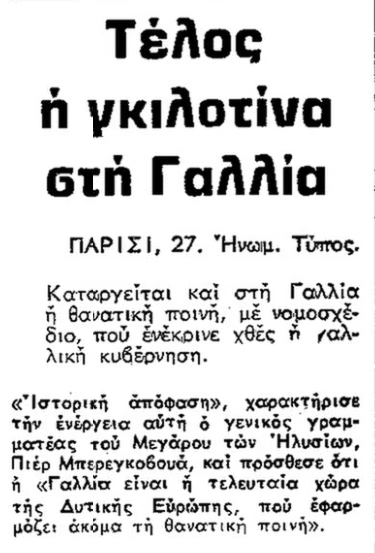
Title reads: “An end to the Guillotine in France”. Text: “France also moves to abolish the death penalty, with a bill that the French government ratified yesterday. A “historic decision”, is how Secretary-General of the Élysée Palace Pierre Bérégovoy, characterised the move, adding that “France is the last country in Western Europe that still enforces the death penalty””. Source: “TA NEA,” 8.27.1981, Historical Archive “TO VIMA” | “TA NEA”
A historical irony
In 1981, France was closing a chapter nearly two centuries long. The guillotine, though, was and remains one of the most powerful symbols of French history itself.
The guillotine was established as a method of execution in the early years of the French Revolution, in the name of a principle that seems paradoxical by today’s standards: equality. Anyone sentenced to death would now be put to death the same way, regardless of social class.
“TA NEA” of July 8, 1989, published an extensive feature marking two hundred years since the French Revolution:
“It is the French Revolution, with its haunting image of the guillotine and the cart carrying the condemned, its rigid ideals and its even more rigid main figures, that seems to mark the beginning of the modern world.
The French Revolution, which preserved all the contradictions recorded by Dickens in “A Tale of Two Cities,” was more bloody and more intellectual, more idealistic and more glorious, more brutal and more melodramatic than anything that had happened until then in England or America.
It grew, however, in a society standing at the crossroads of archaic and modern structures, flooded with the eighteenth century ideals of humanism and equality, yet still under largely absolutist and feudal patterns of governance.”
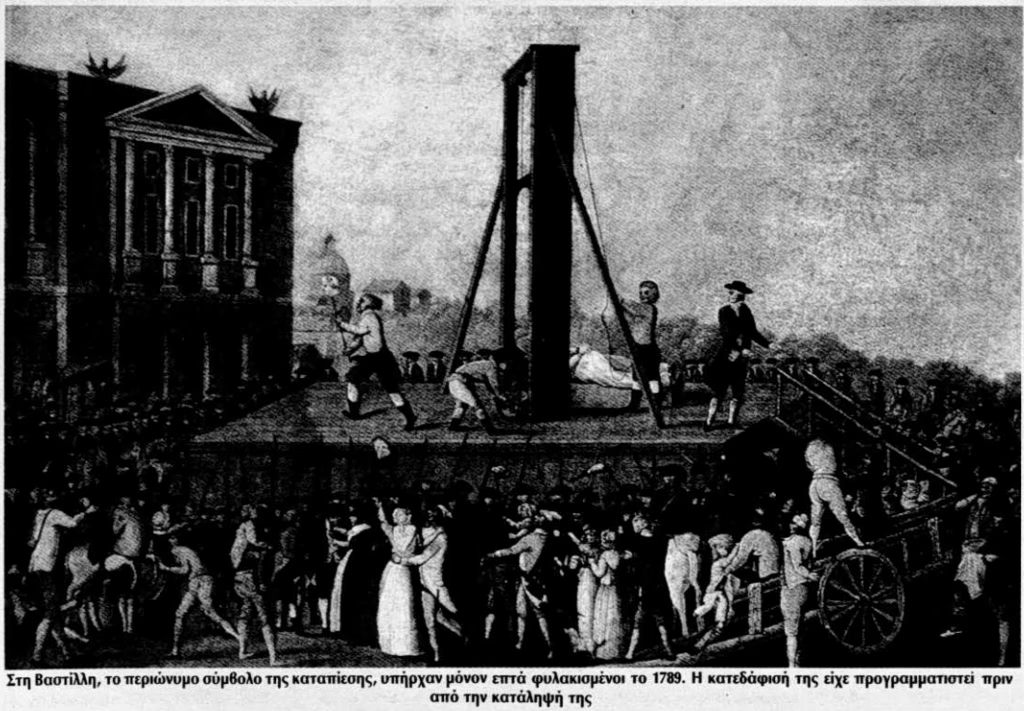
At Bastille, the renowed symbol of oppression, there were only 7 prisoners in 1789. It’s demolition had been planned before its seizure. Source: “TA NEA,” 7.8.1989, Historical Archive “TO VIMA” | “TA NEA”
Although the guillotine was introduced as a single, uniform method of execution meant to end the different ways of putting people to death based on social class, during the years of the Terror it ended up becoming the very symbol of mass state violence.
“A daily spectacle”
The “TA NEA” feature describes how, during the years of the Terror, the guillotine became a daily spectacle:
“Paris filled with guillotines, and people were sentenced to death over whispers or a momentary suspicion.
The blood running along the cobblestones of Place de la Concorde smelled so strong that the residents of Rue Saint Honore asked for the guillotine to be moved to Place de la Nation.”
The same feature notes that it is a myth that most victims of the Terror came from the aristocracy. In reality, they were mostly people from the lower classes.
Robespierre, a central yet deeply controversial figure of the French Revolution, was eventually sent to the guillotine himself in July 1794.
The guillotine’s story, however, did not end with Robespierre. It continued to serve as the French state’s method of execution, surviving empires, monarchies, and republics, right up until the late twentieth century.
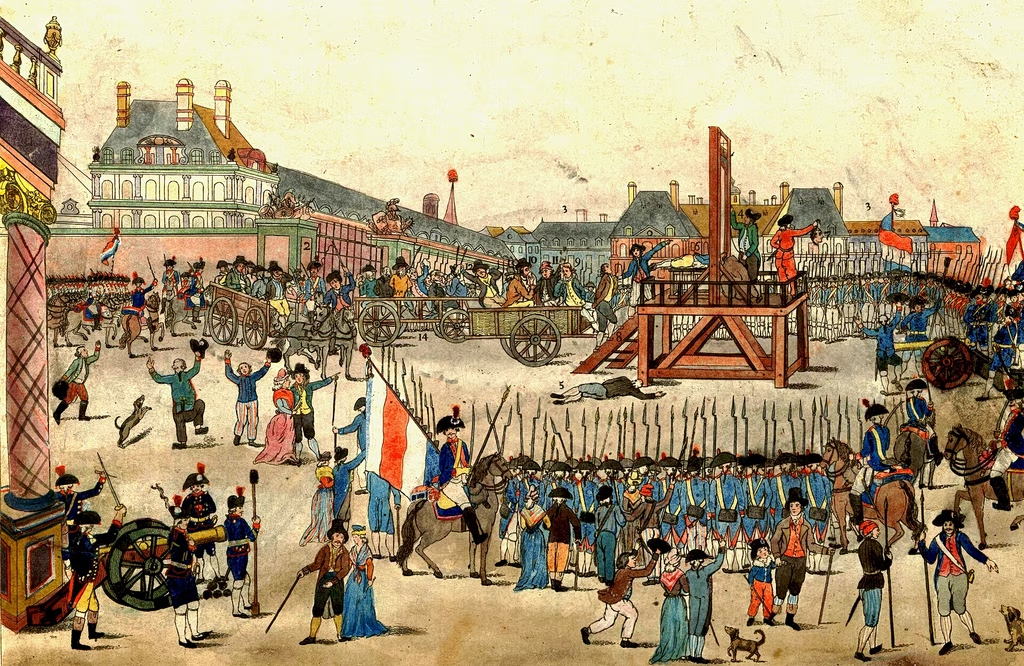
The execution of Maximilien Robespierre and his supporters on July 28, 1794. Anonymous engraving, 1794.
“Is it time for the executioner to leave our lives?”
A few decades later, France would produce one of the strongest literary opponents of the death penalty: Victor Hugo.
In 1829, at just 26 years old, he published “The Last Day of a Condemned Man” (Le Dernier Jour d’un condamne).
The subject was revisited in “TA NEA” on September 30, 2006, in a piece by Takis Theodoropoulos titled “When the Guillotine Was Alive.” On Hugo’s protagonist, he wrote:
“He is not interested in defending the condemned man’s innocence, which the man himself never claims.
He is not even interested in the nature or type of his crime. […]
What interests him is recording the victim’s psychological reactions from the moment his sentence is announced to him.”
Hugo’s France was a very different world. In 1829, as the piece notes:
“voices had begun to speak out against the death penalty, but its application was part of everyday life, and guillotine executions in Place de Greve in Paris were among the most popular public spectacles.”
Three years later, in 1832, in the new edition of his work, Hugo openly declared himself in favor of abolishing it.
“TA NEA” recalls one of his most well known lines:
“Vengeance is man’s business, punishment is God’s. Society stands between the two. It has no right to punish, and it does not stoop to take revenge.”