
 Μake us preferred on Google
 Certain Japanese ideas keep spreading across design, architecture, wellness, and daily life, often marketed as simple antidotes to modern excess. Their real value lies in adapting them thoughtfully rather than adopting them wholesale; introducing one or two at a time tends to work better than trying to overhaul a routine all at once.
These principles are often reduced to aesthetic clichés or shallow self-improvement slogans, but a closer look reveals something more substantial: practical philosophies shaped by long-standing cultural habits and social systems, offering useful frameworks for decision-making, time management, and personal behavior.
Ikigai: a stable reason for living
Combining the Japanese words for “life” and “value” or “meaning,” ikigai loosely translates to “a reason to live.” It’s long been tied to a sense of fulfillment drawn from meaningful activity, whether in work, personal habits, or one’s role in the community. Okinawa is a well-known example, where ikigai has been linked to longevity and lasting wellbeing. Rather than pointing to one grand purpose, it reflects a steady orientation toward meaning, encouraging careful, gradual adjustments over abrupt change in career decisions, creative pursuits, or weekly planning.
Shoshin: keeping a beginner’s mind
Rooted in Zen Buddhism, shoshin, or “beginner’s mind,” emphasizes open-mindedness, curiosity, and freedom from preconceptions. It became widely known through Shunryu Suzuki’s Zen teachings, urging people to approach every experience with the same receptiveness as a newcomer, regardless of their actual expertise. Rather than devaluing knowledge, it reframes it, calling for attentiveness and full presence, encouraging people to question established practices, revisit assumptions, and stay open to different perspectives, which supports innovation and cross-disciplinary problem-solving while guarding against complacency.
Kaizen: the power of continuous improvement
Combining words for “change” and “good,” kaizen expresses a philosophy built on steady, incremental progress. It gained global recognition through corporate practices like the Toyota Production System, where efficiency and quality improved through constant small adjustments rather than sweeping reforms. It later spread into management theory, organizational development, and personal productivity across cultures. Day to day, small adjustments, like refining a morning routine or spending a few minutes daily building a skill, tend to produce more lasting results than dramatic overhauls. By prioritizing consistency over perfection, kaizen eases the pressure that often comes with big changes and supports steady, achievable progress over time.
Ma: the value of empty space and pause
Often translated as “emptiness,” “interval,” or “pause,” ma describes the meaningful space that gives shape, rhythm, and meaning to what surrounds it. Rooted in traditional arts like architecture, calligraphy, music, and theater, it treats emptiness as an active part of composition rather than an absence. In practices like the tea ceremony, deliberate pauses sharpen awareness and create balance, showing that what’s left out can matter as much as what’s expressed. In practice, this principle values restraint and intention: leaving open space in a schedule allows room for reflection, silence in conversation builds clarity and mutual understanding, and avoiding clutter in a space improves both function and harmony.
Wabi-sabi: accepting imperfection
Wabi-sabi centers on accepting transience and imperfection, a cornerstone of traditional Japanese aesthetics. Combining words for simplicity and for the quiet beauty that emerges through age and wear, it developed alongside Zen Buddhist thought and is closely tied to practices like the tea ceremony, where irregular shapes, natural materials, and signs of use are valued as marks of authenticity.
Rather than chasing symmetry or polish, wabi-sabi finds elegance in the incomplete, the transient, and the humble, offering an alternative to ideals of flawless perfection. On a personal level, it encourages accepting imperfection and the passage of time, allowing progress without waiting for ideal conditions, grounded in simplicity and authenticity.
Kintsugi: repair as continuation
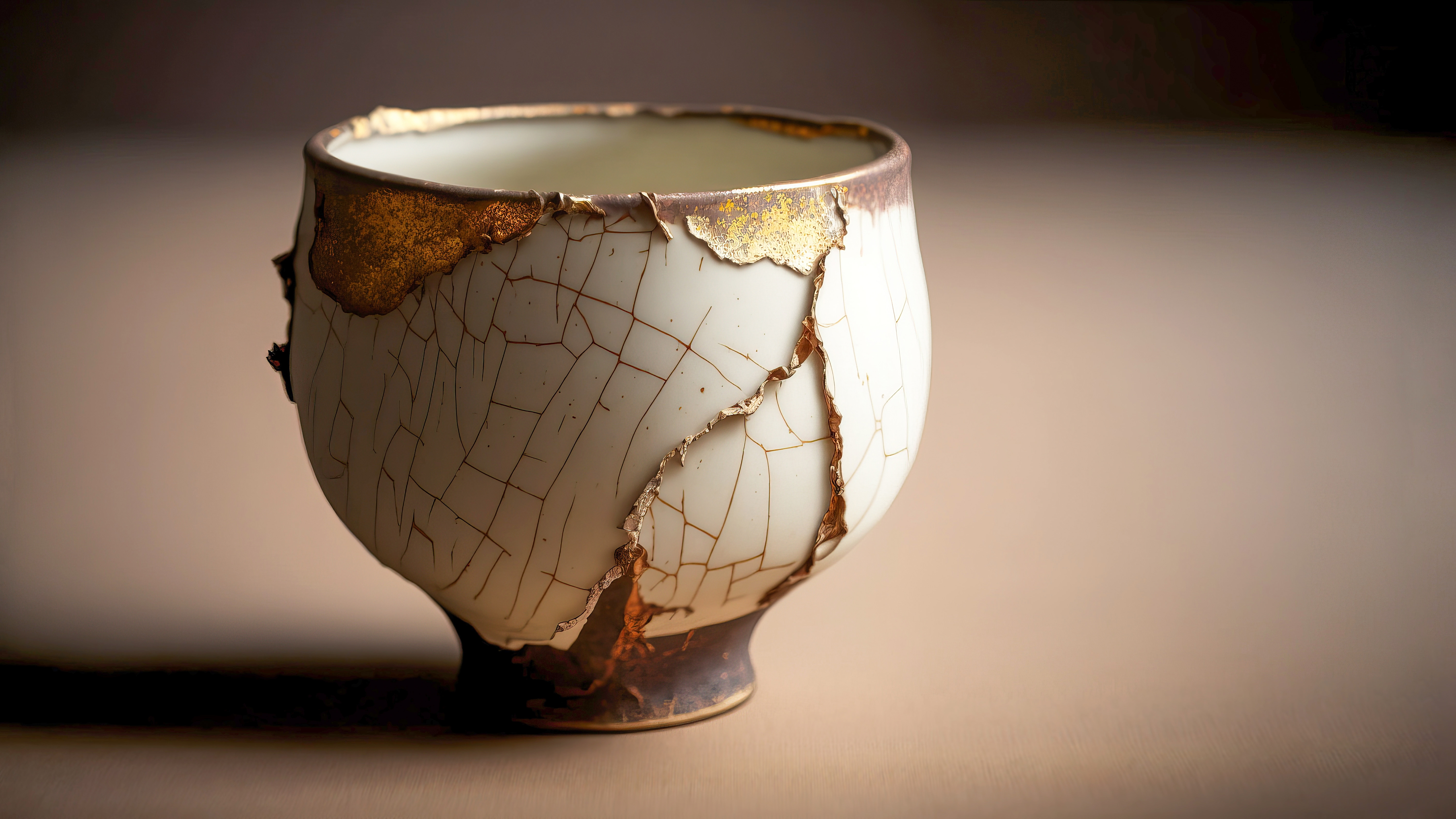
Kintsugi is the traditional Japanese art of mending broken ceramics with lacquer mixed with gold, silver, or platinum, turning cracks into visible lines of renewal. Closely tied to tea ceremony aesthetics and the broader wabi-sabi philosophy, it highlights damage rather than hiding it, letting an object’s history stay visible while elevating its form, a result that’s both functional and symbolic, reflecting respect for craftsmanship, continuity, and intentional restoration. As a principle, kintsugi offers a thoughtful way of handling hardship: rather than discarding or erasing what’s been damaged, the repair becomes part of the object’s story. Applied more broadly, it encourages treating disruption as something that can be acknowledged and integrated, reframing “breaking” as transformation and supporting resilience and continuity without denying that change happened.