 Μake us preferred on Google
Santiago Abascal has built his entire political career on one central slogan: defending the unity of Spain. For the leader of the far-right Vox party, preserving national cohesion is not just one of his party’s positions but the foundation of its political identity. Today, with polls pointing to significant gains for Vox in Sunday’s general election, the 50-year-old politician is closer than ever to holding government power.
A possible alliance with the right-wing Popular Party (PP) could turn Vox from Spain’s third-largest political force into a decisive player in Madrid. Such a development would be historic, as it would mark the first time the Spanish far right has joined a national government since the end of Francisco Franco’s dictatorship in 1975.
Shaped by ETA
Abascal’s political path is closely tied to his childhood experiences in the Basque Country. He grew up in the town of Amurrio at a time when the separatist group ETA was stepping up its attacks. Over roughly half a century, ETA killed more than 850 people. His family was targeted by the group: his father’s clothing store was attacked with Molotov cocktails and, in 1999, was completely destroyed by fire. When it was rebuilt, it was fitted with bulletproof windows.
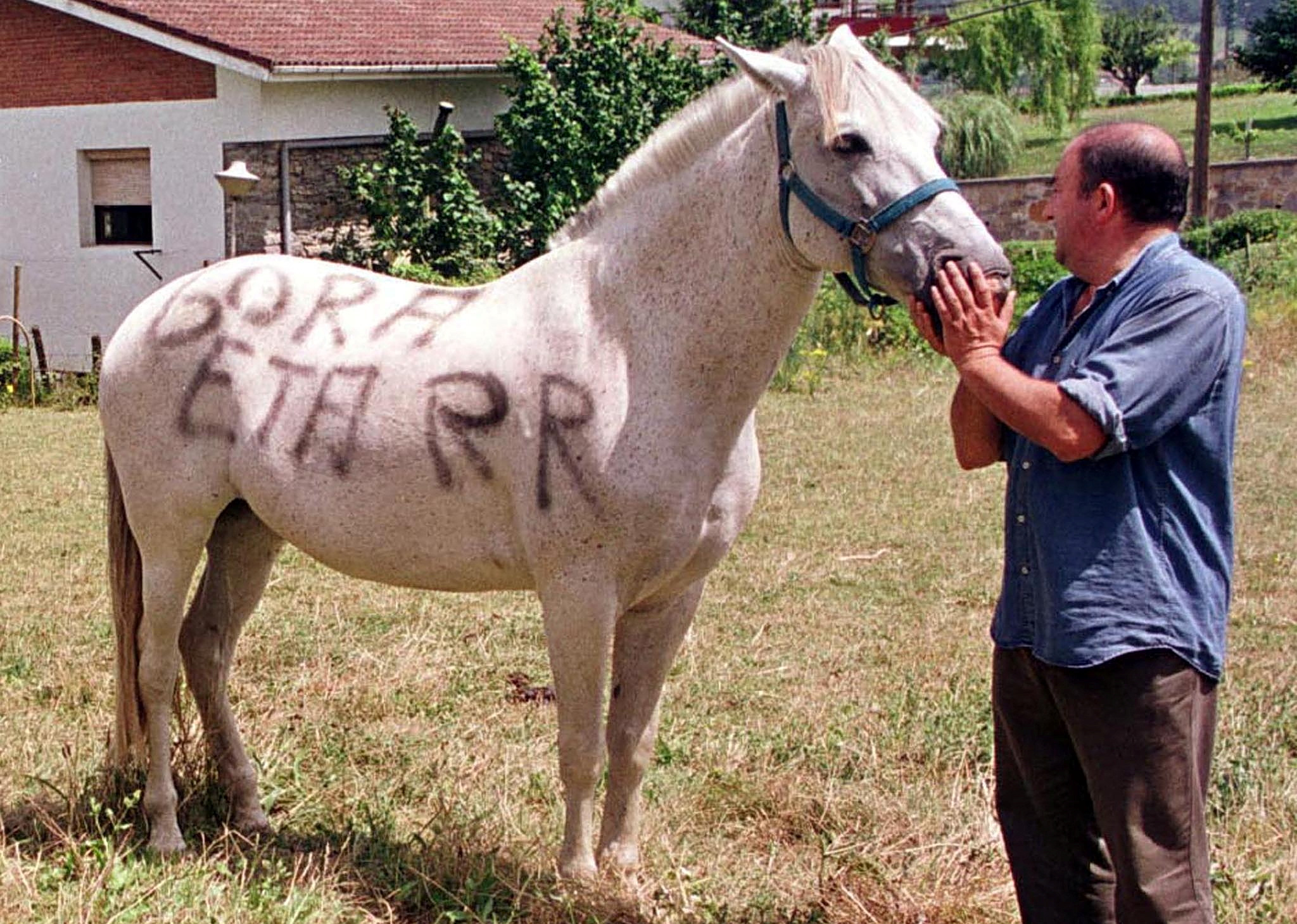
Popular Party Councillor Santiago Abascal shows his horse after it was painted with Basque Separatist Organization ETA graffiti by unidentified people in Amurrio, in the southern Basque province of Alava, July 23, 2000. DB/AA/File Photo
The son and grandson of Popular Party officials, Abascal first followed his family’s political path. In 2013, however, he left the PP, saying he disagreed with what he saw as an overly soft policy toward separatist movements. Defending national unity has since been the main focus of his political activity and the cornerstone of Vox.
From ETA to Pedro Sánchez
His family’s personal experience of ETA violence is a constant part of his public image. Abascal, a father of five, has said he tells his children the story of the persecution his family suffered, believing that knowing these events helps shape their character.
For years, he held political rallies at historic monuments, linking his presence to figures seen as symbols of Spanish resistance against foreign invaders. Among them were the Visigoth Pelagius of Asturias and the Basque admiral Blas de Lezo.
As Carlos Conde Solares, a professor of history and Spanish studies at Northumbria University, has noted, Vox and Abascal have cultivated a political narrative reminiscent of David and Goliath. In it, Spain is presented as a country under siege, while powerful regional governments appear as the forces threatening its unity.
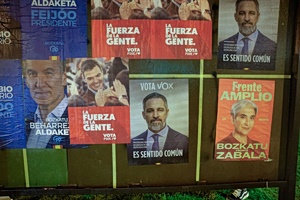
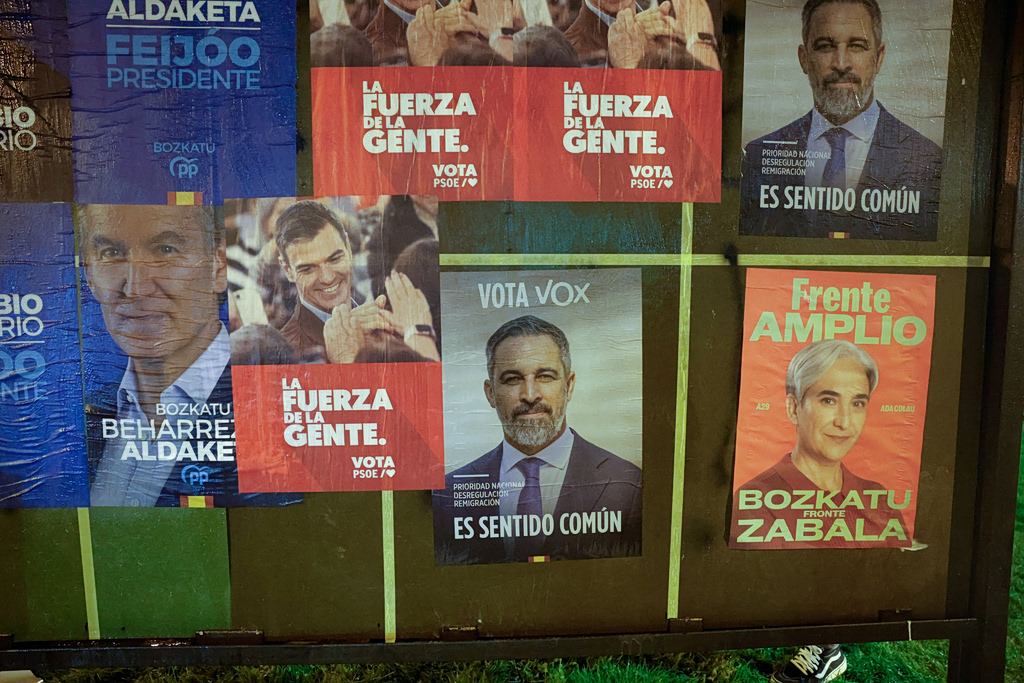
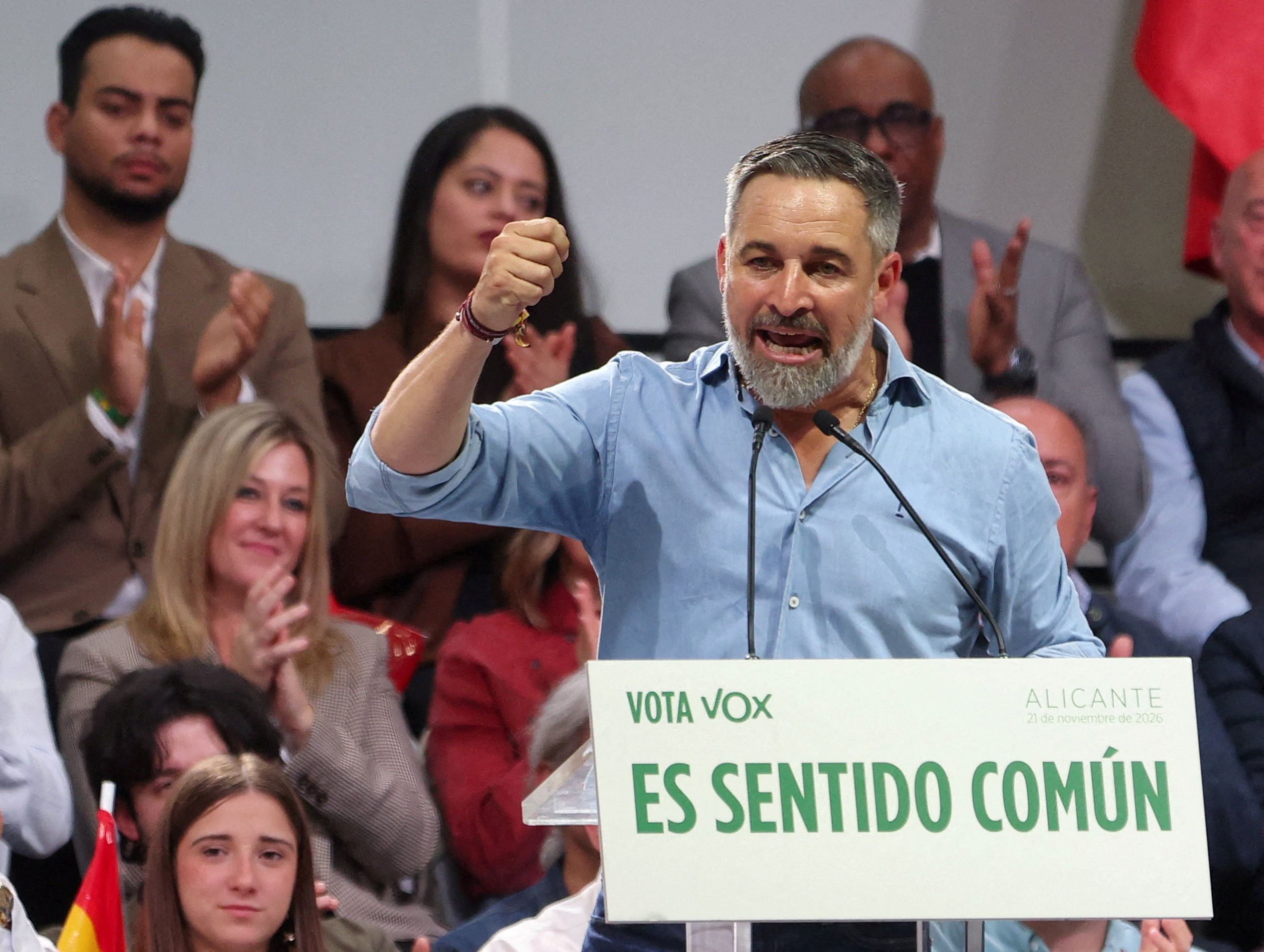
Over time, however, the party’s agenda broadened. Vox’s manifesto, titled “Common Sense,” now emphasizes giving Spanish citizens priority in access to public services, strengthening the borders, deporting migrants the party considers a threat to Spanish culture and deregulating the economy.
During the campaign, Abascal has made Socialist Prime Minister Pedro Sánchez his main target. At rallies, in interviews and on social media, he has used particularly harsh language against him, calling him everything from a “traitor” to a “standard-bearer” for Morocco.
One trigger was the migration crisis in the Spanish enclave of Ceuta in July, when a large number of migrants crossed into Spanish territory. The Vox leader accused Sánchez of failing to protect the country’s borders. In one of his most extreme remarks, he said the Spanish people would like to see the prime minister “hanging upside down” one day. The comment drew a response from the ruling Socialist Party, which referred him to the prosecutor, accusing him of inciting hatred and even violence.
“This is not a normal election: the existence, dignity and unity of the country are at stake,” Abascal said at a campaign rally in Aragon, seeking to frame the vote as a battle for Spain’s future.

A TV screen shows Spain’s far-right party Vox leader Santiago Abascal, Spain’s Prime Minister and Socialist candidate Pedro Sanchez, Spain’s opposition People’s Party (PP) leader and candidate Alberto Nunez Feijoo and Spain’s left-wing Frente Amplio (Broad Front) alliance leader Ada Colau during a live televised debate ahead of general elections at a bar in Madrid, Spain, November 26, 2026. REUTERS/Susana Vera/File Photo
Migration and the Bid for Power
Polls put Vox at 17% to 18%, with the Popular Party leading at 30% to 31%. These figures leave open the possibility of a governing partnership between the two parties if the PP fails to win an outright majority.
An absolute majority requires 176 seats in the 350-member Congress. The final distribution of seats will depend heavily on how the parties perform in smaller constituencies, where Spain’s electoral system favors larger parties.
Vox learned a lesson from the 2023 election, when the loss of about 600,000 votes in certain constituencies cost it a third of its parliamentary seats. This time, Abascal has toured more than 30 cities, large and small, in recent weeks, seeking to strengthen the party’s presence in areas that could prove decisive.
His tactics also include reaching out to voters from separatist backgrounds. Vox has even tried to appeal to supporters of Catalan Alliance (Aliança Catalana), a far-right separatist party that shares some of its views on security, the economy and immigration.
At a campaign rally in Catalonia, Abascal even shouted “Long live Catalonia!” The move sparked debate, as Vox has traditionally opposed Catalan separatism fiercely.
Guillermo Fernández, a researcher and professor of political science at Madrid’s Complutense University, believes this is a purely tactical choice. He notes that Vox still believes separatist parties have no place in Spanish politics but is trying to broaden its appeal by reaching voters who agree with some of its positions.
Abascal himself rejects the view that his party has softened its stance on separatism. He insists that Spain’s unity remains non-negotiable and says he feels at home in every region of the country.
“I am here because I love my country, Spain, and I am Basque. But here I feel as if I am on my own land,” he said at a rally in the Canary Islands on November 17.
The Man Behind the Hard Image
Despite his combative public presence, people who know Abascal describe him as a different character in private. Known to friends as “Santi,” he is described as low-key, loyal to his beliefs and particularly fond of nature and birdwatching.
“He is rough and tough in public, but quiet and shy in private. Those are Abascal’s contradictions,” said Iñaki Ortega Cachón, a former PP lawmaker in the Basque Country who has known him since 1996.
Antonio Peñalver, a former Vox adviser and author of a book on Abascal’s leadership style, believes the confidence with which he defends his positions can make him a “super-leader.” He argues that this ability to persuade is one reason the Vox leader appeals to a significant part of the electorate.
However, the heavy concentration of power around him has also caused internal backlash. Successive waves of departures by prominent figures, including most of the party’s other founders, have been accompanied by public complaints about a centralized leadership model that leaves no room for dissent.
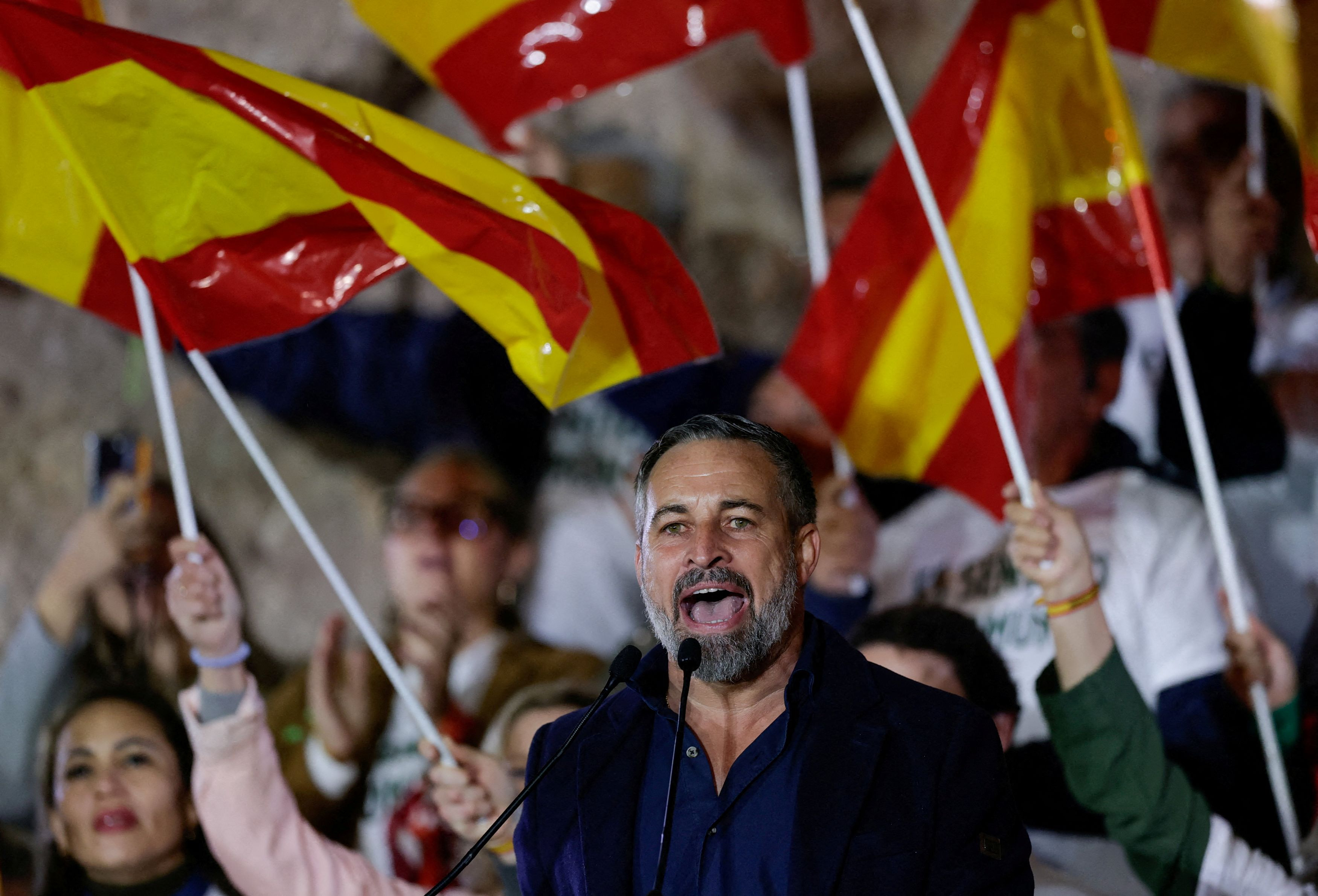
Spain’s far-right party Vox leader and candidate Santiago Abascal speaks during the official launch of his election campaign ahead of the November 29 snap general election, in Madrid, Spain, November 13, 2026. REUTERS/Violeta Santos Moura/File Photo
In 2019, Vox changed its statutes, abolishing the direct election of the leadership by members and strengthening the role of its 12-member central committee in choosing candidates across the country. This set the party apart from other Spanish political parties, where power is more widely shared among regional and party bodies.
Abascal defended the decision at the time, saying the aim was to “shield” Vox from “entryists, opportunists” and people who, as he put it, join a party not to serve Spain but to serve themselves.
Responding to criticism over the departures, he argued that the party’s electoral record should be judged by its results, not by those who chose to leave.
The Final Sánchez-Feijóo Battle and the Prospect of a Coalition
What is at stake in the election also took center stage in the campaign’s final televised debate. Sánchez warned of a possible rollback of rights and social gains if the right and the far right govern the country together.
“On Sunday there will be two very different paths. One leads to a Spain of the past, a Spain of budget cuts, frozen wages and challenges to social gains. And there is another path that leads to a prosperous, modern and pro-European Spain,” the outgoing prime minister said.
Polls still show the PP as the largest party, followed by Sánchez’s Spanish Socialist Workers’ Party (PSOE). However, the gap between them has narrowed in recent days, leaving open the possibility of a closer race.
Sánchez faces a series of political and social crises. Court cases involving members of his family, rail accidents that have killed 115 people in 2026, the migration crisis in Ceuta and the housing problem have all weighed on the political climate for his government. He insists, however, that Spain must remain an engine of economic growth in Europe and keep its role as a country that defends European values.
“What is at stake in this election is for Spain to continue having a government that strengthens the public sector, and not to be run by those who want to cut public spending,” he said, taking aim at the PP and Vox.
Popular Party leader Alberto Núñez Feijóo accused Sánchez of avoiding responsibility. He presented himself as an effective manager, citing his 13 years as president of the regional government of Galicia.
“Spain needs answers, truth, decency and better management,” he said.
Abascal, for his part, raised the tone even further, calling the outgoing prime minister “public enemy number one” and the head of a “mafia” that, he claimed, encouraged mass immigration.
Sunday’s result will therefore decide not only which party comes first but also what role Vox will play in Spain’s future. If the Popular Party needs its votes to form a government, Abascal will be in a position to demand real influence over the country’s political agenda. At that point, defending Spain’s unity, the starting point of his political journey, will meet his biggest bet yet: turning the far right’s electoral strength into government power.