 Μake us preferred on Google
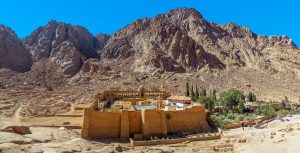
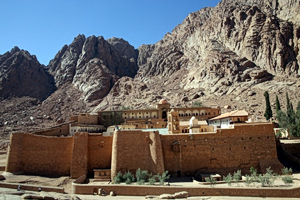
Until late Friday evening, just before Egypt’s Supreme Court of Cassation was due to publish its ruling on Saturday, Archbishop Symeon of Sinai and the Egyptian side were still in talks to finalize the wording of an out-of-court agreement. The deal ends the Sinai Monastery’s long legal ordeal and, for the first time, secures the brotherhood’s religious properties and rights within Egypt’s legal system.
In a statement on Saturday, Symeon said: “In the climate of now firmly established trust between the Arab Republic of Egypt and the Sinai Monastery, we are certain that, following today’s announcement of the agreement, there is no longer any reason for the Supreme Court of Cassation of the Arab Republic of Egypt to issue its ruling.”
He also referred to the support of the Orthodox churches of the East, saying that “this development gives the Sinaite Brotherhood, and me personally, the support to proceed with signing the Agreement.” He noted that the signing will take place as soon as his health allows, at which point “specific outstanding issues that may arise regarding the Agreement and its accompanying documents” will also be finalized.
The Four Pillars of the Agreement
The four pillars of the agreement between the monastery and Egypt are the following:
- The monastery is recognized as the oldest functioning monastery and is therefore distinguished from all others. Egypt is obliged to protect its operation as defined by Orthodox monastic rules. The monastery’s Fundamental Regulations are recognized by the Egyptian state, which must respect them.
- The monastery’s properties are divided into two categories according to their nature: religious and non-religious. For religious properties, the agreement provides for their possession and use free of charge in perpetuity. For non-religious properties, it provides for a grant of use and possession in accordance with Egyptian law.
- The monastery respects and applies Egyptian law and the rulings of Egyptian courts.
- The Egyptian authorities and the monastery withdraw their appeals from the Supreme Court of Cassation and commit to resolving any issues and disputes between them through dialogue.
The Timeline
From May 2015, when the Ismailia Court of Appeal issued its ruling, and with the Court of Cassation’s decision pending, which was reportedly expected to be unfavorable, the Monastery of Saint Catherine found itself on the edge of the abyss. The situation was made worse by an internal conflict within the Sinaite brotherhood, which led to the resignation of the previous archbishop, Damianos, and the election of Symeon. The new Archbishop of Sinai found himself fighting on two fronts.
The first was the Egyptian front. Egypt’s Justice Ministry had undermined and ultimately canceled the out-of-court settlement before the Ismailia Court of Appeal issued its ruling, and it tried to do the same after the ruling, seeking to block any agreement so that the Supreme Court of Cassation would issue its decision.
The ministry’s position was that “the issue of the Monastery of Saint Catherine is exclusively an internal Egyptian matter and no agreement is needed. The monastery is subject to Egyptian law, which it must apply, and there is nothing for us to discuss with it.” The Justice Ministry was also behind Egypt’s refusal to issue the presidential decree recognizing Archbishop Symeon, while at the same time it did not revoke the presidential decree recognizing former Archbishop Damianos. In fact, its representative in the talks with the monks went so far as to insult Archbishop Symeon in an effort to force him to walk away from the negotiations. However, Symeon’s composure and diplomatic skills saved the talks.
The second was the Greek front. It consisted of a diverse alliance of political and church circles. On the political side, it stretched from the far right to SYRIZA, with leading figures including Velopoulos, Natsios, Delveroudis, Gratsia, Bolaris and Polakis, with behind-the-scenes help from Nikos Kotzias. On the church side, the main figure was former Archbishop of Sinai Damianos, along with some monks from Mount Athos. Their common goal was to prevent any agreement, even if that meant enormous cost to the monastery, through Symeon’s resignation and a complete break in relations between the monastery and Egypt, which would also have affected Greek-Egyptian relations.
It was no coincidence that both the Egyptian and the Greek fronts launched their harshest attacks precisely when Symeon fell seriously ill and his life was in danger. During his illness, Egypt’s Justice Ministry launched a campaign to discredit him in Egypt, claiming that his illness was a lie meant to keep delaying the talks and that he did not respect the Egyptian state. Former Archbishop of Sinai Damianos, together with his allies from Mount Athos, issued the well-known statement in which he fully adopted the ministry’s positions.
Facing illness and a battle on two fronts while also having to negotiate, Symeon made sure to keep all the monks living inside the monastery informed of every development. However, it was clear that the brotherhood remained divided between those inside the monastery and those who had left to follow Damianos. This paralyzed decision-making, while time was running out.
The internal situation at the Sinai Monastery was such that the brotherhood was unable to prioritize its demands ahead of the meeting between Egyptian President Abdel Fattah el-Sisi and Prime Minister Kyriakos Mitsotakis on September 8 in El Alamein. As a result, the monastery itself asked that its issue not be raised at the meeting between the two leaders.
Realizing the state the monastery was in, the Egyptian side began to harden its stance and its demands. Once again, the skills of the Archbishop of Sinai and Greece’s full but entirely discreet support prevented an immediate breakdown of the talks.
And while everything suggested the case was heading over the edge, Symeon made the move that would change the rules of the game.
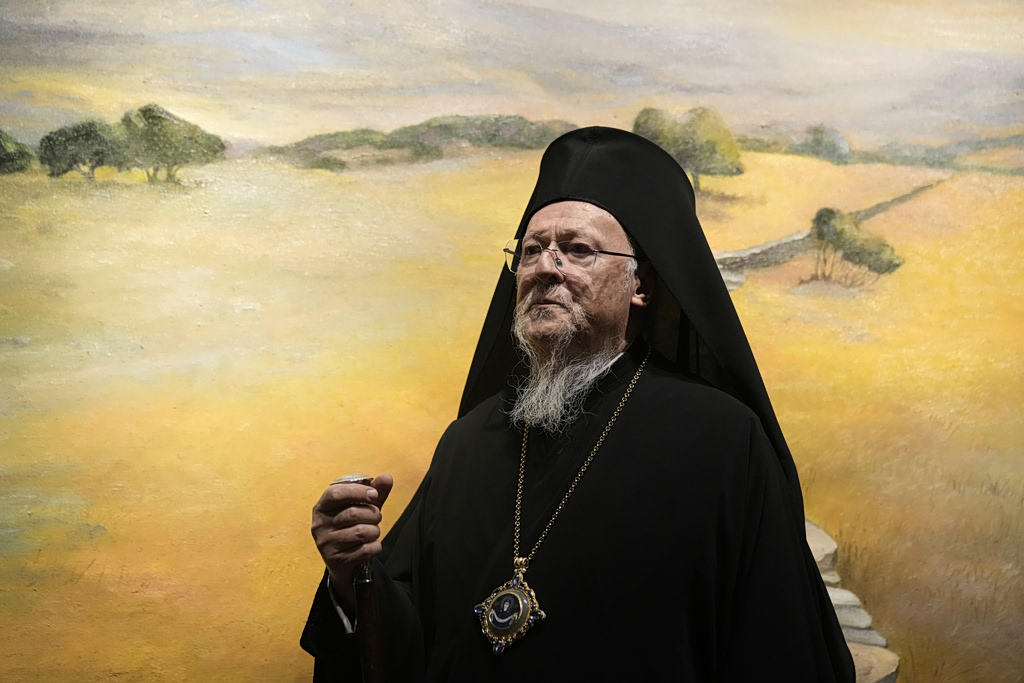
On October 19, he turned to the Patriarchate of Jerusalem, asking for its opinion on the situation, and specifically on the agreement between the monastery and Egypt. The Patriarch of Jerusalem, drawing on his deep knowledge and experience, replied with a landmark letter giving his blessing for the Archbishop of Sinai to proceed with signing the agreement. At the same time, Symeon turned to the Ecumenical Patriarch, the Patriarch of Alexandria, the Archbishop of Cyprus and the Archbishop of Athens, asking for their views as well. Then the unexpected happened. Within four days, all of them responded, in canonical church order, and gave their support to the Archbishop of Sinai to proceed with the agreement.
The Orthodoxy of the East came together, led by the Ecumenical Patriarch, to save the historic monastery and its centuries-old tradition.