 Μake us preferred on Google
 Pricking your own finger is harder than you’d think.
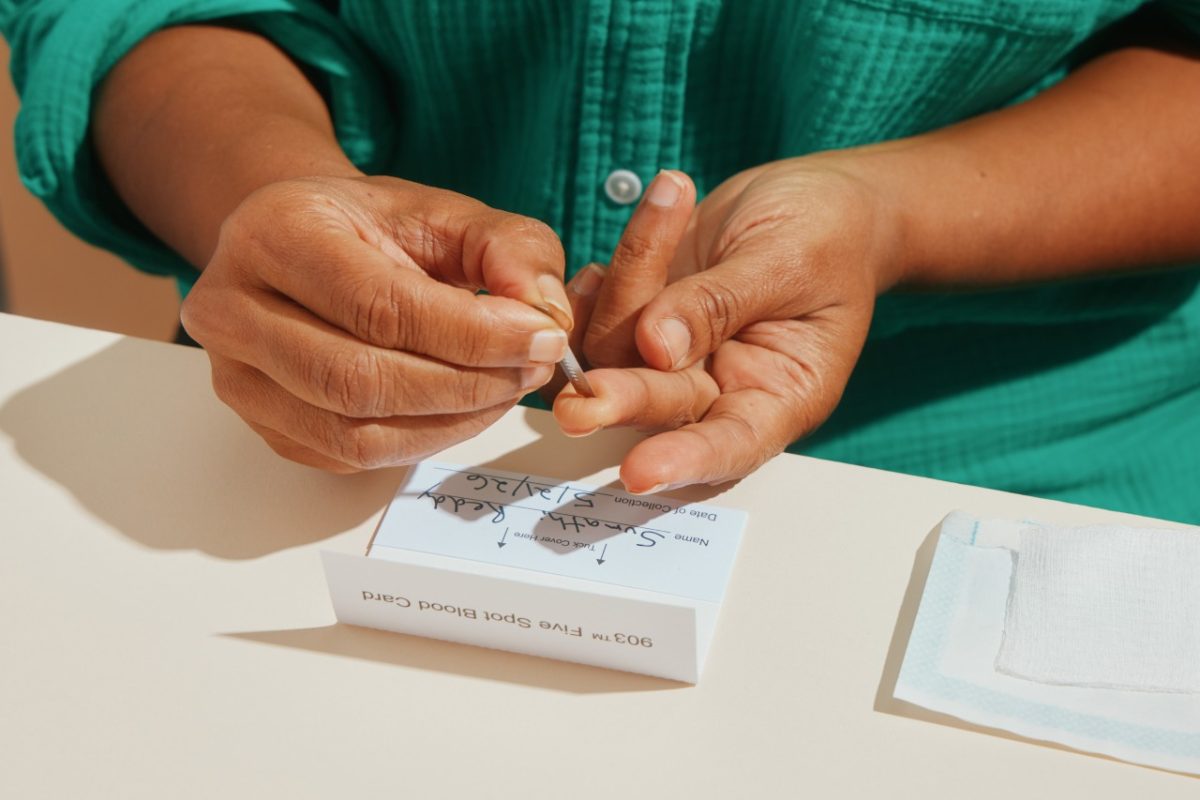
After three unsuccessful jabs with a tiny lancet, I had yet to produce enough blood to fill a circle on a collection card. With one lancet left, I enlisted the services of my photographer-turned-nurse.
Mission accomplished—all in the name of finding out how much plastic might be circulating in my body.
We don’t know much about the tiny pieces of plastic, called microplastics , that have been detected in the human body, but we know they’re there. We inhale and ingest them from almost everything we touch, breathe, eat and drink. While our bodies likely eliminate some, others accumulate in our bodies. Growing evidence suggests they may negatively impact our health.
Scientists are just starting to measure the levels of microplastics in us. And there is at least one product on the market, PlasticTox by Arrow Lab Solutions, that makes at-home blood and saliva tests that estimate the number and size of microplastic particles you carry.
Granted, it’s early days for such tests. There are concerns about contamination, a lack of reference ranges, and what to do with the results. The tests also can’t tell you where the particles came from, or where they are in your body.
But the tests provide a particle count and compare your results with others who have taken them. I decided to try both the blood and saliva versions.
So what exactly are microplastics? They are any type of polymer or plastic less than five millimeters—about the size of a sesame seed. Nanoplastics are generally considered anything less than one micron.
Microplastics are ubiquitous. Bottled water and processed food are big culprits. So is clothing, furniture and just about everything else.
“It’s hard to find things that are not made of plastic,” says Phoebe Stapleton , an associate professor in the department of pharmacology and toxicology at the Ernest Mario School of Pharmacy at Rutgers University.
And they get into our bodies through both ingestion and inhalation. There hasn’t been a tissue or organ in the body where microplastics haven’t been found. Lungs, heart, kidneys, liver, brain, testicles, the fluid in our eyes, and ovaries—all have microplastics, says Stapleton.
No wonder there’s more interest in testing. The blood test has been commercially available since 2023. I purchased it for $135 through Bryan Johnson’s longevity health site, Blueprint.
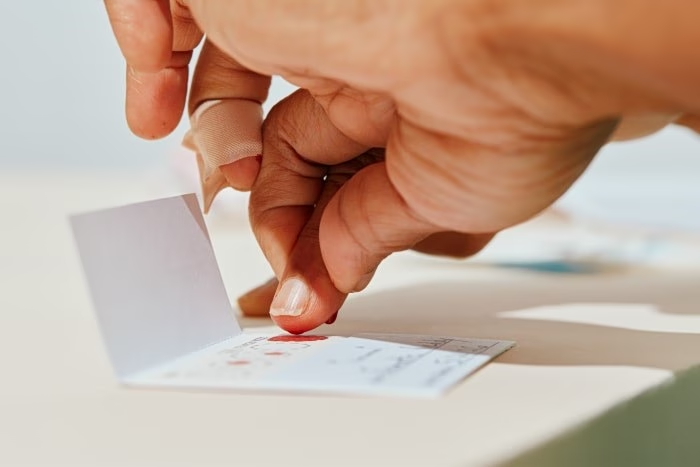
The instructions call for gently massaging your finger from the base to the tip to encourage blood flow. ELIZABETH ARVELOS COETZEE /WSJ
After the somewhat painful task of blood collection and a few bandages later, I mailed the sample in. More than a month later, the results landed in my inbox.
I had 13 particles. Compared to a reference population of 1,000+ samples, my total microplastic-particle level was higher than 53% of people who have taken the test.
Overall, my results were pretty average, says Dr. Matthew Campen , a professor at the University of New Mexico and a leading microplastics researcher.
“Some people have half of what you have and some people have two times as much,” says Campen. “It’s tough to put these into context.”
Dr. Robert Wright , director of environmental medicine at Icahn School of Medicine at Mount Sinai in New York City, says one challenge in assessing the result is that the test hasn’t been around long enough to have a large, representative sample.
“I’m going to guess more healthy people get this test than unhealthy people and it’s not very representative of the U.S. population because it’s self-selected,” he says.
Among my 13 particles, seven were less than 10 micrometers and six were bigger than 10 to 30 micrometers. None were the largest size. Yay?
Well, not exactly. Turns out the smaller the particle, the more toxic, says Wright. “Very small particles can penetrate deeper into the body than large particles,” he says.
The saliva test proved to be almost as difficult to take as the blood test. Purchased through Lumati, the test cost $150 and required not drinking or eating for at least two hours. Spitting to the required level required multiple attempts and near gagging.
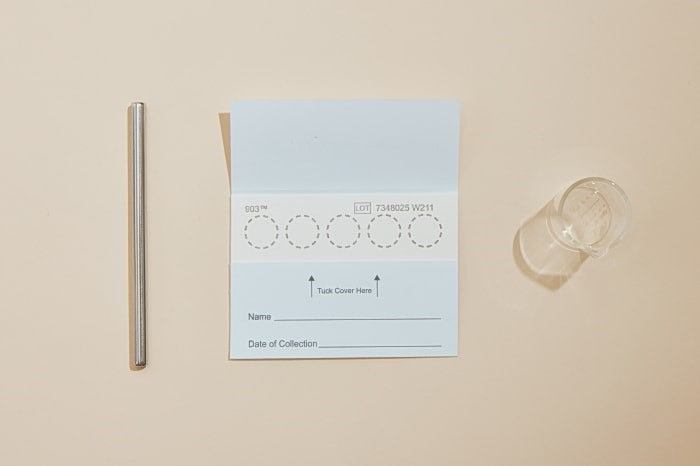
The saliva-test contents include a stainless-steel straw for transferring saliva to a five-spot collection card and a glass beaker for spitting into. ELIZABETH ARVELOS COETZEE /WSJ
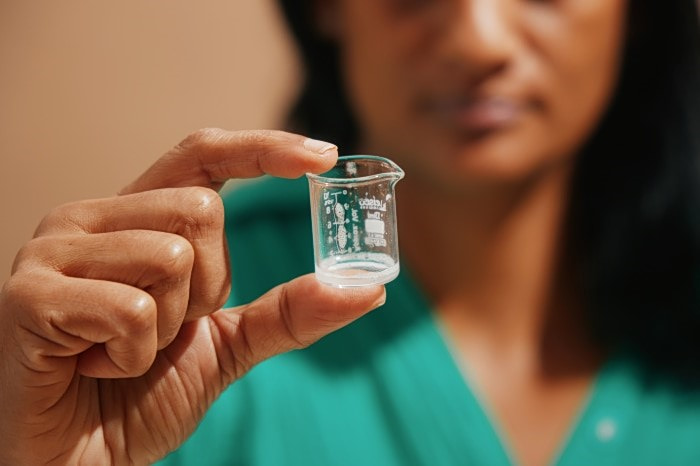
The test requires spitting into the beaker until the liquid reaches the lowest mark. ELIZABETH ARVELOS COETZEE /WSJ
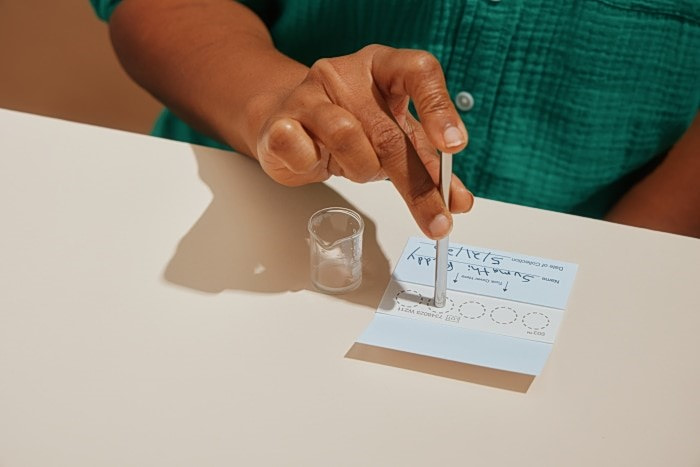
The saliva is transferred by dipping the straw into the beaker and onto the card. ELIZABETH ARVELOS COETZEE /WSJ
A few weeks later, the results showed 17 microplastic particles detected. Eight were less than 10 micrometers and nine were between 10 and 30 micrometers. Again, my results were average: About 48% of people reported lower levels and about 43% higher.
Scientists say one area of concern with such tests is the wide margin for user error and contamination. These can come from improper sample collection or the test material themselves.
Alan Morrison , chief executive of Arrow Lab, says the company has a painstaking process to review each kit component to prevent contamination.
A bigger issue may be what the tests can’t yet tell us. Namely, how much microplastic is absorbed by the body and how much accumulates over time given that researchers think some level of the plastics exit the body. The PlasticTox results are meant to be a baseline to track changes and the test is meant to be repeated.
Dr. Kara Meister, a pediatric otolaryngologist and head and neck surgeon at Stanford University who researches microplastics, says a meaningful microplastics test would measure the quantity and size of plastic, what type of plastic, and where it is. “The other big question is does any of this matter,” she says.
The clearest evidence linking microplastics and negative health outcomes involves the heart. Both human and mouse studies have found higher levels of microplastics are associated with more heart disease, says Campen.
Cell-culture and mouse studies also suggest links to cancer, inflammation and oxidative stress.
So what can you do to reduce your microplastic exposure?
Eat less processed food and use a steel water bottle. Use an air purifier in your bedroom and opt for natural fibers when buying clothes. Store food in glass or foil and don’t heat anything in plastic.
“If we use the environment as our north star, I think that’s a good way to field test things,” says Meister.
Where does that leave me? With a number but not many answers. Yes, I have microplastics in my body like everyone else, but I don’t know how they’re affecting my health.
So, for now, I’ll focus on the environmental factors I can control and be sure to plug back in my pandemic-era air purifier.