
 Μake us preferred on Google
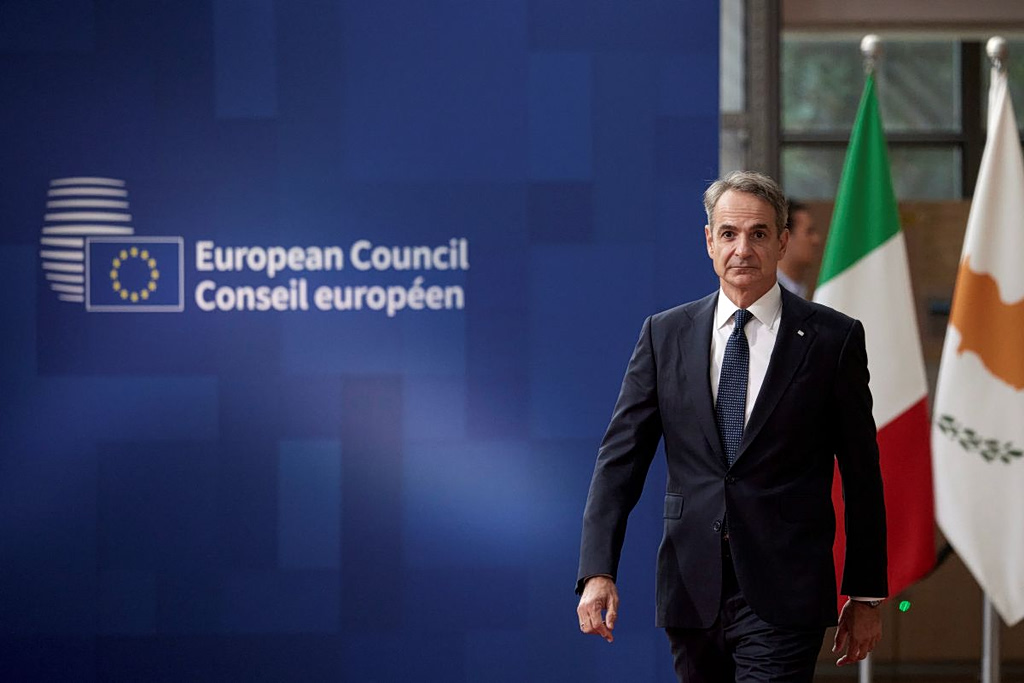
 Speaking from the EU summit in Brussels on Thursday, Prime Minister Kyriakos Mitsotakis announced that the European Commission has backed Greece’s proposal for an EU emergency mechanism to handle migration pressures. Presented by Migration and Asylum Minister Thanos Plevris, the plan combines strict activation criteria with stronger border protection, a temporary suspension of asylum procedures during a crisis and faster returns.
Athens is seeking a common European framework for emergencies, especially sudden surges in arrivals or cases where third countries weaponize migration flows. The mechanism would run for an initial period of up to 30 days, with the option of an extension subject to review and approval. Its activation would have to be formally notified to the Council of the European Union and the European Commission.
At the heart of the proposal are measurable thresholds, so that activation rests on hard data rather than a general sense of pressure. A key trigger would be arrivals in a given border area more than doubling, on a weekly or two-week basis, compared with the average of the previous three months. Other factors include large numbers of crossings and repeated attempts at irregular entry, as well as reception and identification facilities running out of capacity within 48 to 72 hours, posing an immediate risk to public health or public order.
Qualitative criteria also carry significant weight. Authorities would look for documented evidence that migrants are being transported or directed from a third country, or that state actors tolerate or collude with smuggling networks. The focus is on movements driven not by war or natural disaster but by an organized effort to pressure an EU member state. Mass, simultaneous attempts to cross at specific border points would also count.
Once triggered, the mechanism would allow border surveillance to be stepped up, with support from Frontex’s Rapid Border Intervention Teams (RABITs). Its toughest provision would temporarily halt the registration and processing of asylum claims from people entering irregularly. New arrivals would be held in closed detention and identification centers pending accelerated returns to their countries of origin or other countries where return is lawful.
To speed up deportations, the plan would simplify the issuing of travel documents, including emergency EU Laissez-Passer papers. It would also apply coordinated political and economic pressure on countries that weaponize migration or fail to readmit their nationals.
All measures would have to comply with European and international law, including the principle of non-refoulement.