 Μake us preferred on Google
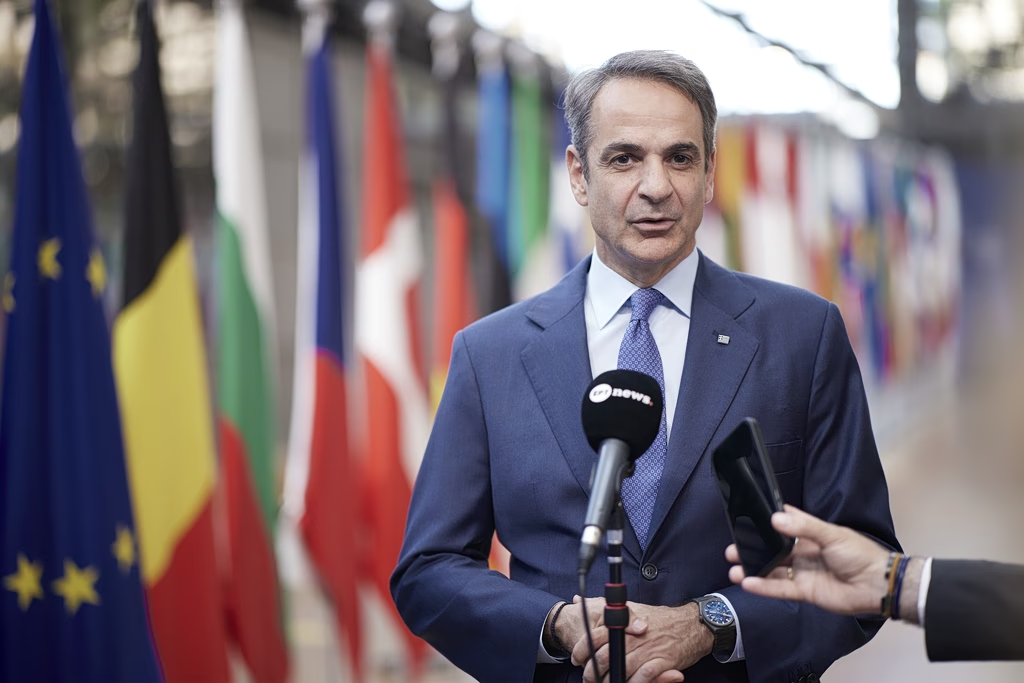
 Prime Minister Kyriakos Mitsotakis arrives in Brussels on Thursday with a series of demands aimed at giving Athens greater room to respond to rising prices and energy costs while protecting key sources of European funding.
At the two-day EU summit on October 15-16, Greece will push for greater flexibility under European fiscal rules to allow additional targeted and temporary support for households and small and medium-sized businesses.
Mitsotakis set out the broader stakes ahead of the meeting during remarks in the central Greek city of Larissa on Wednesday, arguing that Europe must respond to geopolitical upheaval, inflation and the rising cost of living with measures that deliver tangible results.
For Athens, one of the central questions in Brussels will be how much fiscal space governments have to respond to those pressures without compromising fiscal stability.
Greece seeks more room for support measures
Mitsotakis is expected to argue for greater flexibility in European spending rules, allowing Greece to finance additional measures for households and businesses facing continued cost pressures.
He said Wednesday that existing spending ceilings restrict the government’s ability to introduce new measures even when additional resources are available.
Athens wants those limits expanded while maintaining fiscal stability at a time when financial markets remain unsettled.
The issue has taken on greater urgency for the government as Greek households contend with high prices, elevated energy costs and the prospect of another difficult winter.
Athens targets cost of green transition
Greece will also raise the cost of Europe’s energy transition for industry and shipping.
With turmoil in the Strait of Hormuz fueling renewed price increases, Athens argues that European policy needs to adapt to current conditions.
The government continues to regard the green transition as a long-term objective, but Mitsotakis is seeking more time for industry to adjust and for economically viable technologies to be developed, while warning about potential consequences for jobs.
Shipping is another focus. Athens is concerned that additional costs imposed on the sector will ultimately be passed on to consumers, adding further pressure to prices.
The issue feeds into a broader debate over the competitiveness of the European economy.
Mitsotakis is expected to press for implementation of the Letta and Draghi reports on European competitiveness, simpler regulation and a reduction in the EU’s critical dependencies.
Greece will also reiterate its call for the completion of Europe’s energy market and stronger energy interconnections, while seeking measures that address the immediate pressures created by the current crisis.
Farm and cohesion cuts are a ‘red line’
The EU’s next long-term budget will form another key front for Athens.
Greece’s position is that growing European spending requirements for defense, security, research and innovation will require additional resources and should not be financed by cutting the EU’s Cohesion Policy or Common Agricultural Policy.
Athens says it will not accept further reductions in either area.
Greece remains open to discussions over new sources of EU revenue, provided the burden does not fall disproportionately on the bloc’s less-developed economies.
Borders and migration also on agenda
Ukraine, EU enlargement and migration will also feature on the agenda of the summit.
On migration, Greece plans to emphasize the protection of the EU’s external borders and the need for a European mechanism capable of responding to sudden mass arrivals or attempts to use migration pressure as a tool.
For Mitsotakis, the various demands form part of a broader call for the EU to respond to economic and geopolitical pressures with measures that produce concrete results.
“Only responses that ultimately deliver tangible results can close the door to dead-end populism and extremes of every kind,” he said Wednesday.