 Μake us preferred on Google
 The corridors of the Metropolitan Expo convention center outside Athens were charged with the kind of nervous energy that tends to accompany a party convention: a mix of excitement, unfulfilled expectations and back-stage manoeuvring. Over three days, New Democracy, the center-right party that has governed Greece since 2019, held its 16th congress under the official motto “Together for the Greece of 2030.” What unfolded beneath that optimistic banner was something considerably more fraught.
A decade at the helm, under strain
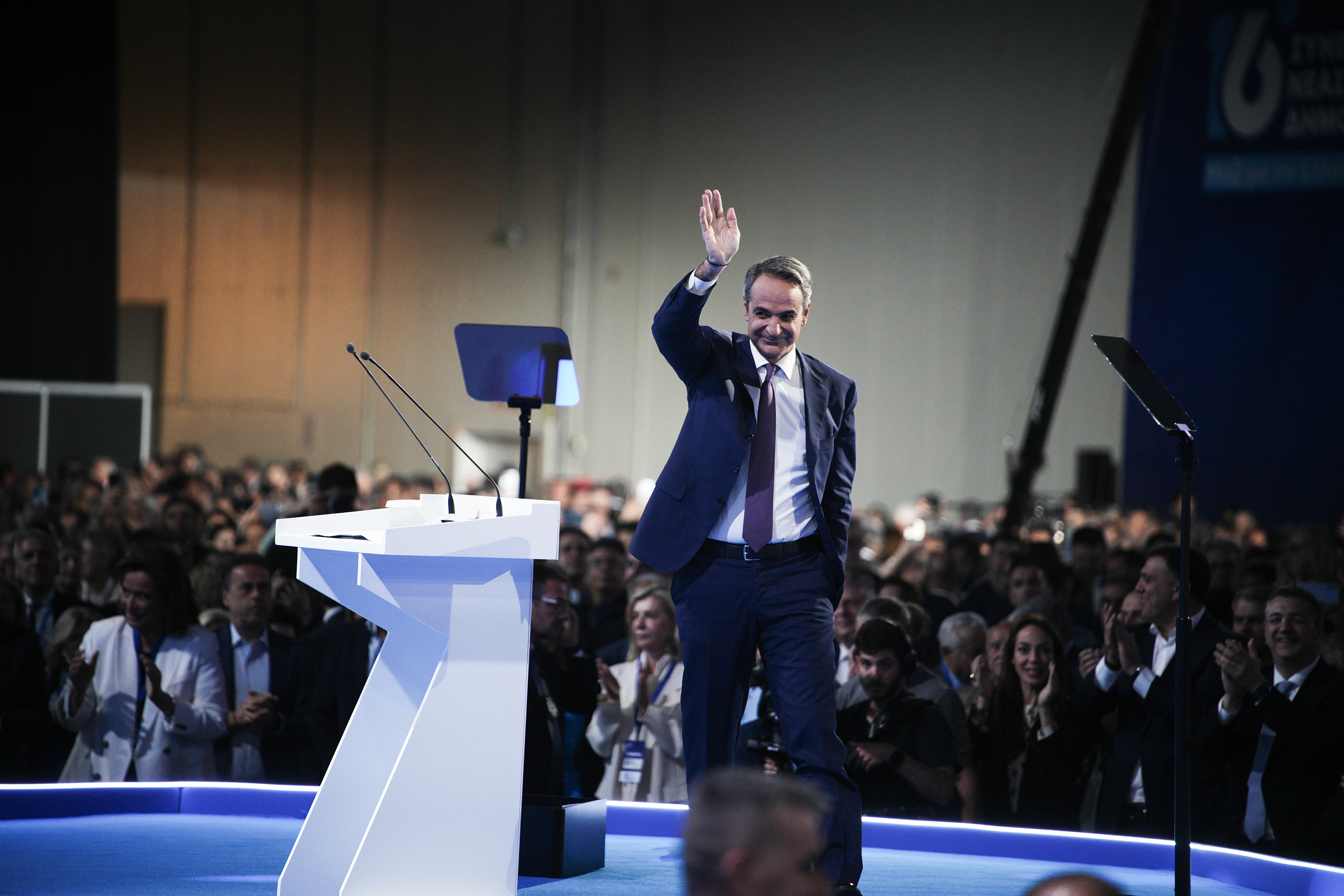
Marking ten years as party leader, Prime Minister Kyriakos Mitsotakis opened proceedings at arguably the most difficult moment of his tenure. Inflation remains the top concern for Greek households who struggle increasingly each passing month, open questions about the state of rule of law in Greece that continue shadow his administration as well as internal pressures that have been building for months. All came into sharp relief over three days at the Metropolitan Expo.
“As Greece has changed, so has our party,” Mitsotakis told delegates, adding that New Democracy had been remade into “a broad movement of progress.” The speech was also an exercise in bridge-building toward figures who had conspicuously chosen to stay away.
The empty chairs
For the first time in the party’s history, both living former prime ministers from New Democracy’s ranks declined to attend, namely Antonis Samaras and Kostas Karamanlis. Their absence fell to Theodoros Rousopoulos, chairman of the organizing committee, to navigate, as he opened proceedings in what delegates described as an atmosphere of visible awkwardness.
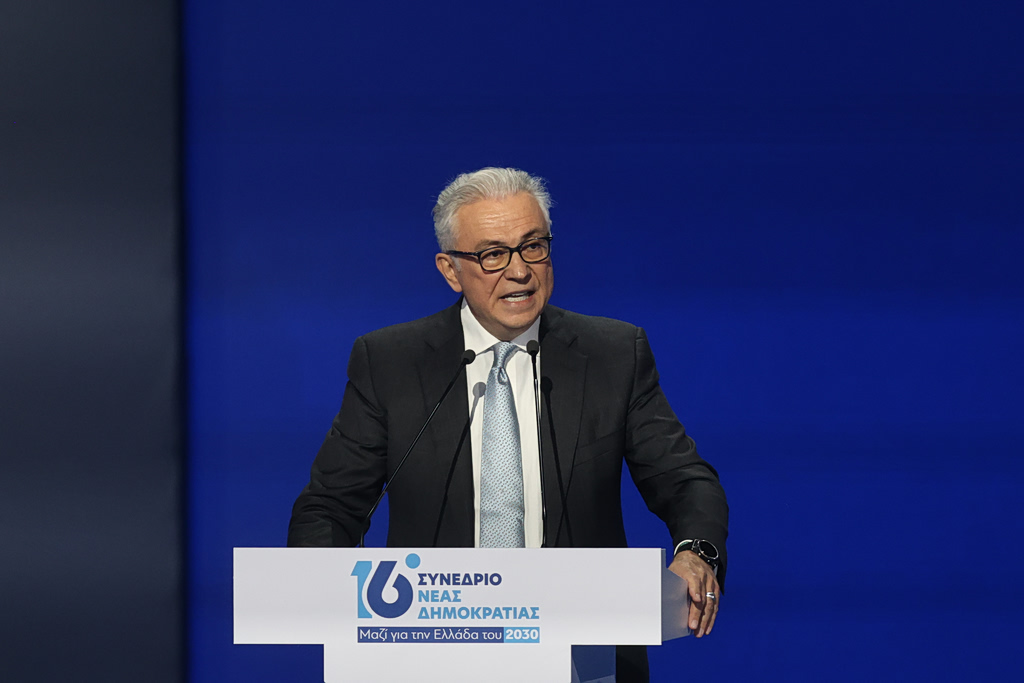
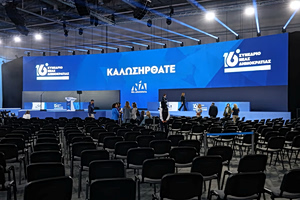
First day of the 16th New Democracy Party Congress, at the Metropolitan Expo, Friday, May 15, 2026. (YANNIS PANAGOPOULOS/EUROKINISSI)
Mitsotakis made a point of name-checking both in his opening address: Kostas Karamanlis — nephew of the party’s founder and himself prime minister from 2004 to 2009 — as the leader of “national self-confidence,” and Antonis Samaras, who led the government from 2012 to 2015 during Greece’s deepest austerity years, as the guarantor of “stability in difficult times.”
The tributes landed differently in each case. Samaras’s ideological distance from Mitsotakis has increasingly been made public for some time; those close to him say the formation of a new party to the right of New Democracy is increasingly likely. His absence, while expected, added urgency to proceedings.
Karamanlis’s empty seat was harder to accept for some New Democracy delegates. In the weeks before the congress, he had pointedly described Greece’s foreign policy under Mitsotakis as insufficiently “multidimensional”, a comment that was widely read as a rebuke of the government’s close alignment with Washington. He had also previously spoken of “poisonous shadows over democratic norms” in the context of the wiretapping scandal that has dogged the Mitsotakis government since 2022, and criticized what he called the “opaque and clientelist management of agricultural subsidies”, a reference to the OPEKEPE agricultural subsidies scandal.
By staying away, Karamanlis denied the party the political endorsement his presence would have carried. “The way things have developed, neither New Democracy wanted him to speak nor did he,” one delegate observed.
The Samaras factor
The specter of Samaras dominated the congress in ways that organizers had clearly anticipated but could not fully contain. In the days before the event, Ioanna Gkelestathi, a member of parliament, resigned from the party citing a “political, values-based and psychological rupture” with the leadership. An open letter signed by ten former ministers and lawmakers spoke of the party losing its “soul.” Both moves were widely interpreted as signals of support for Samaras’s anticipated next steps.
From the podium, senior figures and the party’s aspiring future leaders delivered what amounted to a coordinated plea for unity, interweaving praise for both former prime ministers with warnings about the cost of internal division. Kostis Hatzidakis urged that “there is no room for petty egotism.” The very outspoken Adonis Georgiadis called on disaffected figures to “come back.” Eurogroup President and Finance Minister Kyriakos Pierrakakis said the party had no interest in “internal whispers, narcissism and egos.” Pavlos Marinakis struck the same note, calling on members to place the party’s interests above their own. Foreign Minister Giorgos Gerapetritis joined the chorus, declaring that “responsible patriotism is the soul of this party.”
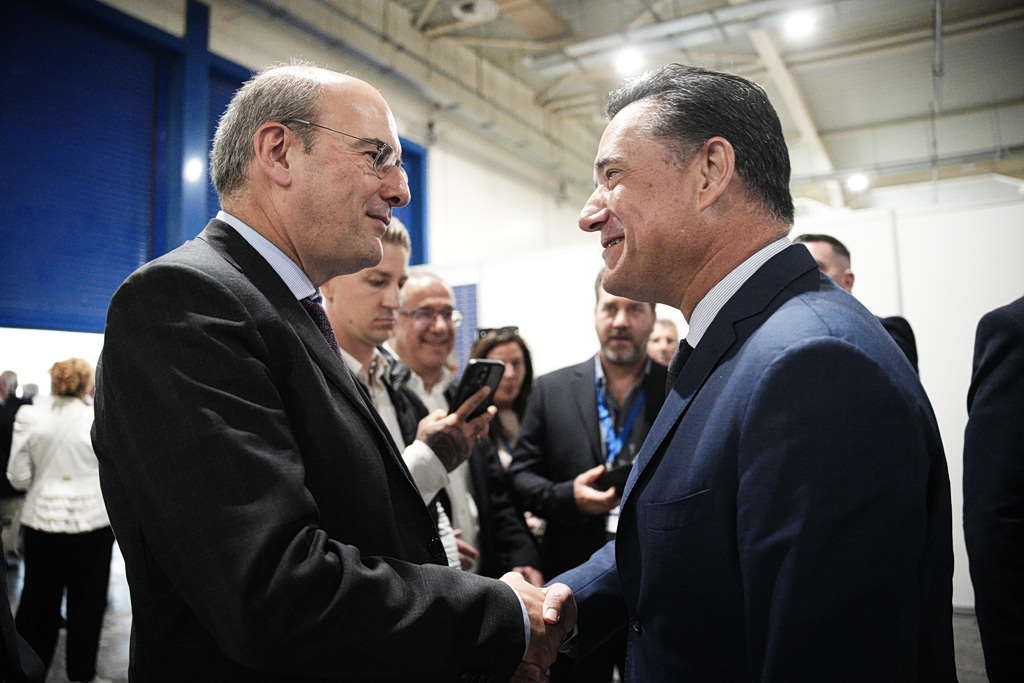
Third day of the 16th Conference of New Democracy party, in Athens, on May 17 2026 (Menelaos Myrillas / SOOC)
The parade of unity appeals reached its most pointed moment when Akis Skertsos, who is a figure closely associated with the government’s more liberal wing and a lightning rod for discontent among traditional party members, also invoked the party’s “soul.” “At this point in the proceedings, we’ve kind of topped out,” one lawmaker remarked.
Rousopoulos closed with a literary warning, invoking George Seferis’s poem “Helen” — in which the Greeks fight and die for an empty tunic, having discovered that the Helen they went to war over was never in Troy at all. He cautioned that a fractured party risked fighting for nothing. “I ask that the introspection now ends. Everyone, present and absent, has contributed to this party. Those who continue the fight should look ahead and extend a hand to one another,” he said. The Prime Minister also struck a pointed note in his closing remarks: “History is written only by those who are present and only by those who take part in the struggle.”
The ideological contest
The divisions on display at the party conference were not merely personal. Two senior figures used the congress to stake out distinct and competing visions for the party’s direction.
Defense Minister Nikos Dendias delivered what several delegates called a “manifesto,” attacking what he described as the “enclosed chancelleries of technocrats” and “mercenaries of power,” and warning against the risk of “governmental institutionalism.” He championed the role of elected lawmakers — “thanks to them, we are ministers” — and sounded a note of caution on the polls, warning that New Democracy’s leads over opposition parties should not breed complacency. He also made specific mention of Samaras in a passage praising the former PMs handling of the far-right Golden Dawn party during the 2012-to-2015 government.
“He’s in a big rush,” a senior government official said of Dendias, with evident irritation. “Even if our lead over the opposition were twice as large, Dendias still wouldn’t be satisfied.”
Vasilis Kikilias, who makes little secret of his own leadership ambitions, addressed the party’s traditional base directly, warning that New Democracy’s identity “cannot and must not be distorted by anyone.” “We are a national and patriotic movement, democratic and liberal, but above all a people’s party,” he said, in a passage interpreted as implicit criticism of Mitsotakis’s centrist broadening strategy.
The Nephew
The congress also played host to Grigoris Dimitriadis, the prime minister’s nephew and former chief of staff, who resigned in 2022 amid the Predator spyware scandal. Dimitriadis has resurfaced over the last few months, conducting tours around the country and maintaining what those in his circle describe as a significant base of influence within the party. Days before the congress, he gave an interview suggesting he had taken the blame for the spyware scandal to protect the party. The remark, interpreted as a warning by many New Democracy officials, provoked considerable unease at Maximos Mansion.
“This intervention was not made by chance, just before the congress,” said one party official. “He wanted to show that he still has strong footholds in the party machinery, whatever distances the official leadership keeps.” Another added: “If he wanted to irritate them, he succeeded.”
Voices from the floor
In the corridors and at the coffee-stand clusters that form at every large party gathering, the mood among delegates from outside Athens was notably less managed than what appeared on stage. Veteran local officials from northern Greece expressed disquiet at what they described as the ideological softening of the party under Mitsotakis, pointing in particular to legislation on same-sex civil partnerships passed during his tenure. Younger delegates countered that the party’s centrist expansion had given them the 41% of the vote at its peak.
From the floor of the congress itself, delegates raised substantive concerns about regional inequality and bureaucratic dysfunction. One lawmaker from Aetolia-Acarnania said that her region, despite its natural resources and geographic advantages, had not seen its potential translate into investment or opportunities for young people, arguing that Greece could not continue to develop “at two speeds.” Another delegate pressed for reform of the legal immigration system, noting that ministries were receiving letters from almost every professional sector about acute labor shortages in tourism, agriculture, construction and technical trades, with residency permit delays compounding the problem.
The road to 2027
The congress also served to telegraph New Democracy’s electoral strategy for 2027: run on its governing record and make Alexis Tsipras its defining opponent. Mitsotakis invoked the former PM by name in his opening address, reaching back to the 2015 bank closures. He also returned to the same theme in his closing speech, with allusions to the street-politics and populist mobilization that defined that era.
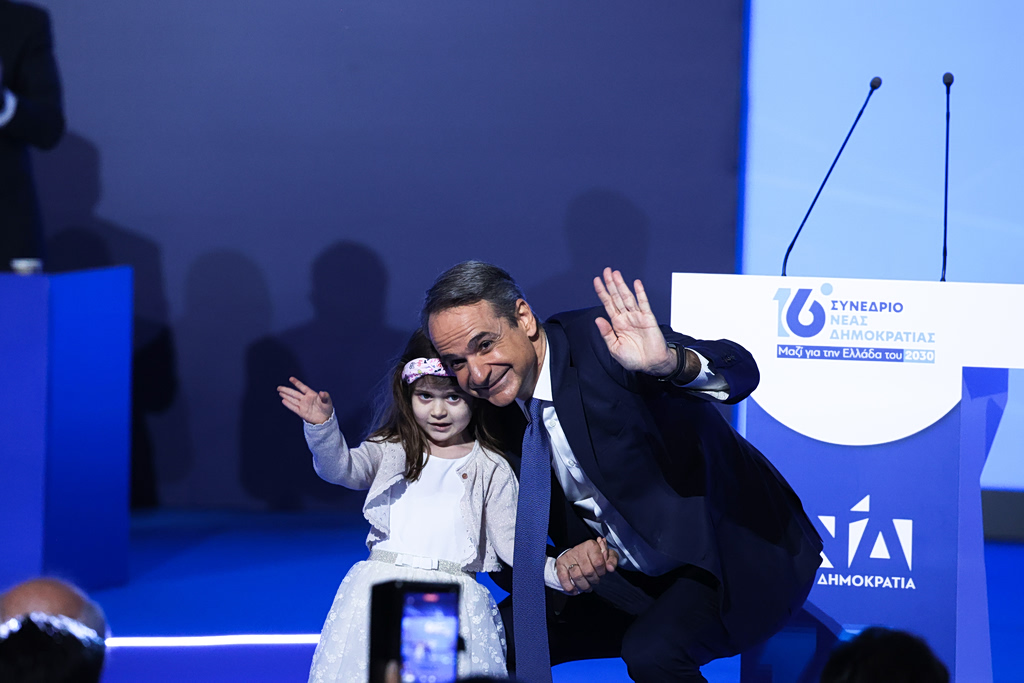
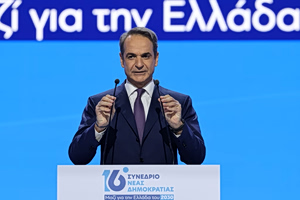
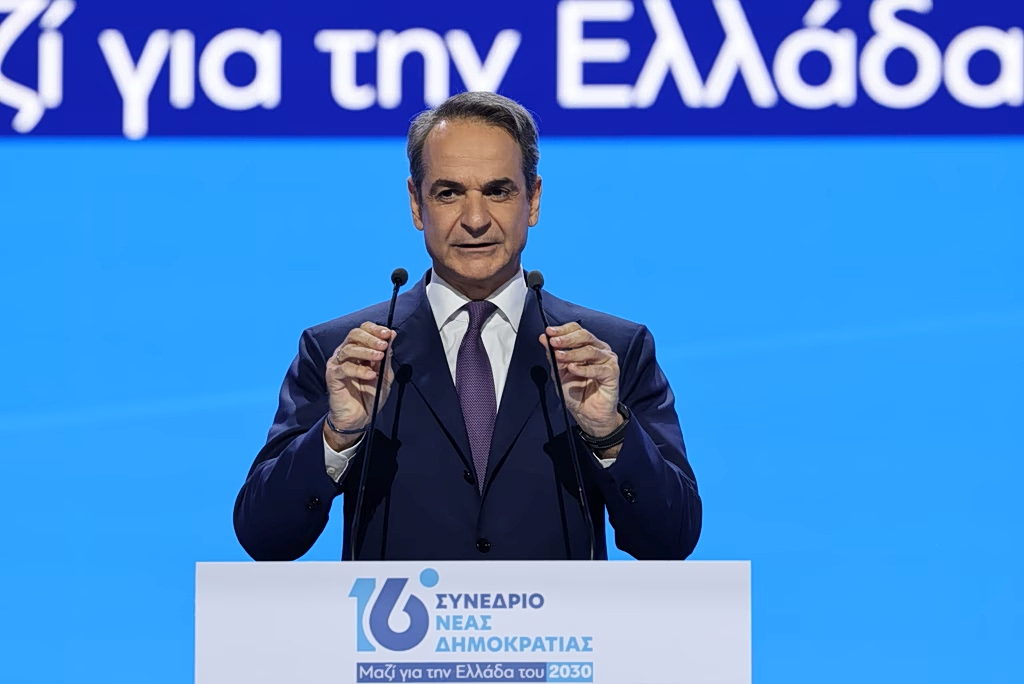
The President of New Democracy and Prime Minister of Greece Kyriakos Mitsotakis delivers his speech during the first day of the 16th Conference of New Democracy party, in Athens, on May 15, 2026. (Aris Oikonomou / SOOC)
The message was clear: New Democracy has already decided who it wants to run against. Senior figures, including Deputy Prime Minister Hatzidakis, were openly speculating about the dynamics of a Tsipras return and the scramble for second place among opposition parties. Prime Minister Mitsotakis tried to wave the topic away in his closing remarks, saying the government had no interest in who finished second or third. Whether the party’s base found that reassuring after three days of barely concealed internal tension was another matter.