
 Μake us preferred on Google
 Prime Minister Kyriakos Mitsotakis on Wednesday announced that Greece is moving toward its first offshore exploratory gas drilling in nearly four decades, with an ExxonMobil-led consortium expected to begin drilling in the Ionian Sea in spring 2027.
Speaking at a Greek diaspora event in New York City during his presence in the metropolis for the 81st UN General Assembly, Mitsotakis said he was proud that the drilling imitative was expected to take place “probably toward spring 2027,” describing it as the first such operation in Greece since 1970.
The Mitsotakis government has repeatedly expressed a volition to turn its offshore hydrocarbon potential into a component of the country’s energy security and geopolitical strategy.

The most advanced project is Block 2 in the northwestern Ionian Sea, where ExxonMobil, Energean and Energean’s Greek partner, HelleniQ Energy, are preparing for the drilling of the Asopos-1 exploratory well. Preparatory work has advanced significantly, including completion of the environmental impact assessment, while the extreme northwest port of Igoumenitsa has been selected as the logistical hub for the operation. The consortium has been preparing for drilling in early 2027.
The development follows a broader revival of Greece’s offshore hydrocarbons program after years in which exploration activity remained limited. Over the past year, Athens has moved to expand exploration opportunities in the Ionian Sea and south of Crete, including through international tenders for seismic surveys covering both areas already under concession and unleased acreage.
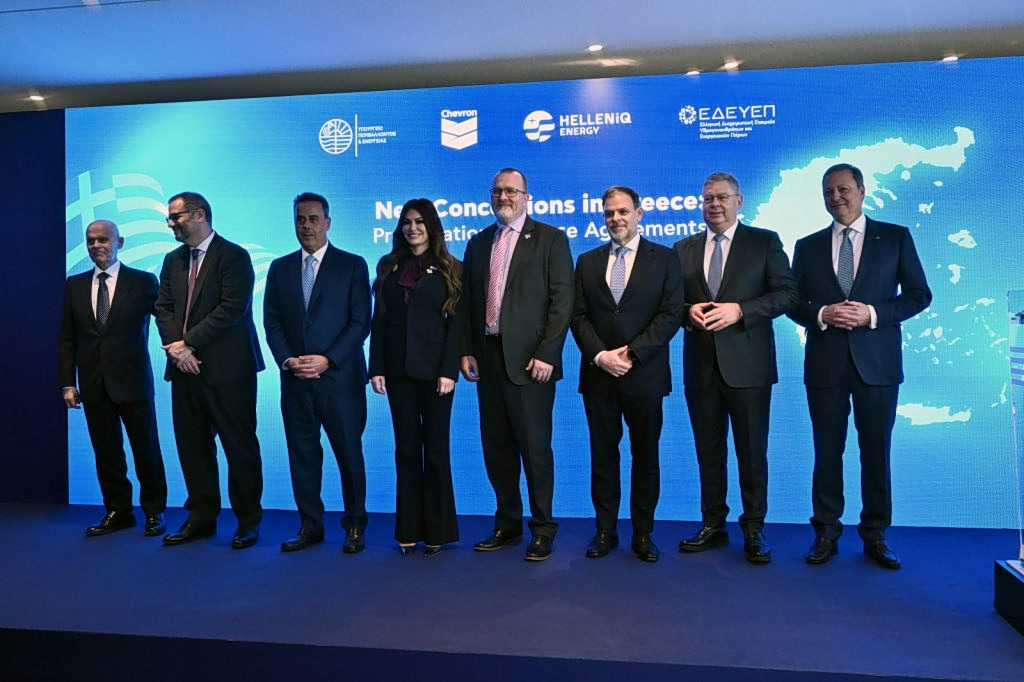
Chevron is also preparing to enter a new phase of exploration, with seismic surveys in the Ionian Sea and south of the Peloponnese and Crete expected before the end of 2026. The company’s activities are part of a wider effort to develop Greece’s hydrocarbons market and attract international investment in offshore exploration.
The hydrocarbon projects also have a regional dimension, as Athens’ plans for exploration south of Crete and in the Ionian Sea have been discussed alongside the country’s wider efforts to strengthen its position as an energy hub in the eastern Mediterranean and southeast Europe.
Mitsotakis has used his current US visit to reinforce the energy component of Greece’s international strategy. In New York, Energy and Environment Minister Stavros Papastavrou has met representatives of Chevron and ExxonMobil, while presenting the country as an emerging energy hub and stressing the importance of energy security and regional interconnections.
At the event with scores of Greek-Americans in the audience, Mitsotakis also linked the government’s energy strategy to its broader record and its plans ahead of the next national election, probably in the spring of 2027. Responding to comments about a possible third term, he said the government’s objective was not to “break the record,” but to continue what he described as the process of changing the country and implementing further reforms.
He said the government would have to work harder to persuade voters that it deserved their trust, arguing that it had fulfilled most, if not all, of the commitments it made to the Greek people in 2023.