
 Μake us preferred on Google
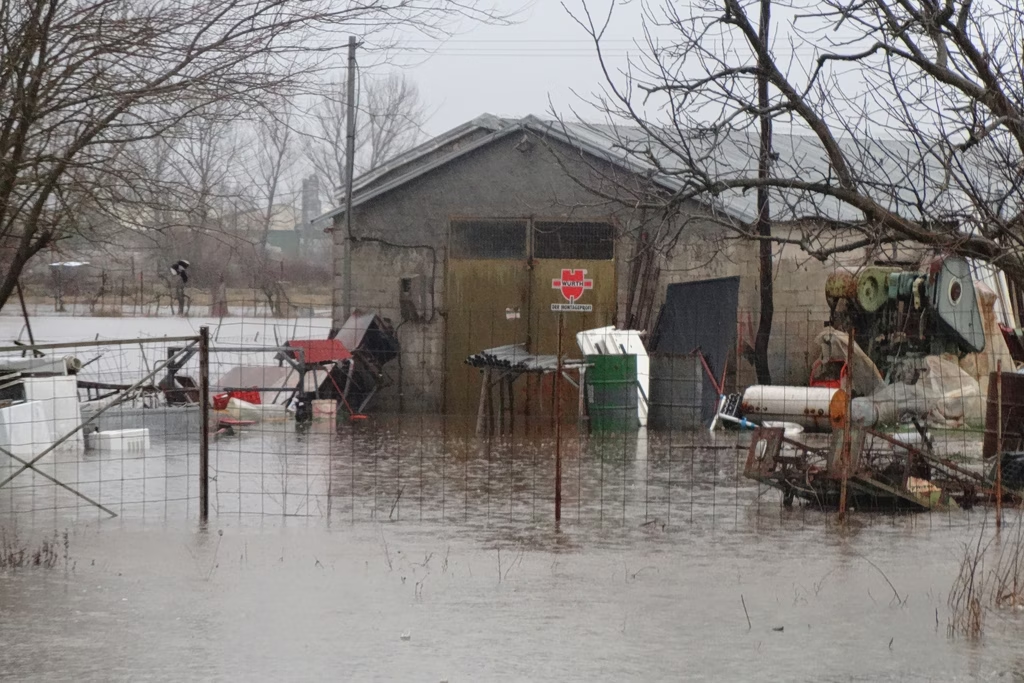
Six Greek regions have been placed under the highest level of civil protection mobilization (red code) through Sunday as severe weather brings flooding, landslides and transport disruption, particularly in the Ionian Islands and western Greece.
The National Meteorological Service (EMY) upgraded its severe weather bulletin to an emergency warning for dangerous weather phenomena on Friday, forecasting heavy rain and thunderstorms across an expanding area of the country.
The Ionian Islands, Epirus and western Greece are under red code status on Friday and Saturday, while Thessaly, central Greece and the Peloponnese will follow on Sunday.
View this post on Instagram
Corfu Hit by Torrential Rain, Flooding and Landslides
Corfu, an Ionian island off northwestern Greece, has experienced serious problems following hours of continuous rainfall, with flooded roads, fallen trees and landslides reported in several areas. Dozens of homes lost electricity on Thursday evening, while transport services were also disrupted.
Rainfall reached nearly 200 millimeters in parts of southern Corfu, equivalent to approximately 200 liters per square meter. Private weather stations recorded 197.6 mm in Chlomos and 192.8 mm in Perivoli, both villages in the island’s southern end, according to state broadcaster ERT.
In Epirus, northwest mainland Greece, a weather station in Grika, Thesprotia prefecture, recorded 141.99 mm of rain, with intensity reaching 15 mm per hour.
In Lefkimmi, southeast Corfu, stream levels rose significantly, while sections of the road network were flooded. Rockfalls and fallen trees were also reported.
⚠️Ενεργοποίηση 1️⃣1️⃣2️⃣
🆘 Λόγω έντονης βροχόπτωσης στην περιοχή του δήμου #Μεσολογγίου, της Περιφερειακής Ενότητας #Αιτωλοακαρνανίας, περιορίστε τις μετακινήσεις σας στις απολύτως απαρραίτητες
‼️ Ακολουθείτε τις οδηγίες των Αρχών
ℹ️ https://t.co/0nAVk3qTT2…
@pyrosvestiki
@hellenicpolice
— 112 Greece (@112Greece) November 27, 2026
Storms to spread across mainland Greece
According to EMY, heavy rain and thunderstorms will continue on Saturday in the Ionian Islands, Epirus and western central Greece, while western Peloponnese will also be affected. From Saturday evening, the storms are expected to spread to parts of central Macedonia, particularly Pieria and Halkidiki prefectures, north of Thessaloniki, and eastern Thessaly.
On Sunday, the main areas at risk will be Thessaly, eastern central Greece, particularly Fthiotida, and the large island of Evia. The storms will gradually extend to eastern and southern Peloponnese.
Very strong northerly to northeasterly winds are also forecast in eastern Greece, reaching nine on the Beaufort scale and locally 10 in the Aegean.
112 Alert for Messolonghi, fire brigade on standby
A warning was sent through the 112 emergency system to residents of Messolonghi, a coastal town in western Greece, urging them to restrict travel to essential journeys and follow official instructions.
The fire brigade has been placed on heightened alert, with its operational plan for floods and related hazards activated. The National Coordination Center for Operations and Crisis Management (ESKEDIK) is coordinating with regional and municipal authorities, which have been instructed to assess their readiness and convene civil protection coordination bodies.
The civil protection general aecretariat has urged residents to avoid unnecessary travel, stay away from flooded roads and streams and secure objects that could be swept away by strong winds.
The main risks through Sunday include flash flooding, landslides, damage to road infrastructure and transport disruption.