
 Μake us preferred on Google
When French liberal thinker and politician Alexis de Tocqueville visited the young United States in the mid-19th century, he was impressed by how its democratic system had been structured to prevent the tyranny of the majority. In his landmark work, Democracy in America, he described the institutional safeguards and system of checks and balances designed to prevent excessive concentrations of power.
U.S. midterm elections, held halfway through a president’s term, serve precisely this purpose. When Donald Trump won a second presidential term in 2024, Republicans secured control of all three branches of government: the presidency and majorities in both chambers of Congress, alongside a favorable majority on the Supreme Court. They also enjoyed the backing of many of the country’s most powerful figures.
Two years into Trump’s administration, however, the president’s approval rating had fallen to a historic low, as had satisfaction with his government. The economy was under pressure from the war in Iran, while growing public discontent was accompanied by concerns about authoritarian governance.
Against this backdrop, the November 3 midterm elections marked a major political correction. Democrats won majorities in both the House of Representatives and the Senate, securing several striking victories in traditionally Republican strongholds, including Texas and Mississippi. The so-called “blue wave,” referring to the Democratic Party’s signature color, swept across the country, from the East Coast to the West Coast.
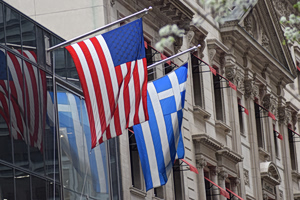
In an increasingly interconnected world, the political impact of the results extends well beyond the United States. A survey examining Greek public opinion reveals how people in Greece interpret the Democrats’ victories and what they expect from their consequences for the United States, Europe and their own country.
Most Greeks See the Results as Positive
A clear majority of respondents, 60%, believe the outcome of the midterm elections will have a positive impact, while just 10% expect a negative one. One in four believes the results will have little or no effect on Americans’ lives.
Political and ideological differences are evident in the responses. Positive assessments are strongest among respondents on the left of the political center, reaching 76% among center-left voters. They are also shared by a substantial majority of center-right respondents, at 66%.
The picture is notably different among those who identify as right-wing. Only 40% of this group view the election results positively, while 20% consider them negative.
Generational differences are also significant. Baby boomers are the most enthusiastic about the Democrats’ victories, with 70% assessing the results positively and just 6% negatively. This postwar generation, which experienced the political and cultural influence of 1960s America as well as the Cold War, stands out for its favorable assessment.
A similar pattern emerges when respondents are asked whether the United States as a whole will benefit from the election outcome. Nearly six in 10 (59%) believe the country will be better off, compared with just 14% who expect it to lose out.
Expectations for U.S.-Europe Relations and the Global Economy
When asked about the potential consequences of the election results for issues extending beyond the United States, Greeks are most optimistic about relations between Washington and Europe.
Some 38% expect the Democrats’ victories to have a positive effect on U.S.-European relations, which have been significantly strained during Trump’s second term.
Respondents are also relatively optimistic about the global economy, with 32% anticipating a positive impact. The international economy has faced instability following major policy decisions by the Trump administration, including the imposition of tariffs and the military conflict in Iran.
However, opinions are not uniformly positive. Nearly one in four respondents (23%) believes the election results could have a negative impact on the global economy.
Greeks Remain Cautious About the Impact on Their Country
When the focus shifts to Greece’s own interests, expectations become considerably more cautious.
More than half of respondents believe the U.S. midterm election results will have neither a positive nor a negative effect on Greece’s national interests or Greek-Turkish relations.
Among those who expect a change in Greece’s national interests, optimism outweighs pessimism: 25% anticipate a positive impact, compared with 16% who expect a negative one.
Views are more evenly divided on Greek-Turkish relations. While 20% expect the election results to have a positive effect, 21% anticipate a negative impact.
Interestingly, center-right respondents, despite being less enthusiastic than other political groups about the Democrats’ victories, are the most optimistic about the potential benefits across all four areas examined: U.S.-European relations, the global economy, Greece’s national interests and Greek-Turkish relations.
By contrast, right-wing respondents are more likely to anticipate negative consequences, particularly for the global economy and relations between Greece and Turkey.
Mixed Expectations About International Conflicts
Beyond the United States, Europe and Greece, the outcome of a major American election carries global implications, particularly amid the current climate of geopolitical uncertainty.
Asked whether international tensions and conflicts would ease following the midterm elections, respondents expressed more mixed expectations.
Some 41% believe international tensions will decrease, as the war in Iran and its consequences were among the main factors behind the Democrats’ sweeping victory.
However, 26% expect tensions to increase, while another 26% take a neutral position. Younger respondents belonging to Generation Z are more skeptical than any other age group about the prospect of a reduction in international tensions.
Whether these expectations will ultimately prove accurate remains to be seen. What is clear, however, is that the November 3 “blue wave” marks a shift in American politics, with repercussions extending across the globe.
Greece, its society and its political system are unlikely to remain unaffected by these developments.
Giannis Balabanidis is a political analyst and head of political and social research at Metron Analysis.