Greece’s Ministry of Climate Crisis and Civil Protection has warned that the country and Europe are facing a “new era” of wildfires, with increasingly destructive “megafires” driven by climate-related conditions.
The ministry said large-scale fires, such as the one that recently affected areas of Boeotia and Attica, differ significantly from wildfires seen before the effects of the climate crisis became more pronounced.
According to government sources, megafires spread rapidly because dry vegetation has very low moisture levels due to extreme temperatures and prolonged lack of rainfall. They often burn with exceptional intensity, producing high thermal loads that reduce the effectiveness of traditional firefighting methods.
Authorities also noted that these fires can overcome previously effective firebreaks, often sending embers hundreds of meters ahead of the main fire front. During major wildfires this year in Spain and France, firefighters reportedly observed flames quickly crossing mixed zones containing maintained farmland, open areas and cleared forests — areas that usually slow or stop smaller-scale fires.
According to data from the European Union’s Copernicus service, burned areas across the EU had exceeded 460,000 hectares by the middle of the previous week since the beginning of the year. Government sources said the figure is more than double the average recorded over the previous 20 years, adding that Europe is the fastest-warming continent in the world.
Erickson helicopters played key role in Attica-Boeotia fire
Government sources said firefighting operations during the major wildfire in Attica and Boeotia relied heavily on firefighting helicopters, forest firefighting units and prevention measures carried out in previous years.
Firefighting aircraft were unable to operate effectively due to turbulence caused by strong winds in the area, according to sources from the Prime Minister’s Office.
The sources said three metal water tanks, with capacities ranging from 25 to 100 cubic meters, had been installed near Oinoi and Veniza, a few kilometers from Porto Germeno, allowing rapid and continuous refueling of Erickson firefighting helicopters.
Unlike firefighting planes, Erickson helicopters can operate despite strong winds and are considered among the most effective aerial firefighting tools globally, according to government sources.
They added that the installation of the water tanks maintained a key aerial firefighting capability despite the absence of aircraft operations. Greece, they said, is among the countries that have invested significantly in acquiring and leasing such helicopters.
Antinero prevention projects around Porto Germeno
Government sources also highlighted the role of the Antinero wildfire prevention program, which carried out forest management and fire protection projects around Porto Germeno during the previous three years.
According to the Ministry of Climate Crisis and Civil Protection, works carried out between 2023 and 2025 included clearing forests and forest roads of flammable biomass, pruning and removing trees and shrubs, reducing vegetation density, and opening or maintaining firebreaks.
The projects covered areas surrounding the settlement, including zones under the responsibility of the Megara, Aigaleo and Thebes forestry authorities.
According to government sources, nine contracts were issued for the projects, with the final cost exceeding €19.1 million. The largest fire prevention interventions, accounting for around half of the total spending, were carried out last year.
Public contracts show that in 2025 alone, three projects involving clearing, pruning, vegetation management and logging covered more than 494 acres according to the Prime Minister’s Office.
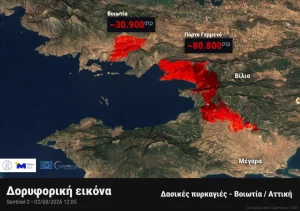
However, authorities said the intensity and speed of the Attica-Boeotia megafire were so extreme that flames managed to overcome an extensive network of firebreaks in several areas, based on an initial comparison of satellite images from the affected region.