 Μake us preferred on Google
It all began with a fisherman’s smile. In 1973, in a studio on Akadimias Street, Athens, Christos Christofis found himself standing in front of a watercolor by N. Nikolaidis. More than half a century later, he continues to recall that encounter with a precision akin to that with which he catalogs the works in his collection. Born on Oinousses, having studied marine engineering in England, Christofis embarked on a career in shipping. He neither inherited a collection nor was brought up in a home filled with paintings. Rather, he learned to look at art through visits to exhibitions, bookshops, and ateliers. Only then did the acquisitions, the acquaintances and friendships, the exhibition curations and ceaseless documentation begin—all focused, above all, on living Greek artists and their work in a conscious decision to trace their artistic evolution as it happened. During our conversation, he does not describe his collection in terms of a list of acquisitions, but speaks instead of the gaze that matures, of the works that only disclose their meaning years down the line, and of the art that finds its place beyond established exhibition spaces. It is there, it seems to me, that the essence of his collection lies—not in the things one comes to possess over time, but in the way in which one learns to perceive art in a broader sense.
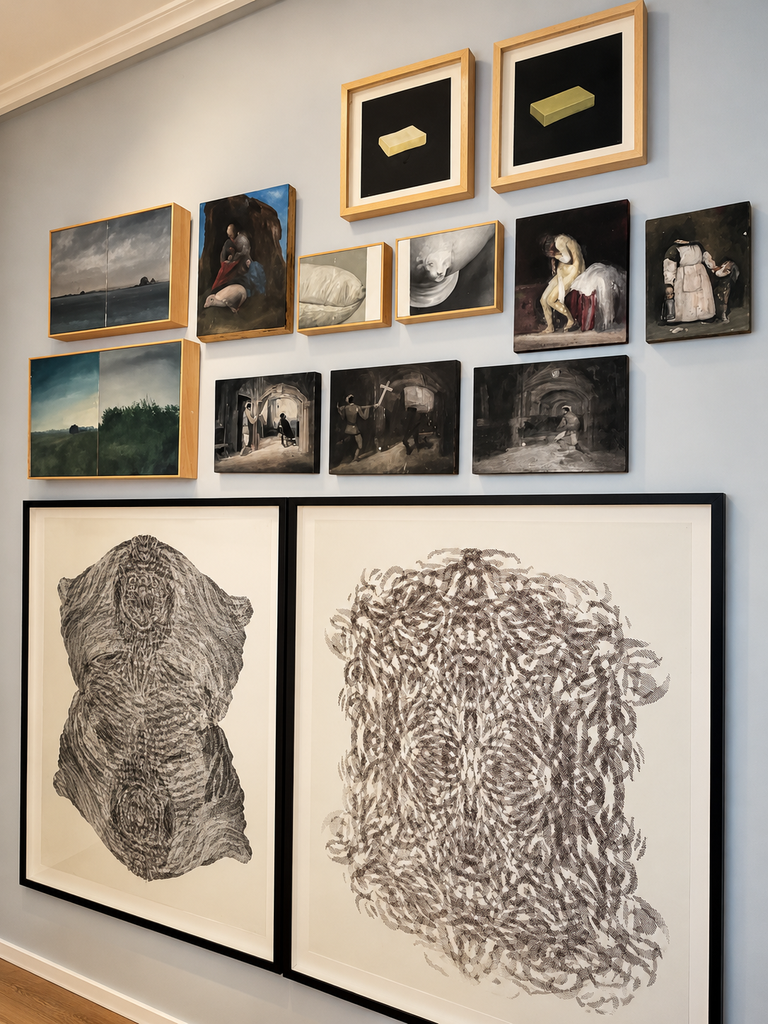
Works by Vasilis Vasilakis, Vangelis Gogas, and Martin Donev, from the collection of Christos Christofis. PANOS KOUGIAS/ TO BHMA INTL EDITION
Professionally, shipping is your sphere of expertise. How did painting enter the picture?
My fascination with painting began during my years as a student in Newcastle, from 1966 to 1971. Whenever I saw an exhibition advertised, I’d go. I’d wander into bookshops, leaf through volumes on art, trying to learn. Later on, business trips gave me the opportunity to visit museums abroad. But it was only in 1979, when I moved back to Greece, that I began to attend shows systematically and read art publications like Zygos. In those early days, I was an art lover, not an art collector.
Do you remember your first ever purchase, in 1973?
Down to the last detail! I wandered by chance into Nikolaidis’s studio, on Akadimias Street. He primarily painted warships—commissions for men in the Greek Navy. But my gaze went straight to a smiling elderly man. It was Barba-Lias, a fisherman from Petries on Euboea. I bought the watercolor for five hundred drachmas. I still have it, and I cherish it. Later on, through talking with painters, I came to understood just how hard it is to portray a smiling face. And I esteemed it all the more after that.
When did this love begin to turn into deliberate collecting?
Round about 1983-84. I’d hardly miss a single exhibition, I was reading everything I could get my hands on, and had started to form a viewpoint of my own. Of course, I couldn’t buy whatever caught my fancy; I had to restrict myself to what my budget allowed. The paintings I collected at that time were predominantly figurative and anthropocentric, mirroring a large part of the Greek art produced in that decade. I documented everything from the start, too: when and where I acquired each piece. And I’ve kept that up till today.
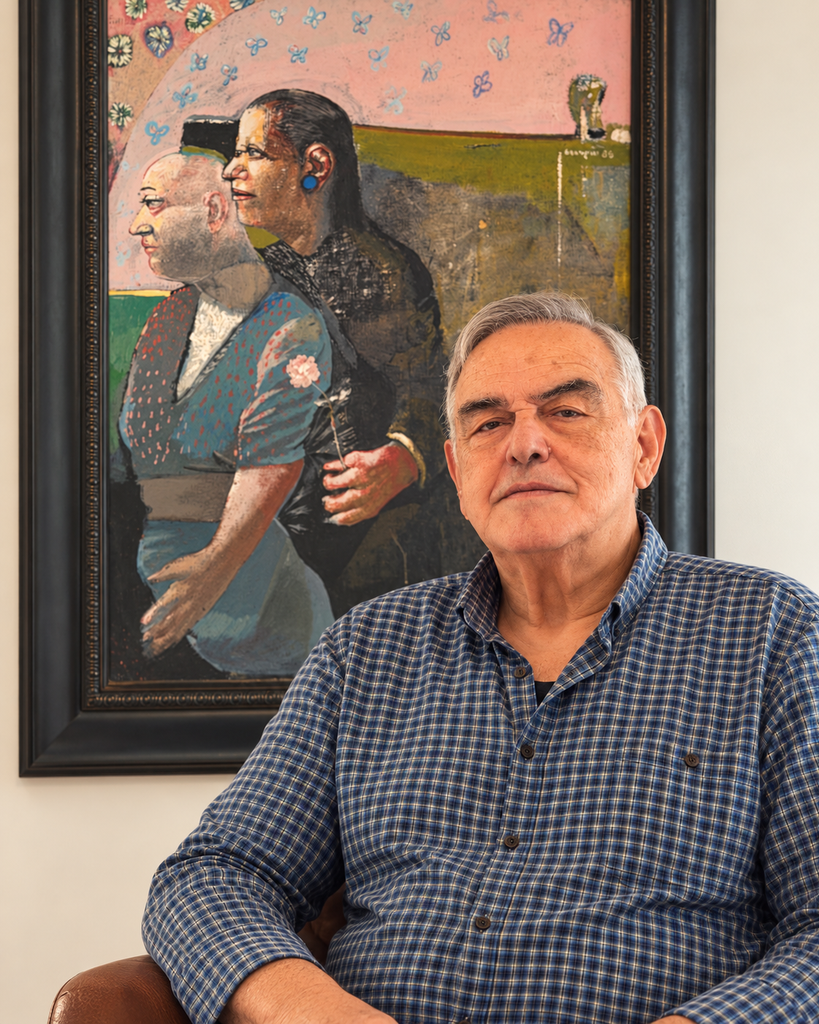
Christos Christofis in front of Bride by Force (1986), oil on canvas, 98 × 75 cm, by Edouardo Sakayan.
Why did you elect to focus your collection exclusively on living Greek artists?
I wanted to grow alongside them. To live my life in parallel with theirs, to follow their careers and their development as artists. It was never a matter of authenticity or how sound an investment a work would be. I was especially interested in the new and in upcoming artists. There is great joy to be had in spotting something in an unknown artist and then, years later, seeing the heights they have scaled. It’s a choice I have never regretted. I also tried, as far as possible, to ensure that each new acquisition entered into a seamless conversation with the collection’s existing works.
What occurs in that moment when you decide a work is of interest to you?
First and foremost, it has to speak to me. Over the years, you accrue experiences and imagery, comparisons. The mind acquires such a wealth of information that you only have to lay eyes on a piece to instantaneously recognize a detail, a kinship, an element that draws you in. If I find myself before ten works by the same painter, it doesn’t take me long to pick out those I prefer.
Your rapport with several painters evolved into friendship. How decisive a factor is that?
I formed a connection with Michalis Madenis just as he was starting out on his career, and I have kept a close eye on his output ever since his first one-man show. Tasos Mantzavinos and I also developed a very close relationship; we would converse and while away the hours together. I am deeply invested in knowing what the artist is creating, and how they are growing. I have stayed close to various individuals for decades—with Manolis Bitsakis, for instance. Still, that doesn’t mean that friendships dictate my acquisitions; the initial encounter with the artwork itself remains paramount.
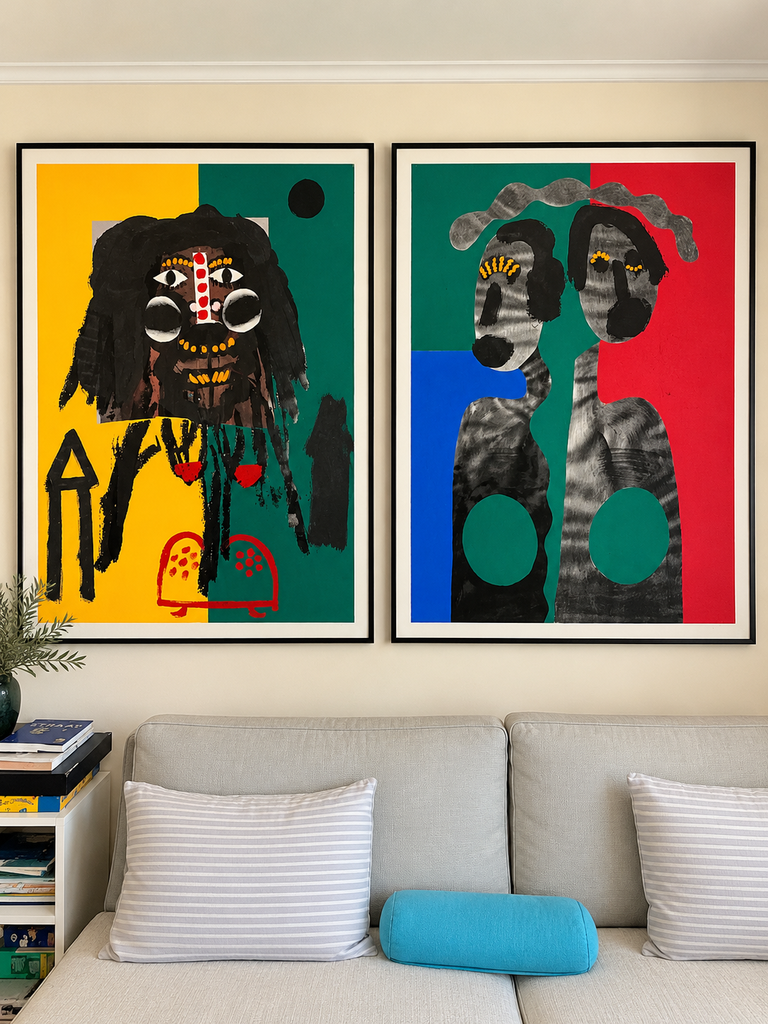
Two works from Giannis Varelas’s triptych Trois Reines, 2021, gouache, charcoal, graphite, acrylic ink, and collage on paper, 150 × 110 cm each. PANOS KOUGIAS/ TO BHMA INTL EDITION
Has there been a specific work that vindicated your choice many years later?
In 2001, I purchased a drawing by the architect Christos Papoulias from a group exhibition. I saw something enigmatic in it, and I have have had it hanging on my wall for twenty-five years. Recently, I was asked if I would loan it out for an exhibition. This was a vindication. It doesn’t matter if it has commercial value or not. I chose it because I liked it.
How did you get involved in curating exhibitions?
I started out rather timidly through my participation in exhibitions and my social interractions with artists. I believe that curation isn’t something that can be taught; it has to be mastered in practice: from the things one observes and selects, and from the idea you want to serve. It’s a lot like writing. You select works, uncover the connections between them, come up with a concept, then put pen to paper. I have revisited my older texts, and there are exhibitions among them which I still enjoy.
You have also shown works in spaces other than conventional galleries. What are you looking for in these alternative venues?
I presented work by ITSMI at the “Kanaria”. Recently, we’ve started something radically simple: I bring a work, we hang it for four or five hours, discuss it, look through catalogs, and then I take it back. In a way, these are one-man one-work shows. I do this with friends and artists. My aim is for the art to provide the impetus for a gathering, rather than being restricted to a formal visit.
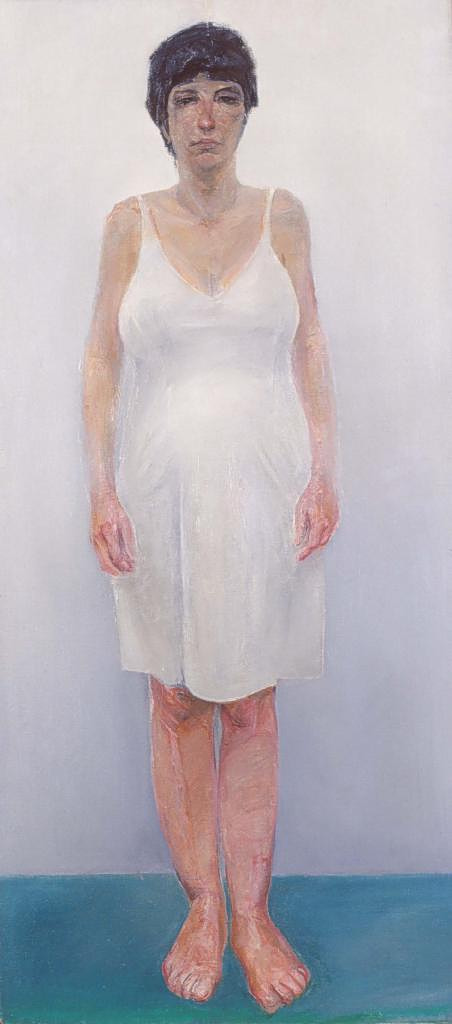
Chronis Botsoglou, The Pregnant Woman, 1981, oil on canvas, 110 × 50 cm. PANOS KOUGIAS/ TO BHMA INTL EDITION
Your collection is accompanied by texts and thorough documentation. What place does the written word hold in your approach?
To my mind, it is part of an indivisible whole. I did not start out buying four or five paintings to decorate my home with. I wanted to study, to understand and to document. I am especially drawn to creators in whose work the image engages intimately with the written word. I hold the writings of Chouliaras in high regard. In drawings by ITSMI, the inscribed phrase is no mere title; it is a fundamental part of the work. This nexus between image and discourse continues to fascinate me.
Has your gaze altered with the passing of so many decades?
Definitely. I don’t drive the painting; the painting drives me. Initially, I was drawn far more to intense, expressionistic works. And while I still like them, I have gradually turned toward a simpler style, sometimes even to forms of abstraction. I am fascinated when something infinitesimal has the power to stop you in your tracks without the need for a narrative or nostalgic allusion.
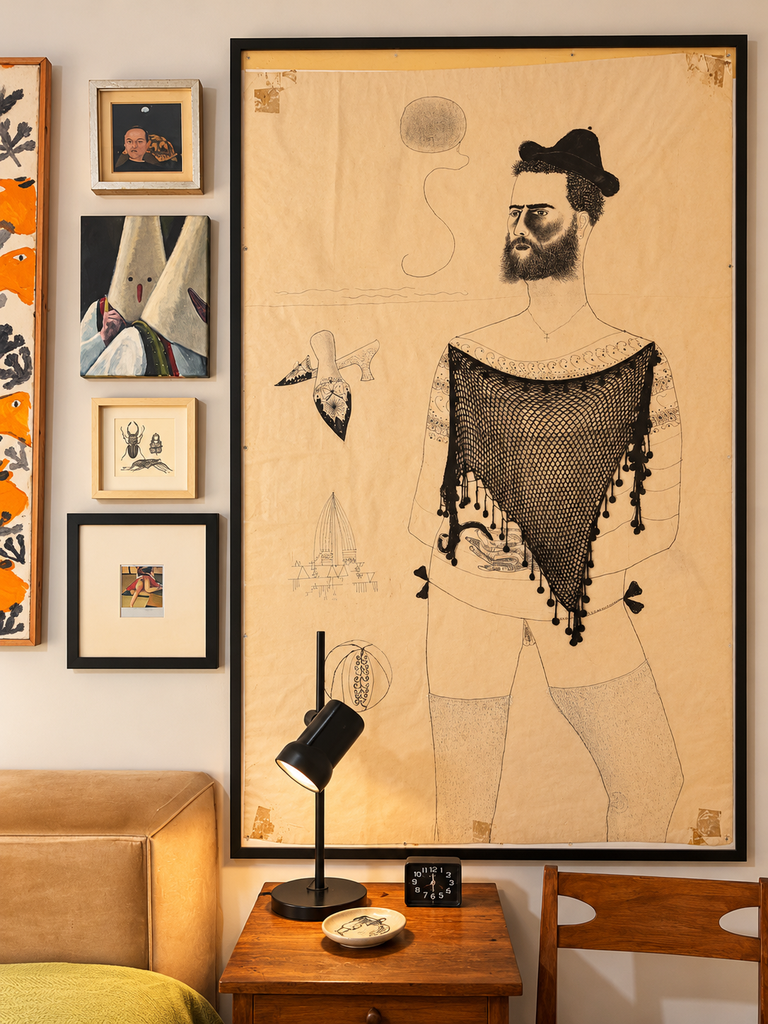
Giannis Varelas, Untitled, 2002–03, charcoal, oil, and collage on paper, 160 × 100 cm. PANOS KOUGIAS/ TO BHMA INTL EDITION
How do you feel about contemporary Greek art and the younger generation of Greek artists?
I believe that they were given a major boost by the artists who ventured abroad, to Germany, Switzerland, Belgium, the Netherlands, and beyond. They were exposed to disparate ways of working, they blazed new trails, and returned with a more international outlook. When people ask me which young artist is going to rise to the top, I reply that no one can be certain. You can have your preferences, but you can never tell where an individual oeuvre or artists is going to end up.