
 Μake us preferred on Google
Ukraine’s General Staff said on Monday that Russian forces took advantage of last week’s humanitarian ceasefire in the Russian-occupied southern town of Oleshky to strengthen their military positions.
The six-day truce, brokered through US first lady Melania Trump with the involvement of Pope Leo, was intended to allow aid deliveries and civilian evacuations from the frontline town. Melania Trump said on X that close to 800 people were evacuated in total.
THE CEASEFIRE CONCLUDES
The mission was a success, delivering critical aid to the region and enabling the evacuation of nearly 800 people.On behalf of America, I commend Russia and Ukraine for their leadership and cooperation surrounding the Oleshky ceasefire. I hope Oleshky serves as a foundation for lasting peace between both nations.
The ceasefire began on October 27, 2026, and concluded on November 1, 2026, as planned.
— First Lady Melania Trump (@FLOTUS) November 1, 2026
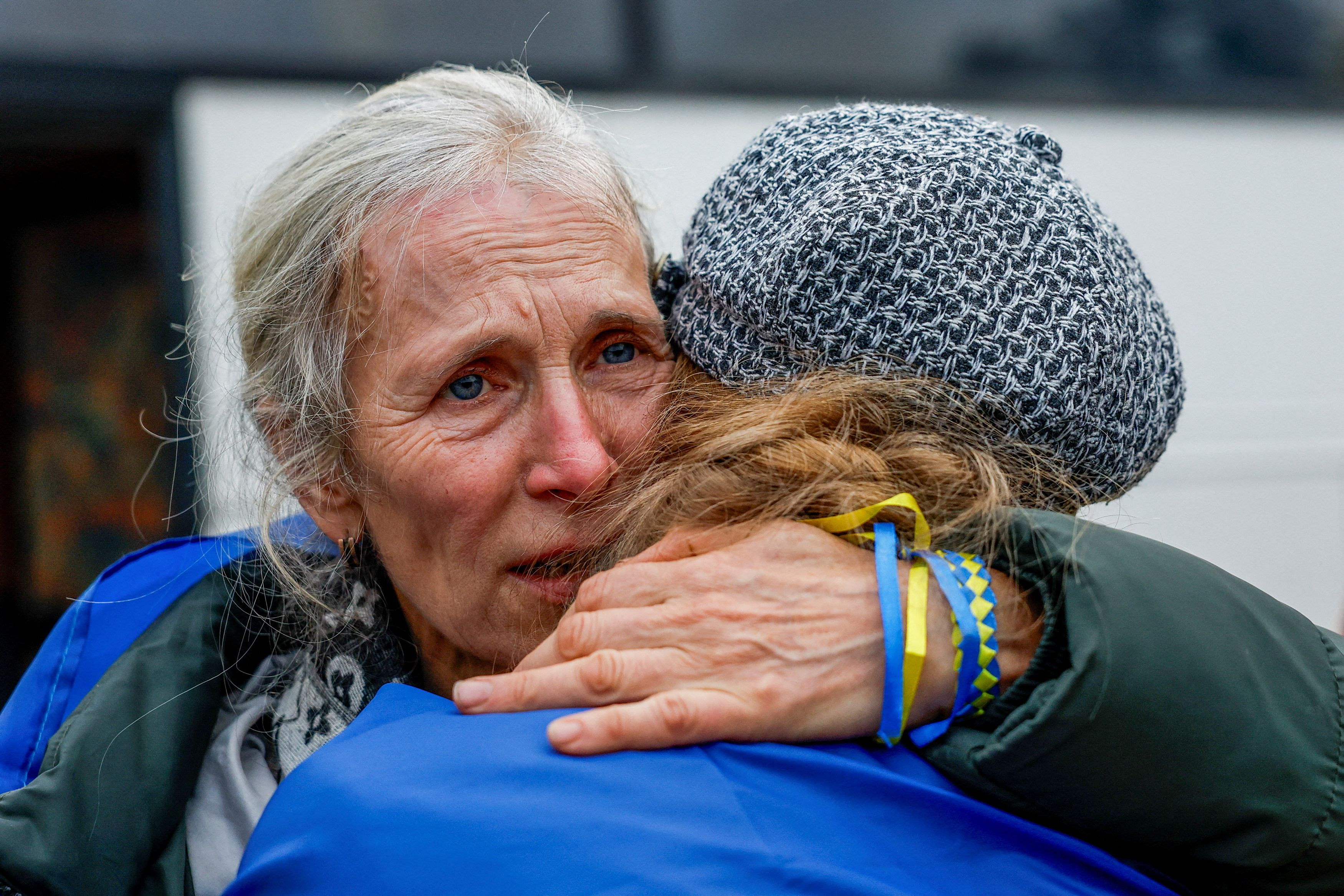
Larysa, a resident evacuated during a humanitarian mission from the Russian-occupied town of Oleshky, embraces her daughter Anna, who was waiting for her return to Ukrainian-controlled territory, amid Russia’s attack on Ukraine, at an undisclosed location October 31, 2026. REUTERS/Valentyn Ogirenko
According to the General Staff, however, Russian units were rotated, positions were fortified, anti-drone measures along roads were expanded, and logistics activity increased, including ammunition deliveries. In a statement on X, the General Staff said Ukrainian forces had respected the ceasefire and stayed strictly within the agreed terms, while the enemy used the pause to improve its positions.
Oleshky: the Defence Forces of Ukraine ensured the ceasefire in Kherson Oblast
Under the ceasefire introduced for the humanitarian operation in Oleshky, units of the Defence Forces of Ukraine ensured that the ceasefire was observed and acted exclusively within the framework of the agreements reached.
As a result, humanitarian cargo was delivered to its destination, and Ukrainian men and women who wished to leave Oleshky have returned to Ukrainian-controlled territory.
The enemy, by contrast, used the humanitarian pause to improve its positions. During the ceasefire, the rotation of russian units, the fortification of positions, the expansion of anti-drone measures along roads and increased logistics activity, including the delivery of ammunition, were recorded.
— Генеральний штаб ЗСУ (@GeneralStaffUA) November 2, 2026
Ukraine’s 34th Separate Marine Brigade “Borysfen” urged residents of the Kherson region in a Facebook video not to ignore air raid sirens, warning that Russia had used the ceasefire to build up its capabilities and that there was reason to expect fighting to intensify.
The ceasefire took effect on October 27 and ended at 2100 GMT on Sunday. It was the longest local pause in fighting since Russia launched its full-scale invasion in 2022.
On Monday, Yaroslav Shanko, head of the Kherson City Military Administration, reported a drone strike in the city center. Kherson sits on the west bank of the Dnipro River in Ukrainian-held territory, across from Oleshky. No casualties were reported. Regional governor Oleksandr Prokudin said on Telegram that Russian forces had attacked 16 settlements in Ukrainian-controlled parts of the region, including Kherson city, with shelling, drones and aircraft in the 24 hours to 0400 GMT on Monday.
Ukraine’s human rights ombudsman, Dmytro Lubinets, offered a different assessment on Sunday, saying on Telegram that both sides had kept their commitments for the duration of the truce.
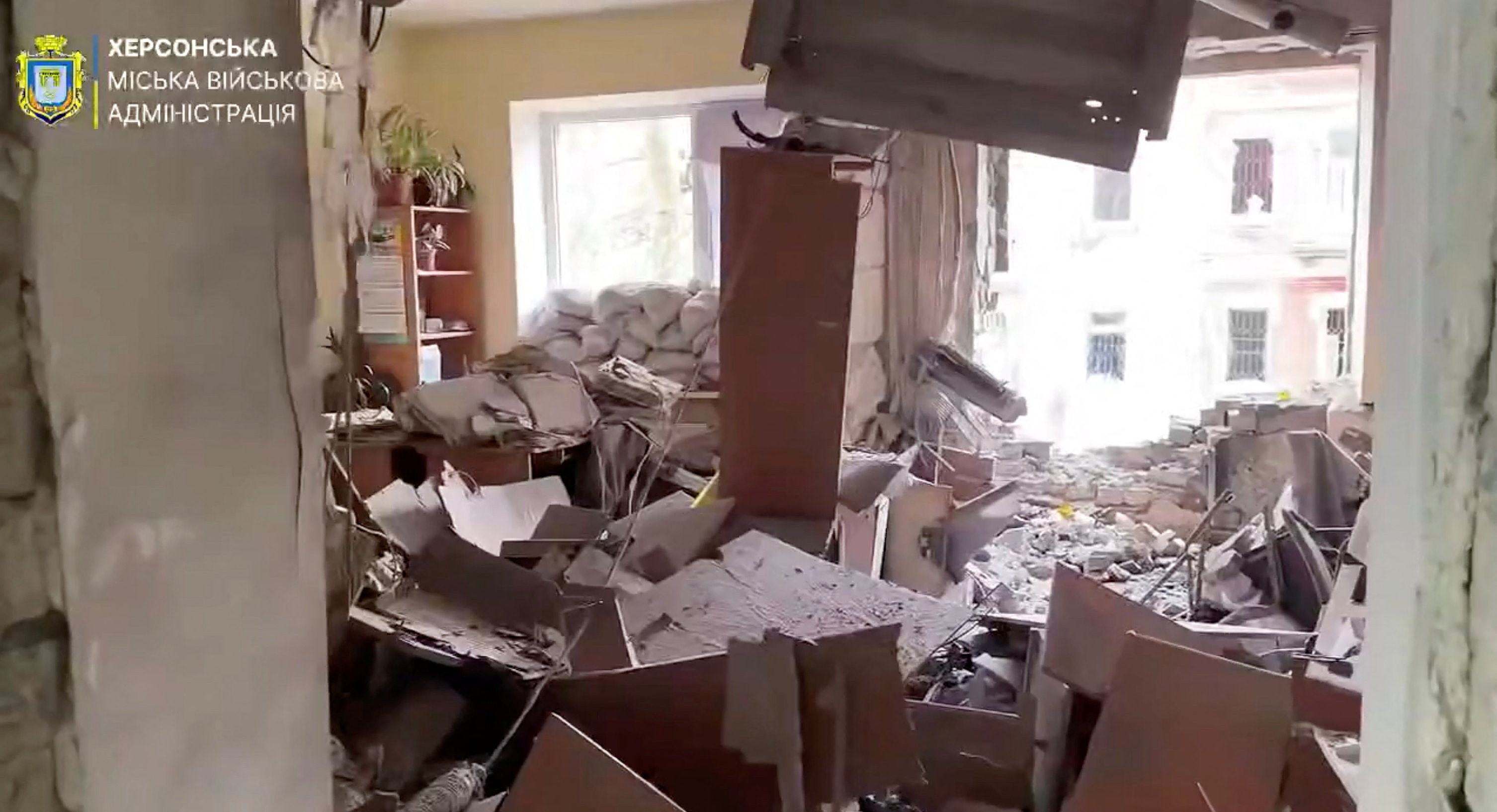
Debris, broken furniture and ceiling fragments lie inside a building in this screengrab from a handout video released on November 2, 2026, in central Kherson, Ukraine, after what the Kherson City Military Administration says was a Russian drone strike on a medical facility. Kherson City Military Administration/Handout via REUTERS
A rare window into the kill zone
The pause also gave Ukrainian officials, police, the Ukrainian Red Cross Society and volunteers a short opportunity to reach civilians on their side of the river, some of whom had been cut off for nearly two years.
In Kozatske, a riverside village less than 2 kilometers (1.2 miles) from Russian-held territory, only a handful of residents remain. One of them, 53-year-old Nataliia Diadiuk, has relied on a white towel hung on her gate and a white rag in her hand to signal to Russian drone operators that she is a civilian.
Her daily life has been reduced to survival. She drinks rainwater that she filters through gauze, treats with chlorine and boils. She gathers firewood for heat, charges her phone with solar panels and checks it mainly to know what day it is. Until the ceasefire, no humanitarian aid had reached her in two years. Mines scattered by drones lie throughout the village, and many homes are burned-out shells. Diadiuk refused to evacuate, saying in part that she could not abandon the dogs left behind in the empty houses.
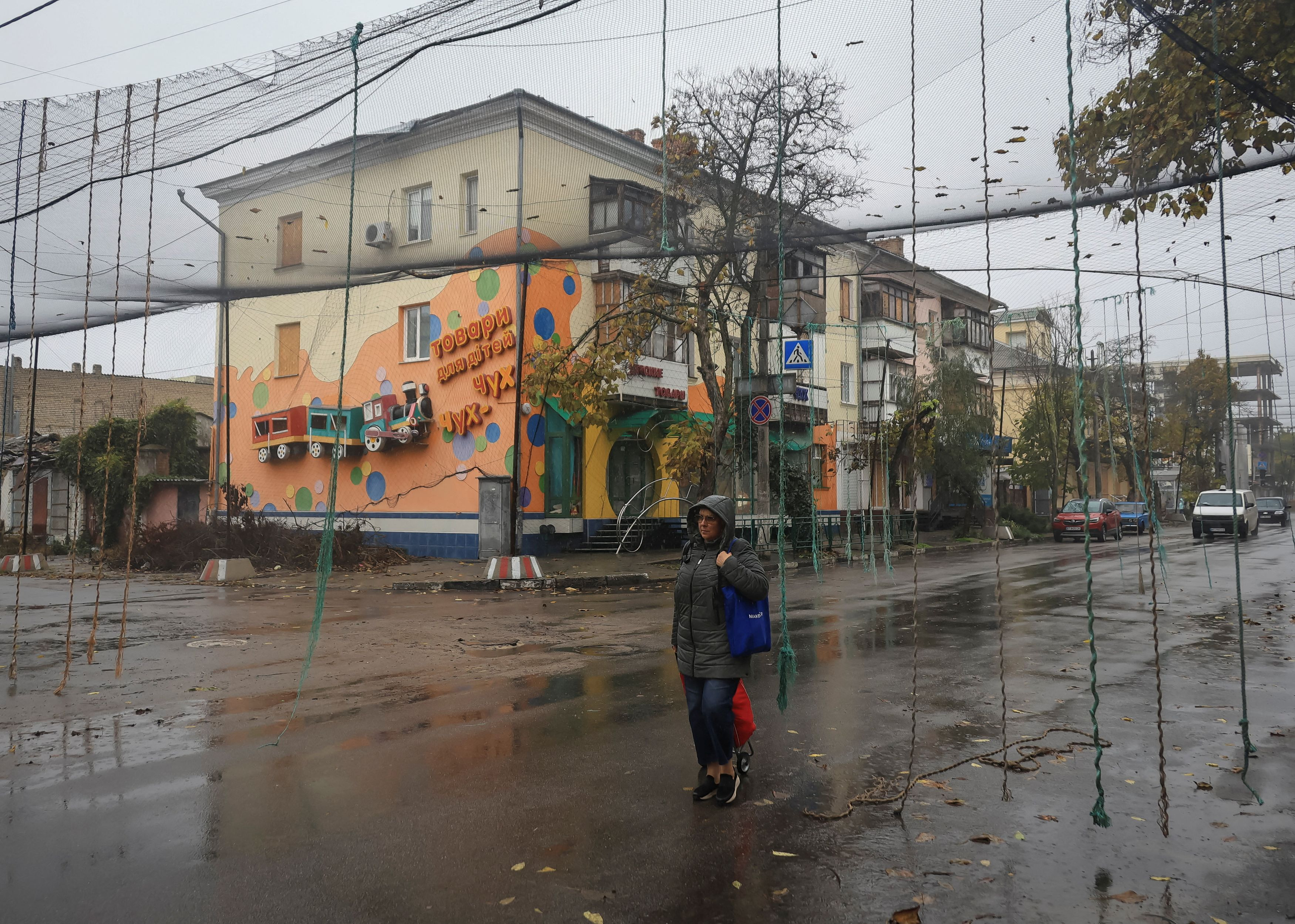
A woman walks on a street covered with an anti-drone net, amid Russia’s attack on Ukraine, in the frontline city of Kherson, Ukraine October 30, 2026. REUTERS/Nina Liashonok
“I really want silence,” she said, holding back tears.
Neighbor Oleksii Shavokin, 54, also chose to stay. His house burned after a mortar attack in early 2023, but he repaired it and lives on old aid supplies and eggs from his hens. He now eats once a day and has lost about 30 kilograms (66 pounds). Many people he knew were killed or have left. He said danger can find a person anywhere, but added that he hopes the war ends soon.
Why many refuse to leave
Oleh Tarabaka, head of the Nova Kakhovka city military administration, who helped try to persuade residents to leave, said many fear having nothing to live on elsewhere, and some have no relatives to turn to. He said the evacuations would simply not have been possible without the period of quiet, because teams could not have driven into the area.
Some did agree to go. Yevhen and his mother, Antonina, who withheld their last names for security reasons, accepted evacuation after soldiers from the 42nd Marine Brigade urged Yevhen to make the decision. Antonina cried the whole way out of her bombed-out town.
The Kherson regional administration said 180 people, including 23 children, were evacuated from riverside communities and Kherson city during the truce. About 140,000 people remain in the Ukrainian-held part of the region, which had around 1 million residents before the war and is now nearly 70% under Russian control.
In Kherson city, the Red Cross rapid response team, which normally evacuates about 10 people a week, took out 32 during the ceasefire. Its commander, Mykola Taranenko, said parts of the city are themselves a kill zone where the risk of moving is extremely high.
Among those evacuated were Volodymyr and Kateryna Yakuba, both 77, who divorced more than two decades ago but left together to stay with their daughter in Odesa. Kateryna said she did not know how they would have gotten out without the pause, and that leaving home was frightening because they could not know whether anything would be left to come back to.
With the ceasefire over, residents who stayed behind once again face drones, artillery, glide bombs and air-dropped mines.