 Μake us preferred on Google
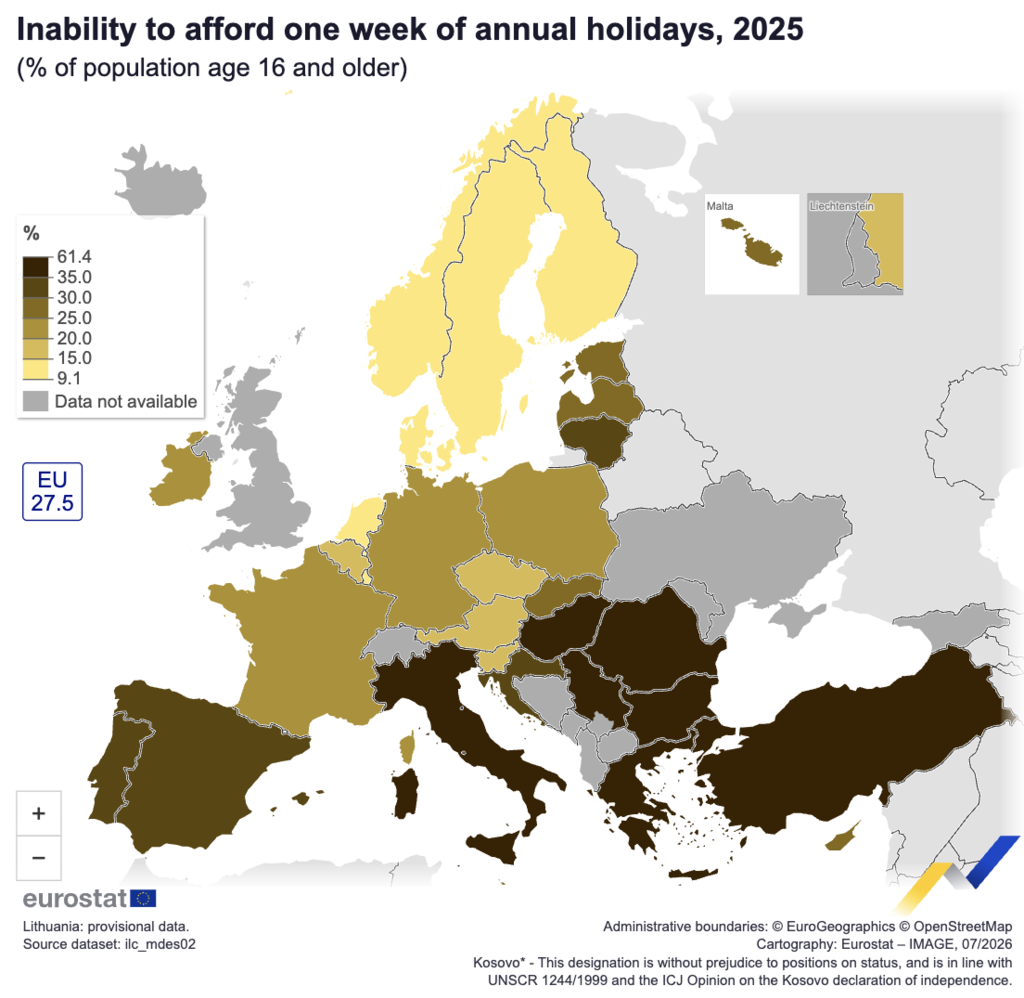
 Financial pressure is making it increasingly difficult for Europeans to go on a weeklong holiday with nearly three in 10, or 27.5% of the EU population admitting that they cannot afford to do so, according to the latest data released by Eurostat.
In Greece, 46.6% said they were unable to pay for a weeklong vacation. Greece ranks second to last among EU countries and only above Romania, where 61.4% said they can’t afford a vacation.
The Eurostat findings are backed up by national data. A recent ELSTAT survey found that nearly six in 10 Greeks do not travel primarily because of financial constraints, while health reasons ranked a distant second at 20.8%.
Separately, an Alco opinion poll, found that rising living costs continue to weigh heavily on Greek households. Nearly half (47%) of respondents said their financial situation had worsened over the past year, while a similar proportion said they would not go on a summer vacation at all this year.
The figures reflect the continuing impact of inflation and higher cost of living across the European Union. Indicatively, the share of EU residents unable to afford a one-week holiday rose by 0.5 percentage points compared with 2024 and is 7.7 percentage points higher than a decade ago.
At the other end of the scale, Luxembourg recorded the lowest proportion of residents unable to afford a weeklong holiday (10.6%), followed by Sweden (12.4%), and the Netherlands (12.8%).