 Μake us preferred on Google
 After an extended road trip across Iceland, one thing stood out: it was surprisingly easy to encounter Greeks.
In fishing villages, cities, restaurants and even at the airport, Greek workers have become a familiar presence across the country.
An estimated 1,100 Greeks work in Iceland during the summer, mainly in seasonal jobs in bars, restaurants and other tourism-related businesses. During the winter, their number falls to around 400 to 500.
Their reasons for coming vary. Some are looking for the experience of living and working abroad, while others are seeking greater stability and financial security. For many, however, Iceland also presents challenges, including high living costs and limited opportunities to work in the professions they studied.
Life in a small Icelandic fishing village
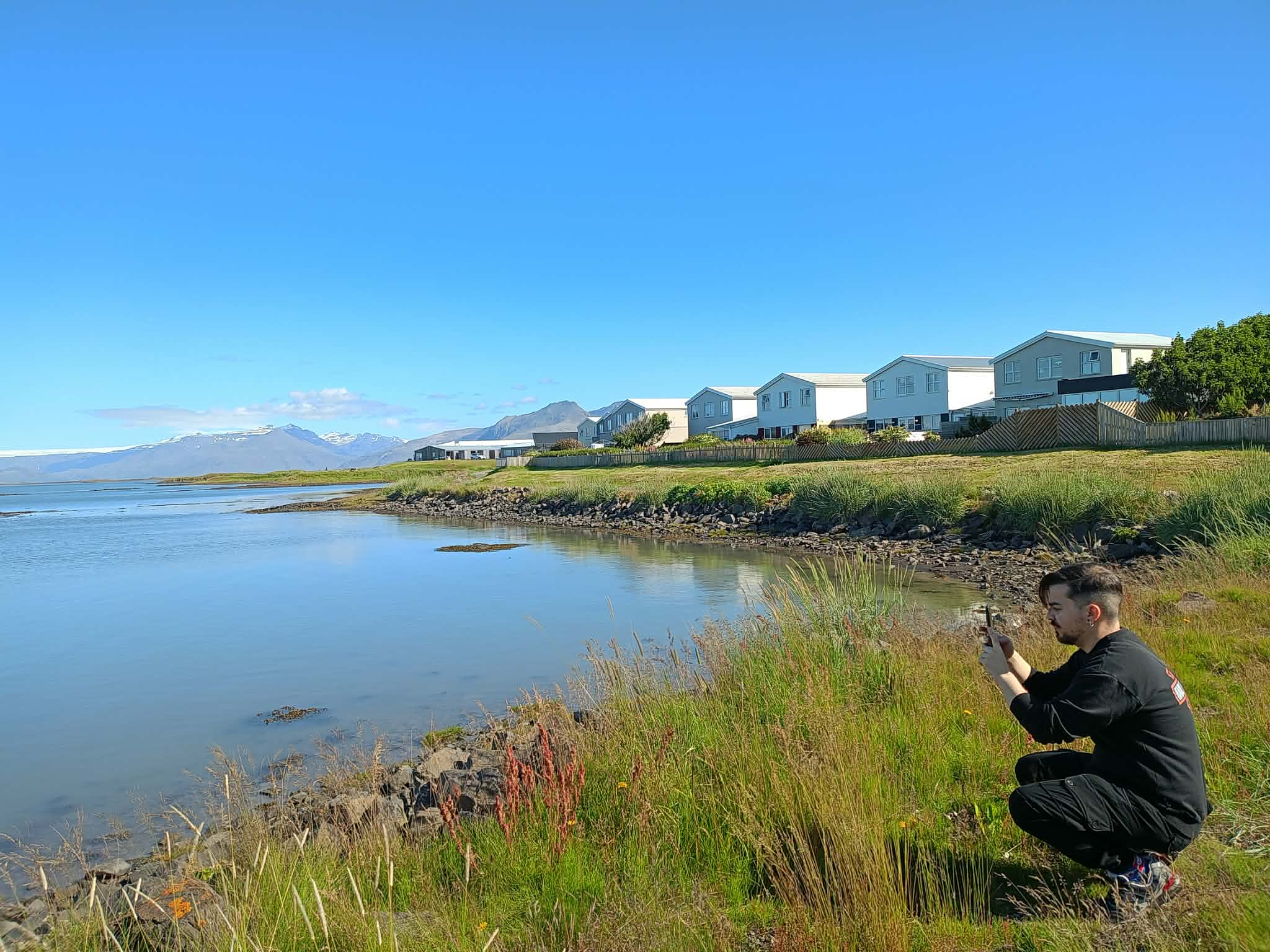
The first encounter came in Hofn, a small fishing village in southeastern Iceland, after a day spent visiting waterfalls, glaciers and black-sand beaches.
At dinner, the waitress taking the order turned out to be 26-year-old Katerina Karaiskou, who had arrived in Iceland in June 2025.

26 year old Katerina Karaiskou, works in a tavern in Hofn, a small fish island in the northeastern part of the island
“I always wanted to see what life and work abroad were like. I also wanted stability and financial security,” she said.
Iceland became an option through a friend of her boyfriend who had previously traveled to the country for work. After hearing about the opportunities, the couple decided to give it a try.
Finding a job, however, was not easy.
“It requires a lot of patience and persistence. After months of trying and sending many emails, we received the long-awaited response,” Karaiskou said.
Most immigrants in Iceland work primarily in tourism. The country’s tourism industry experienced a major expansion from 2022, when Iceland increasingly became a tourist destination and businesses needed workers for its growing tourism infrastructure.
Karaiskou said her own experience had been positive. She was given the opportunity to work at the restaurant despite having no previous experience in food service.
“The environment is healthy, there is respect and politeness, education. You have your rights, breaks for rest and food, free meals and enough days off. The financial compensation is very high,” she said.
Life in Hofn can nevertheless be quiet.
“It is a small place and there aren’t many new things to do, so it can become boring,” she said.
At the same time, she sees the quiet surroundings and free time as an opportunity. Residents can spend time outdoors, particularly during the summer, take up sports, go for walks or learn Icelandic.
“You are given the time, and therefore the opportunity, to do things for yourself. That way you calm down, mature and develop,” she said.
A Greek couple in Hofn
At the table next to the visitors, a group of Greeks had gathered for a beer on their day off.
Among them was 27-year-old Stelios-Athanasios Trimis, Karaiskou’s boyfriend.
Trimis currently works at a local tavern. He previously worked at a gas station but had much less free time.
“I believe that personal time is more valuable than money,” he said.
The supermarket, he said, is the most expensive part of living in Iceland.
But prices can depend considerably on what consumers buy. Even a basic meal such as pasta with tomato sauce can, despite Iceland’s reputation for high prices, cost roughly the same as in Greece, he said.
Working conditions are another important difference.
“In most cases, the employee works without shouting and without stress. Employers respect your rights. Generally, they like there to be no tension,” Trimis said.
The couple plan to remain in Iceland for several years while taking vacations in Greece.
Karaiskou encourages people considering moving abroad to take the opportunity.
“I wanted to tell those who are thinking about going abroad to take the chance. Otherwise, the thought ‘what would have happened if…’ will always trouble them,” she said.
“There are, of course, always difficulties, but from my personal experience, it is worth it.”
Greeks behind the counter in Husavik
The second stop was Husavik, another Icelandic fishing village.
After three hours of whale watching in the open sea, the visitors were told about a shop on the waterfront known for having some of the best fish and chips in the area.
They headed there and ordered their meals and beers in fluent English from two women behind the counter.
The women turned out to be Greeks named Kleio and Margarita.
Souvlaki finds an audience in Akureyri
The third stop was Akureyri, Iceland’s fourth-largest city.
There, in a central location, a food truck decorated with an image of the Parthenon and the Icelandic flag carries the slogan “Icelandic meat the Greek way.”
The business is owned by George Charakopoulos and his 23-year-old son, Alexandros.
The food truck first began operating in the summer of 2025.
Alongside its permanent location in Akureyri, it travels to festivals around Iceland. In December, the owners are preparing to take part in a major Christmas festival in Reykjavik.
Their souvlaki is made by the owners themselves using locally sourced ingredients, and it has proved popular with Icelanders.
“We are the first in the city to do something Greek,” Alexandros said.
“They have loved it, they keep coming back. We have received a lot of very positive feedback.”
The popularity was also evident to the visitors, who noted the positive reviews on Google.
A different view from Reykjavik
The fourth stop was Reykjavik, where the experience of Greeks living in Iceland appeared more complicated.
Nikos Skoulidas, a film director by profession, has lived in the Icelandic capital for almost five years. Despite his professional background, he works in food service at a hotel.
Skoulidas moved to Iceland after previously living in Germany. He believed Iceland would be more open-minded and that people would give him an opportunity to work.
“It turned out that it is not exactly like that,” he said.
The conversation turned to the young Greeks who travel to Iceland for seasonal work.
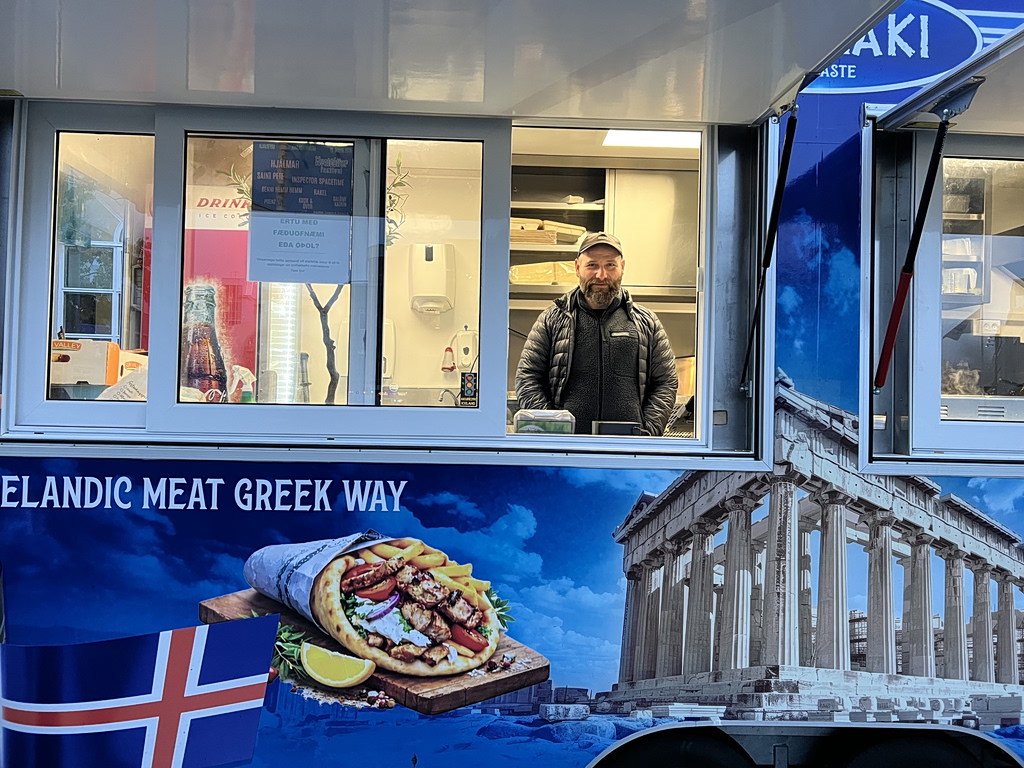
A canteen painted with the image of the Parthenon and the Flag of Iceland with the signature of “Icelandic meat the Greek way”. Owner George Charakopoulos with this 23 year old son Alexandros.
According to Skoulidas, about 80% are university graduates.
“They are graduates of some university. But here they don’t do what they studied, and the worst thing is that they are not even given the opportunity to do so,” he said.
The relatively high wages in Iceland are also not the whole story, he argued.
“The money they get here, let’s say, is three times what they would get in Greece. But the cost of living is 3.5 times higher,” he said.
Seasonal workers manage to make ends meet by sharing accommodation with others, going out less often and doing very little shopping.
For the 15 to 16 days they typically work each month, they often eat at the restaurant or bar where they are employed.
Skoulidas also questioned Iceland’s reputation as a highly organized and meritocratic society.
He described Iceland as “very overrated” when it comes to organization, arguing that there is little evaluation or meritocracy.
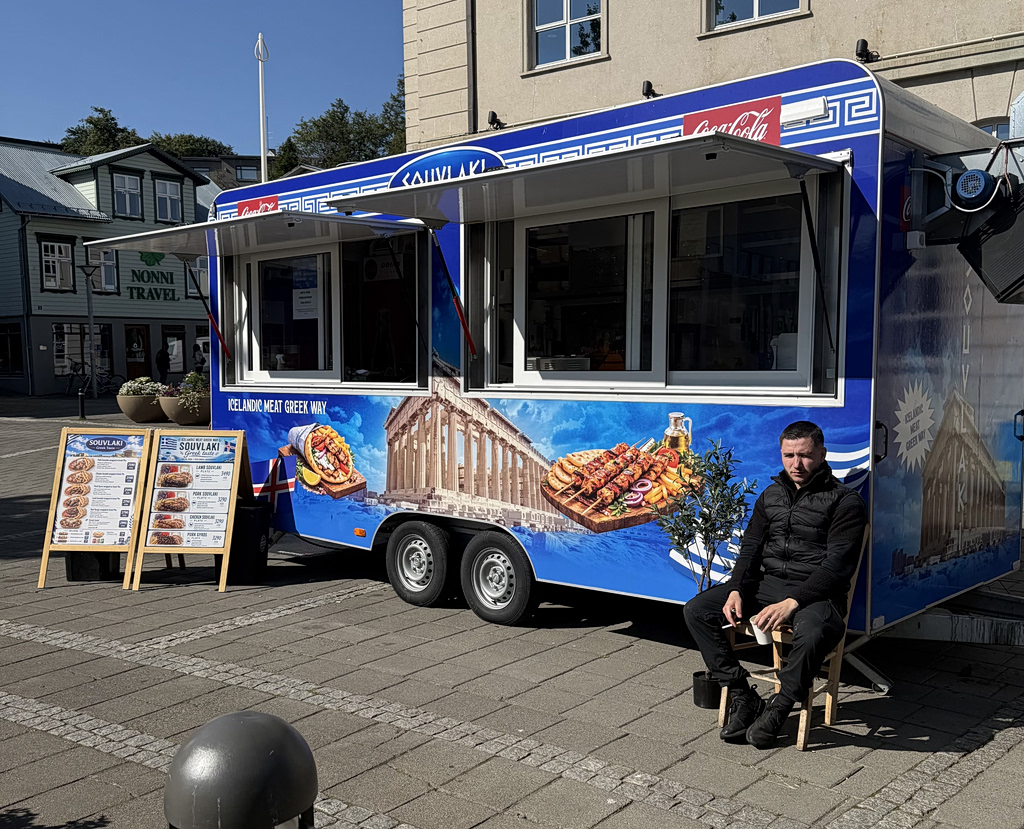
A canteen painted with the image of the Parthenon and the Flag of Iceland with the signature of “Icelandic meat the Greek way”. Owner George Charakopoulos with this 23 year olkd son Alexandros.
“There is no evaluation nor meritocracy, they don’t know what organization means,” he said.
He also said that workplace pressure can simply take a different form than in Greece.
“There may not be the brutal boss like in Greece who will tell you ‘work,’ but here they will do it indirectly,” he said.
Pay raises, he added, can be difficult to obtain, sometimes taking as long as 10 years.
He also dismissed what he described as a myth that Icelandic companies commonly operate on four-day workweeks.
“There is no such thing,” he said.
Despite his criticisms, Skoulidas said the Greek community in Iceland has become active again over the past two years and is doing good work.
A Greek welcome at Keflavik Airport
The final encounter came at Keflavik Airport, Iceland’s main international airport.
At the gate, a young ground staff member bid the travelers farewell in fluent Greek.
From remote fishing villages to the country’s largest city and its airport, the encounters offered a glimpse of a Greek community that has become increasingly visible across Iceland — particularly alongside the country’s tourism economy.
For some, the island offers a chance to earn more, slow down and gain personal time. For others, the experience exposes the gap between high wages and high living costs, as well as the difficulty of turning academic qualifications into professional opportunities.
But across the country, from Hofn and Husavik to Akureyri, Reykjavik and Keflavik, Greeks have established a presence that makes them unexpectedly easy to find in one of Europe’s most distant northern destinations.