 Μake us preferred on Google
 The systematic cleaning and conservation of the marble covering Athens’ Panathenaic Stadium has attracted international media attention, as the Hellenic Olympic Committee (HOC) undertakes what it describes as the first such organized intervention in about 120 years.
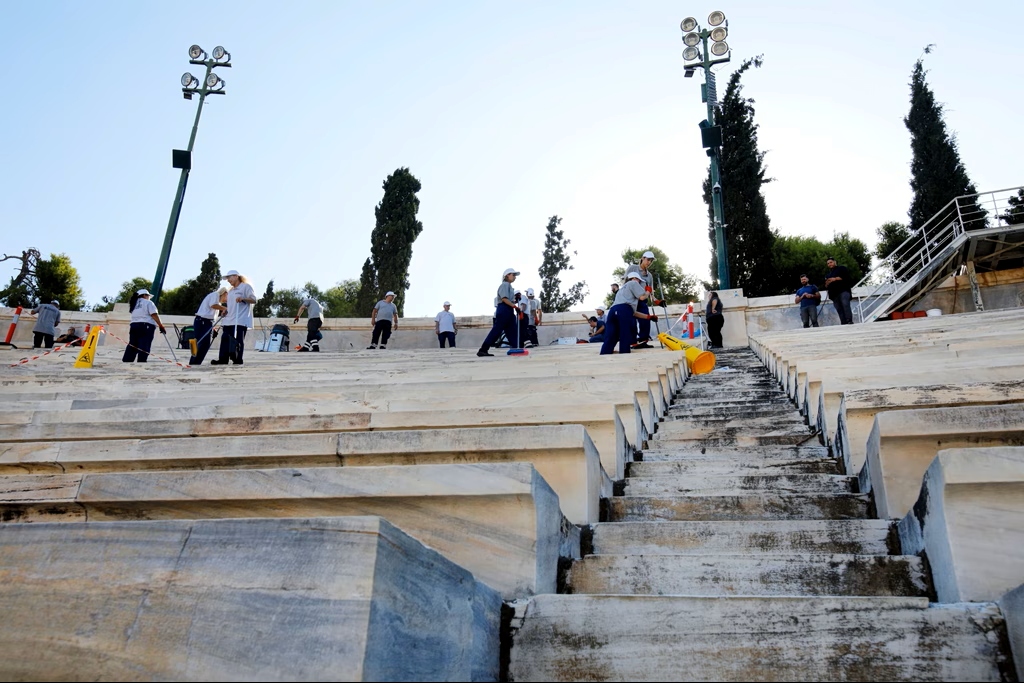
The work began at the stadium’s curved end, known as the sphendone, and is expected to be completed there by Sept. 10, when the Kallimarmaro, as the venue is known in Greece, is due to host the lighting and handover ceremony of the Olympic flame for the Dakar 2026 Youth Olympic Games. Cleaning will then continue across the rest of the U-shaped stadium, with the entire project expected to be completed by the end of 2026.
The initiative is being carried out by the HOC with financial support from Capital Maritime & Trading Corp., the shipping company affiliated with Evangelos Marinakis. The sponsorship forms part of a wider renovation program at the stadium that also includes replacement of the athletics track, installation of new LED lighting and upgrades to electromechanical equipment.

HOC President Isidoros Kouvelos.
HOC President Isidoros Kouvelos told the Associated Press this week that the organization had assumed responsibility for the historic intervention to restore the all-marble stadium’s brightness while preserving its character. He said the project was selected as a priority because of the stadium’s importance to the Olympic movement and Greece’s sporting heritage.
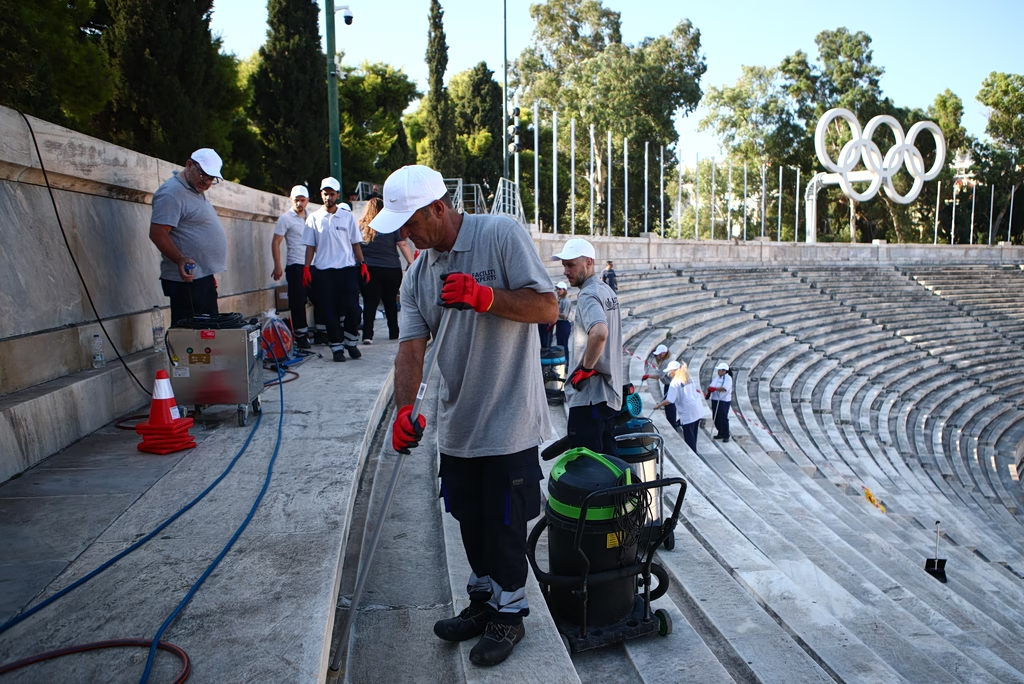
The cleaning method was chosen after other options, including laser technology, were considered. The selected approach uses clean water applied through specialized equipment at a controlled low pressure, a method intended to remove surface dirt without altering or damaging the Pentelic marble or stripping away its accumulated patina. Architect and academic Manolis Korres has advised on this conservation approach.
The stadium’s marble is Pentelic, the same type of marble used for the Parthenon, and named for Mount Penteli, overlooking Athens from the north, where it was quarried. According to the HOC, the marble had not previously undergone comparable systematic cleaning since the stadium was reconstructed for the first modern Olympic Games in 1896.
The marble work forms part of a broader modernization effort launched this year. The athletics track is being replaced with a new surface intended to meet World Athletics requirements for elite competitions, while a new lighting system is planned to improve conditions for athletes, spectators and television broadcasts. The HOC has said the upgrades are intended to enable the stadium to host international athletics at Diamond League level.
The project follows a sponsorship agreement announced in December 2025 under which Capital Maritime & Trading Corp. undertook to fund the stadium’s comprehensive renovation. The plan was presented as an effort to return the venue to a role as a major international athletics site while preserving its status as one of Athens’ most prominent historic monuments.
The Panathenaic Stadium or Kallimarmaro, which means “beautifully marbled” in Greek, is the only major stadium built entirely of marble. Its modern reconstruction was completed for the 1896 Games, and the venue later served as the finish line of the marathon at the 2004 Athens Olympics. It remains a central site for Olympic ceremonies, including events associated with the transfer of the Olympic flame.
The first visible results of the marble cleaning are expected during the Sept. 10 ceremony, which will be attended by International Olympic Committee (IOC) President Kirsty Coventry.
The HOC has presented the project as both a conservation effort and an attempt to ensure that the Kallimarmaro can continue to serve as a functioning sporting venue while retaining its historic character.