 Μake us preferred on Google
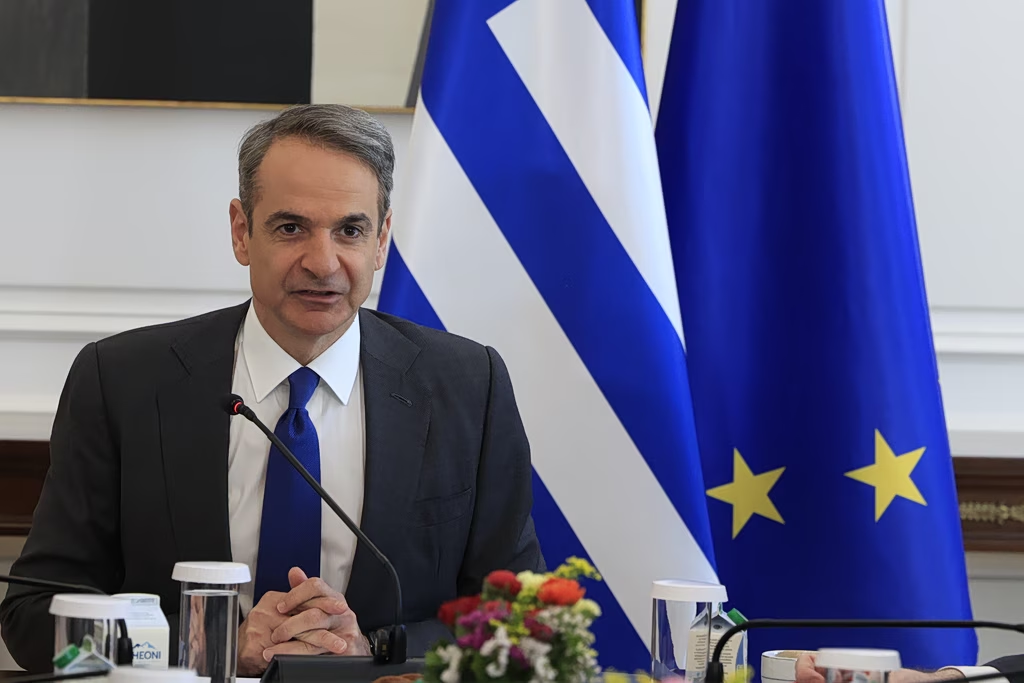
 Greece’s economic policy team is racing to finalize a package of measures that Prime Minister Kyriakos Mitsotakis will announce in early September at the Thessaloniki International Fair (TIF), the annual trade exhibition where Greek prime ministers traditionally lay out their economic agenda for the year ahead. This year marks the 90th edition of the fair, and the measures unveiled there are expected to form the centerpiece of the government’s pitch to voters ahead of national elections, whenever they are called.
According to information reported exclusively by To Vima, the focus of this year’s package will fall on small and medium-sized businesses and the self-employed, rather than on salaried employees and pensioners. Whether the government will press ahead with a tax cut for property owners who collect annual rental income of up to 12,000 euros remains an open question.
In terms of timing a senior official at the Ministry of National Economy and Finance said an initial review of the package will take place in late July. The measures will then be finalized in early August and handed in full to the prime minister by the end of the month, leaving him to make the final decisions. Each measure will be costed and will carry a key footnote: how many people it affects and over what time frame it would apply.
Mitsotakis is not looking to pick fights with any voter group at this stage. That is why, he will steer clear of the hundreds of tax breaks currently implemented, which cost the state budget 22.8 billion euros a year. The official acknowledged, though, that sooner or later the next government will have to touch this political hot potato and go through the hundreds of tax exemptions and decide which ones are still worth keeping.
The self-employed question
The central debate, already underway and set to intensify, concerns the taxation of the self-employed, specifically the system of presumed minimum income that requires them to declare a baseline level of profit each year regardless of actual earnings.
The government is well aware that the self-employed are a powerful constituency whose votes are swayed by tax policy. Polls show New Democracy, the governing center-right party, has been losing ground with over the pomicy of presumed minimum income, which in many cases can double or even triple the tax they would otherwise pay.
Two camps have emerged within the government on how to tackle this. One favors a sweeping overhaul of the presumed income rules to ease the burden across the board. The other prefers narrower, bureaucratic fixes to correct distortions without scrapping the system, preserving roughly 400 million euros a year in additional state revenue. According to the same official, full abolition is not expected, but a redesign of the system is needed, and all scenarios are being studied, both those that would ease the burden on specific categories at no fiscal cost and those that would deliver real relief.
Officials are also weighing the gradual elimination of the 1,000-euro annual business levy, known as the trade fee, and a reduction in the advance tax paid by businesses and professionals. The advance payment for self-employed individuals could fall to 40 percent or lower, from 55 percent, while for legal entities it could drop below 60 percent from the current 80 percent. The 100 percent advance tax levied on banks is not expected to change.
No giveaway spree
At a recent online meeting with ruling-party lawmakers, Finance Minister Kyriakos Pierrakakis came under pressure for a giveaway spree. Ruling party lawmakers have been actively lobbying the head of the Eurogroup to bring back the 13th pension and 13th salary for civil servants, both of which were scrapped during Greece’s debt crisis.
The government has moved to shut that down. Deputy Minister Dimitris Markopoulos said the next package would take a holistic approach across social and professional groups and that there was no possibility to return to the former status quo. According to information, the prime minister’s office, specifically asked Markopoulos to make the aforementioned statement in order to shut down any speculation by government lawmakers, who have been telling voters back in their districts that Mitsotakis is ready to spend big at the fair. Markopoulos ruled out such a move on cost grounds. A 13th pension would run about 2.5 billion euros a year and a 13th salary for civil servants about 1.5 billion, some 4 billion euros all told. Last year’s fair package, by comparison, came to 1.76 billion euros. Pensioners may not receive a full 13th pension, but the government is considering doubling the annual support payment of 300 euros, paid each November, to as much as 600 euros without a major fiscal hit.
So far, Pierrakakis has secured about 1.2 billion euros for the package. More optimistic estimates put the figure as high as 1.8 billion or even 2 billion euros.