
 Μake us preferred on Google
 Maricarmen Abascal was carried out of her apartment in Madrid’s Ibiza district on a stretcher last week, past riot police who fired teargas at the neighbors and activists who had gathered in an attempt to stop her eviction. The 87-year-old woman, who has a disability and uses a wheelchair, had lived in the flat for seven decades before the investment fund Urbagestión bought it.
Using a legal technicality, the fund more than tripled her rent to €1,650 a month, far beyond her pension of around €1,300. After a long legal process, the courts authorized the eviction. Even when an anonymous donor offered at the last minute to pay most of her rent, Urbagestión reportedly rejected the offer and went ahead with the eviction, unfazed by the hundreds of protestors who had gathered outside of Maricarmen’s home. The 87-year-old womanwent from her home to Gregorio Marañón hospital, a few streets up, where she has remained ever since, while city officials try to find a way to bring her back to her home.
The images of her eviction, a frail 87-year-old carried out on a stretcher surrounded by first responders and uniformed police, spread across Spain within hours and were soon picked up by news outlets across Europe and beyond.
View this post on Instagram
On Saturday tens of thousands marched through central Madrid, rattling their keys and demanding limits on housing costs and tougher rules on evictions. When the march ended, many of the demonstrators pitched their tents in Puerta del Sol, setting up an encampment they say will stay until the government acts. The first test comes on Tuesday, when Pedro Sánchez’s cabinet is expected to approve an emergency housing decree, already named the “Maricarmen decree” by the protesters, that would suspend evictions and rent increases for a month. The government is still negotiating the text against the clock with its coalition partner Sumar and with Junts, the Catalan pro-independence party whose votes it needs in Congress.

Demonstrators hold a banner reading: “Not one Maricarmen more” during a protest against Spain’s housing crisis after the forceful eviction of an 87-year-old woman from her apartment in Madrid, Spain, September 26, 2026. REUTERS/Alejandro Martinez Velez
Sánchez was in New York when Maricarmen was evicted, and on Sunday, at a Socialist rally in Getafe just outside Madrid, he spoke to her directly. “Maricarmen, I have a message for you: the government is working against the clock to bring the housing decree law on Tuesday,” he said, before asking the parliamentary groups to “leave ideology behind and act with humanity.” Municipal and regional elections are eight months away and a general election is due in 2027. Housing has been the top concern for Spaniards in every monthly survey by the Center for Sociological Research (CIS) since December 2024, and in May a record of nearly half of respondents named it the country’s biggest problem.
For many of the young Spaniards who are part of the new encampment in Puerta del Sol, housing is an existential issue. Rents in Spain have risen 80% in a decade. According to Euronews, the average Spaniard now leaves the family home at 30, four years later than the European average. Long before last week, the running joke on Spanish social media was that the only affordable home left in the country was a cardboard box on the sidewalk.
As El País pointed out, the new encampment at Sol closely resembles the one young Spaniards set up in the same square in 2011. That year the 15-M movement, also known as the Indignados, occupied the square in protest against austerity and the political class. Amplified by social media and unaffiliated with any party at first, it paralyzed the country for months and inspired similar protests from Barcelona to New York. The new protest has nowhere near that reach, and it is too early to say how far it will go. It does, however, have a concrete goal and a deadline, which El País argued could be the key to its success. The camp is run by the Tenants’ Union, whose members move through the square in orange vests and who were instrumental in spreading the footage of Maricarmen’s eviction around the world.
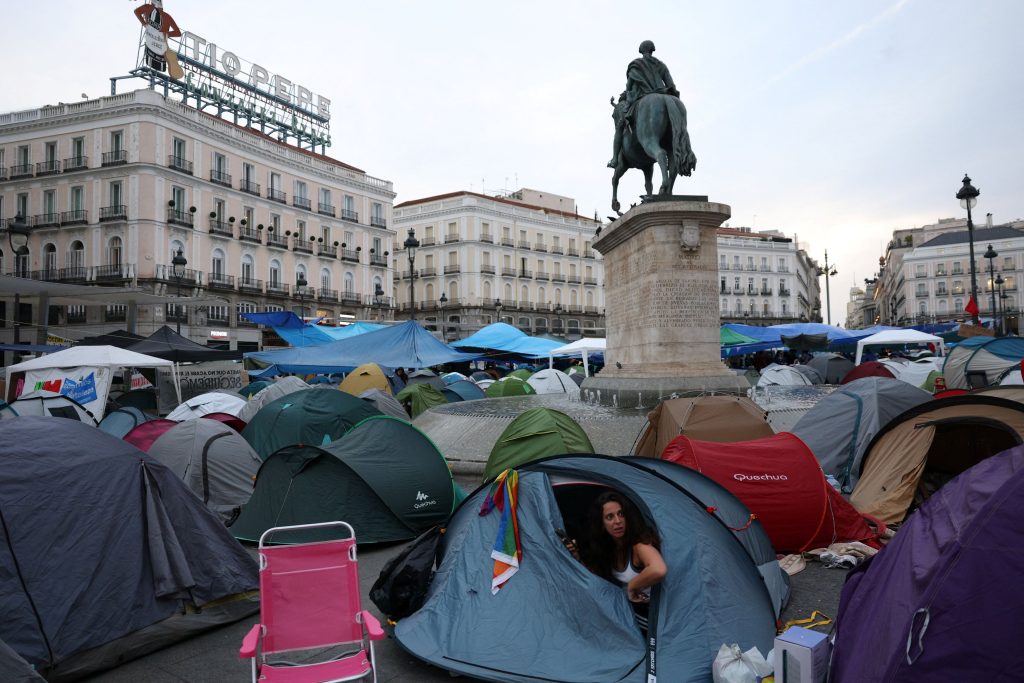
Demonstrators and supporters use tents after setting up a camp at Puerta del Sol square in protest against Spain’s housing crisis after the forceful eviction of an 87-year-old woman from her apartment in Madrid, Spain, September 28, 2026. REUTERS/Juan Medina
Even if the cabinet approves the decree on Tuesday, it would still need to be ratified by Congress within a month to remain in force. A similar measure lasted only a month earlier this year before lawmakers rejected it. The government’s parliamentary allies remain divided over what the new decree should include. Sumar and Podemos are calling for rent freezes and expropriations, with Sumar proposing that the state begin with Maricarmen’s former apartment. Junts and the Basque Nationalist Party, or PNV, have instead called for more housing construction and tax incentives for property owners. Sumar’s ministers have said they will not attend Tuesday’s cabinet meeting if they object to the final text, as they did six months ago. Earlier this year, Junts voted with the conservative People’s Party and the far-right Vox to end a moratorium that had protected some vulnerable tenants from eviction for six years.
Much of the authority over housing, however, rests with Spain’s regional governments. Sánchez’s government passed a housing law in 2023 that expanded tenant protections and rent controls, but several regions governed by the conservative People’s Party, including Madrid, have declined to apply parts of it. Isabel Díaz Ayuso, the president of the Madrid region and one of the PP’s most prominent national figures, has sought to minimize the significance of Maricarmen’s eviction. She described it as “one out of the 25,500 that take place every year in Spain” and stressed that the eviction had been authorized by the courts. At the same time, Ayuso’s government has been facing questions over its purchase in April of a €6.3 million penthouse in Chamberí, one of Madrid’s most expensive neighborhoods. The transaction was not made public at the time and became known only after El País reported it in late July. According to the newspaper, the regional government put the property back on the market within hours of the report. Ayuso has since offered differing explanations for why the apartment was bought and how it was intended to be used, but the purpose of the purchase has not been clearly established. The two stories became linked in the protests that followed Maricarmen’s eviction. Hours after she was removed from her home, demonstrators gathered outside the Chamberí property, chanting, “Ayuso’s penthouse for Maricarmen.”
Urbagestión now says it wants to return Maricarmen’s home through an agreement with Madrid’s municipal housing company. The city council has called the proposal unworkable but has offered to mediate. For now, Maricarmen remains in the hospital, not knowing whether she will be able to return home.
With information from El Pais, The Guardian, Euronews