
 Μake us preferred on Google
 BERLIN—Germany’s Alternative for Germany scored a historic victory at a regional election on Sunday but was just short of the majority needed to form the country’s first far-right government since World War II, according to preliminary results.
The result, if confirmed, will face other parties on the right and the left with a stark choice: keep banding together to keep the AfD out of power despite deep political differences—a decades-old strategy known as the firewall—or let the AfD form a minority government for the first time.

A supporter holds a sign with an image of top candidate of the far-right Alternative for Germany (AfD), Ulrich Siegmund, at the AfD election party, after exit polls in the Saxony-Anhalt state elections, in Magdeburg, Germany, September 6, 2026. REUTERS/Thilo Schmuelgen
Now the ball is with Chancellor Friedrich Merz and his center-right Christian Democratic Union. The path he takes could decide his fate and that of his government.
Merz has ruled out even passive cooperation with the AfD, but CDU lawmakers in Eastern Germany, where the far-right party is strongest, are divided about the firewall, setting the stage for a possible split in the party. Critics think ostracizing the AfD has alienated voters and forced the CDU to govern with parties that don’t support its agenda, leading to policy paralysis.
“The firewall is a signature policy of Friedrich Merz,” said Sudha David-Wilp, vice president and senior fellow at the German Marshall Fund of the U.S., a think tank. “It goes to the heart of what it means to be conservative in Germany, which is antithetical to a lot of what the AfD stands for, whether it’s their support for Russia or hostility to Europe.”
The closely followed vote in Saxony-Anhalt, a state of 2.3 million inhabitants in the former East Germany, ended with the AfD securing about 44% of the votes, more than twice the score of the CDU. This was one of the best performances by any party at a state election since the 1950s.

Top candidate of the far-right Alternative for Germany (AfD) Ulrich Siegmund kisses his wife Julia Siegmund as they take stage at the AfD election party, after polls closed in the Saxony-Anhalt state elections, in Magdeburg, Germany, September 6, 2026. REUTERS/Thilo Schmuelgen TPX IMAGES OF THE DAY
Still, early results showed the party would fall just short of the absolute majority of seats in the parliament needed to govern without the support of other parties. The figures could evolve in the AfD’s favor through the night as more votes are counted.
“It’s a historic result…We have very clearly received a mandate to govern,” AfD’s co-chairwoman, Alice Weidel , said. Even if the party fell just short of a majority, she added, it would reach out to like-minded state lawmakers who might support an AfD-led government.
A small party, the far-left Sahra Wagenknecht Alliance, or BSW, breached a longstanding taboo on Sunday by calling for the end of the firewall, saying voters had rejected it.
Other parties wouldn’t have to actively help the AfD to form a government in Saxony-Anhalt. Under the state’s constitution, Ulrich Siegmund, the AfD candidate , would only need a sufficient number of lawmakers from other parties to abstain for him to be elected state premier. He would then have to seek cross-party support in the house for every bill his government puts to a vote.
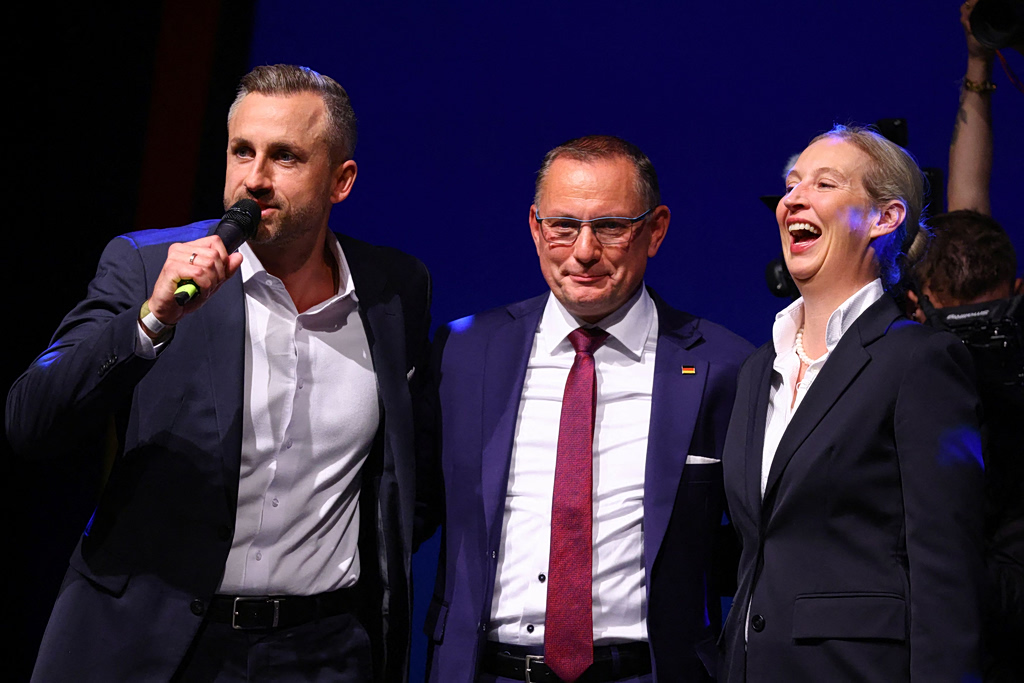
Top candidate of the far-right Alternative for Germany (AfD), Ulrich Siegmund, speaks next to party co-leaders Tino Chrupalla and Alice Weidel at the AfD election party, after exit polls in the Saxony-Anhalt state elections, in Magdeburg, Germany, September 6, 2026. REUTERS/Thilo Schmuelgen
Asked whether he was still committed to the firewall, Sven Schulze, the outgoing CDU state premier, declined to answer, telling the ZDF public-sector broadcaster that his party would need to analyze the reasons for its defeat.
This leaves Merz, who is also CDU chairman, with two options.
He could insist on the CDU sticking to the firewall and working to form an anti-AfD state government with Green lawmakers, Social-Democrats, former Communists and even far-left populists.
There is strong resistance to this scenario among CDU state lawmakers. A rebellion against the chancellor could leave his authority permanently damaged. With the worst popularity ratings of any postwar chancellor, his standing in the party is already diminished.
Merz could instead give the state CDU free rein to deal with the AfD. This too could fracture his party and would likely spell the end of his coalition government. His ruling partner, the center-left Social Democratic Party, has categorically opposed any form of cooperation with the AfD.
While it took place in one of Germany’s smallest states, the election marks a new milestone in the shrinking of the political center that has made Europe’s largest economy ever harder to govern. The CDU halved its 2021 score in the state. Nationally, the party is between five and six points behind the AfD, which has increased its lead recently as Germany’s most popular party.
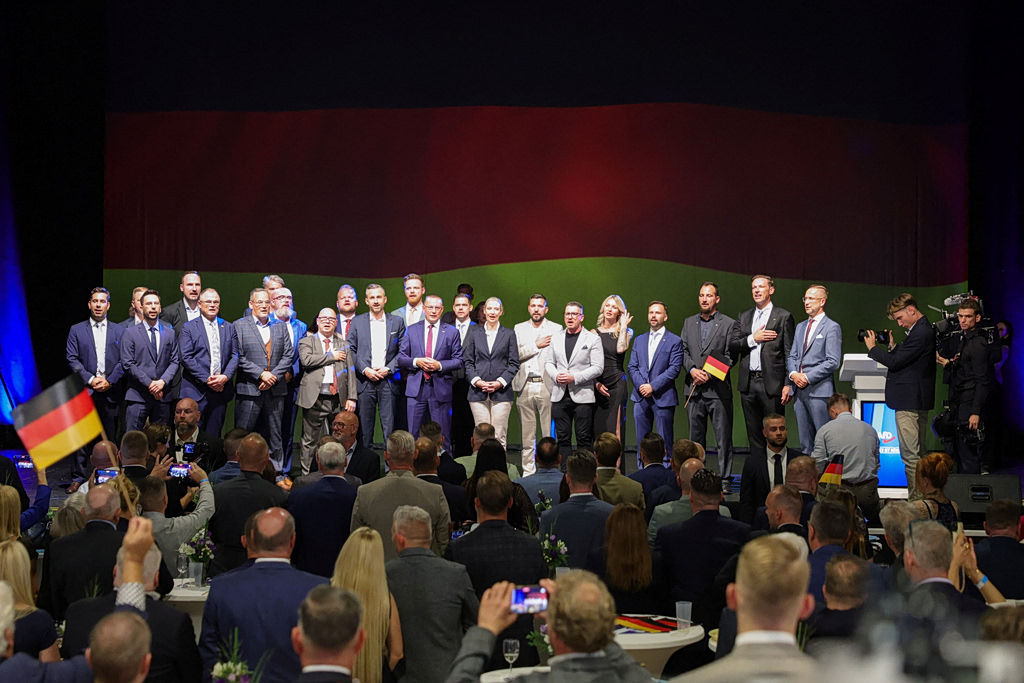
Top candidate of the far-right Alternative for Germany (AfD) Ulrich Siegmund, party co-leaders Alice Weidel and Tino Chrupalla, and others stand onstage during the national anthem at the AfD election party after polls closed in the Saxony-Anhalt state elections and exit polls were announced, in Magdeburg, Germany, September 6, 2026. REUTERS/Fabrizio Bensch
The AfD’s populist agenda includes speeding up the deportation of undocumented migrants, increasing welfare benefits for native-born Germans, ending sanctions on Russia and German aid to Ukraine, and pulling the country out of the European Union. It is among the most radical of the nationalist parties that have been ascendant in Western Europe in recent years.
Many of its policies are beyond the powers of a state government. Yet the AfD has pitched the election as a chance to show it can successfully implement policies outside of the mainstream consensus that has endured in the postwar era.
If the BSW enters parliament, which requires reaching a 5% threshold of voters, it would be in a kingmaker position. By abstaining during the election of the future state premier, its lawmakers alone could decide whether the AfD can form a government. Without the BSW in the house, the AfD could try to persuade a handful of CDU lawmakers in parliament to abstain.
An AfD government in one of Germany’s smallest states wouldn’t interfere with policymaking at the federal level. Saxony-Anhalt has little weight in Germany’s upper house, which represents the regions, and little economic significance.
However it would give the party power over the police and the state branch of the office for the protection of the constitution, the German domestic intelligence agency. One of the tasks of the agency has been to surveil the AfD, which it considers an extremist organization.
The prospect of a Russia-friendly party gaining access to secret intelligence has alarmed security officials in Berlin and across the country.
Georg Maier, interior minister of nearby Thuringia, told The Wall Street Journal that AfD lawmakers in his state had repeatedly requested classified information about defense installation, antidrone measures and Russian espionage activities in the region, using a parliamentary procedure that compels the government to respond.
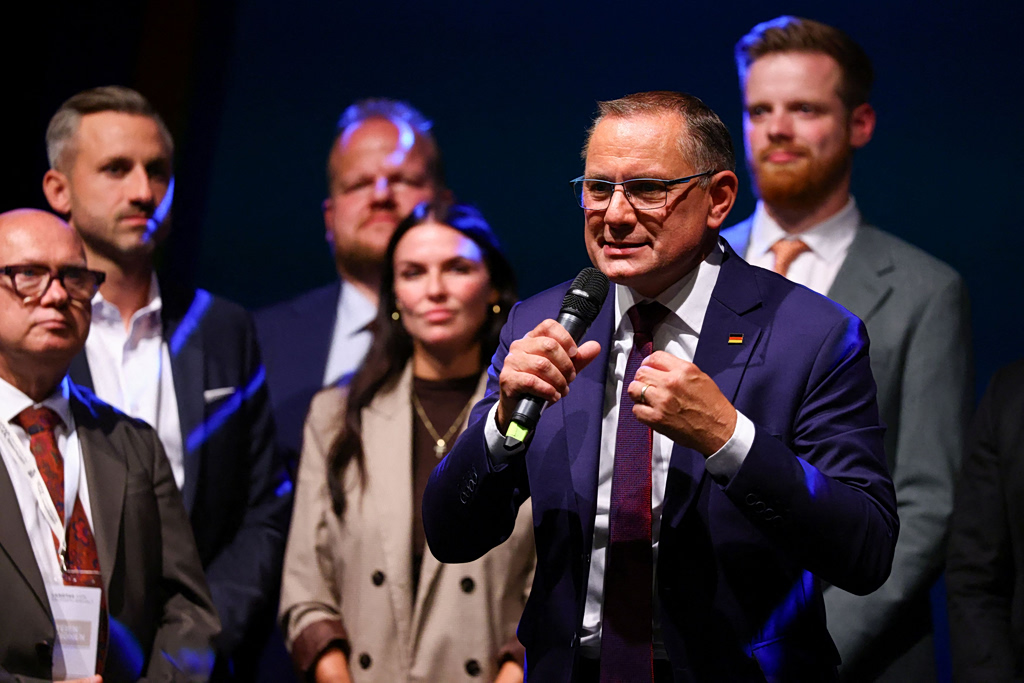
Far-right Alternative for Germany (AfD) party co-leader Tino Chrupalla speaks at the AfD election party, after exit polls in the Saxony-Anhalt state elections, in Magdeburg, Germany, September 6, 2026. REUTERS/Thilo Schmuelgen
Write to Bertrand Benoit at bertrand.benoit@wsj.com