 Μake us preferred on Google
 LONDON—European countries are putting together a plan for a broad coalition of countries to help free up shipping through the Strait of Hormuz, including sending mine-clearing and other military vessels. But the plan would only come after the war and may exclude one country in particular: the U.S.
French President Emmanuel Macron said Tuesday the plan is for an international defensive mission that doesn’t include the “belligerent” parties, meaning the U.S., Israel and Iran. European diplomats familiar with the plan say European ships wouldn’t be under American command.
The goal of the European plan is to give shipping companies confidence to use the strait after the fighting has ended, which officials say could be some time away.
The European plan is likely to include Germany, which had until now been publicly reluctant to even contemplate any military involvement, according to a senior German official. Germany, which has faced high political and legal hurdles to take part in overseas military ventures since World War II, could spell out its commitment as early as Thursday, according to the official.
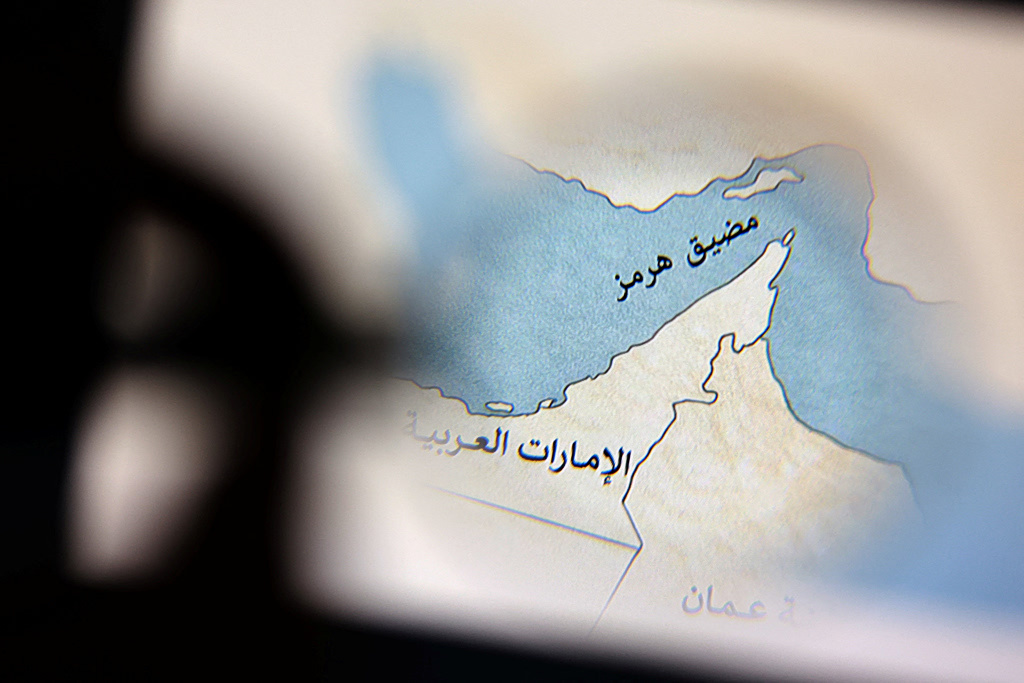
A map showing the Strait of Hormuz, also known as Madiq Hurmuz, is seen in this illustration taken March 26, 2026. REUTERS/Dado Ruvic/Illustration
Berlin’s involvement means the mission could be more substantial than previously expected. Germany has more fiscal firepower than the U.K. and France and some key military assets needed for this specific mission.
This Friday, Macron and U.K. Prime Minister Keir Starmer will host an online meeting of several dozen countries to discuss how best to police Hormuz once hostilities end. Starmer will attend the Paris event in person, while most other countries will join via videoconference. The U.S. won’t attend, French and British officials said. China and India were invited, but it’s unclear if they will attend, a French official said.
“The mission we are referring to could only be deployed once calm has been restored and hostilities have ceased,” French Foreign Minister Jean-Noël Barrot said on Tuesday, adding that the international coalition would coordinate with countries bordering the strait, including Iran and Oman. That suggests no mission would go ahead without Iranian approval.
Some differences must still be worked out among the Europeans. French diplomats think that any U.S. involvement in the operation would make it less palatable to Tehran, while British officials worry that not including the Americans will anger President Trump and limit the operation’s scope, according to people familiar with the talks.
The debate about whether to sideline the Americans is a sign of increasingly strained trans-Atlantic ties after a year in which Trump placed tariffs on European exports, pulled support for Ukraine in its defense against Russia, and threatened to use military force to take over Greenland from Denmark, a NATO ally. Strains have deepened over the Iran war, which most European leaders view as illegal and an unwelcome economic shock.
Trump has lobbied for weeks for European allies to send warships to the Gulf to help forcibly reopen the strait. But European officials have declined. France’s Macron said reopening the strait by force would be “unrealistic,” take an infinite amount of time, and expose ships passing through to coastal threats and ballistic missiles. And several leaders have said such a move would mean getting sucked into a conflict that is deeply unpopular with European voters.
Trump has now called on Europe to help with current U.S. efforts to blockade Iranian ports. That is aimed at causing enough economic damage to Iran that it agrees to reopen the vital waterway, which carries about a fifth of the world’s oil and other valuable commodities like fertilizer.
Starmer and others have also declined, saying the focus for Europeans is on how to free up traffic, rather than restrict it further.
Trump has criticized the Europeans for not helping more, saying he is reconsidering U.S. membership in the North Atlantic Treaty Organization. Trump told NATO Secretary-General Mark Rutte during a visit last week that he was expecting Europe to step up. It remains to be seen if Europe’s desire to help only after the conflict is over will assuage the American president.
The plan has three broad aims: first, put logistics in place to ensure the hundreds of ships currently stuck in the strait can leave. Then employ a major demining operation to clear the way for a far larger number of ships to use a broader part of the strait. Iran mined parts of the waterway in the early days of the conflict, and removing those is crucial to getting ships going again.
Demining is one area of military power where Europe has many more assets than the U.S., which has largely decommissioned its minesweeping fleet, whereas European powers have upward of 150 vessels, according to analysts. But it is also a long and time-consuming process.
The final aim is for regular military escorts and surveillance—via frigates and destroyers—to give shipping companies confidence that it is safe to transit the strait. It isn’t clear at this stage how big a naval presence will be required to do this.
Even after a durable cease-fire, having a Western military presence will be crucial to getting the waterway going again, say analysts. “There will need to be at some point an escort system or some convoy to protect ships,” said Mujtaba Rahman, head of Europe for the Eurasia Group risk analysis firm. “Insurance companies and shippers will likely demand that protection.”
The allied mission will be modeled on the European Union Naval Force’s Operation Aspides, which involved several EU nations clubbing together in 2024 to provide naval escorts for commercial shipping through the Red Sea and protection from Houthi attacks.
During that mission, which the EU said was purely defensive in nature, countries including France, Italy, Germany and Greece provided frigates and helicopters on a rotational basis to help fend off Houthi missile and drone attacks. The allies provided around three ships at a time to help escort cargoes and provide surveillance.
This ran independently of a U.S.-led plan called Operation Prosperity Guardian, which operated in the Red Sea between 2023 and 2025 and was far bigger in scale, involving aircraft carriers and several destroyers.
Germany has strict constitutional limitations governing any such deployments. To join a Hormuz mission, the government would need to secure parliamentary authorization, which in turn requires a robust international mandate.
This could be a Chapter IV mandate adopted by the United Nations Security Council, which includes permission to use force not just in self-defense. Alternatively, the EU could expand the mandate of the so-called EUNAVFOR Aspides mission in the Red Sea.
Germany could contribute ships, including minesweepers. The country’s minesweeper squadron is based in the port of Kiel on the Baltic Sea coast and includes some 12 minehunting and clearance diving vessels.
Germany’s navy is currently deployed in the Baltic Sea and the North Atlantic to deter Russia. Berlin would need to be satisfied that some of these assets can be transferred to the Middle East without endangering that mission.
Another area where Berlin could help is surveillance. Germany has had at least one surveillance aircraft based in Djibouti that took part in the Red Sea mission.
The plan is also based broadly on the concept of the “Coalition of the Willing” in Ukraine, whereby several European countries are offering to deploy limited numbers of military troops into the country—but only after a permanent peace deal is signed—to act as a deterrent force against Russia to help rebuild investor confidence in the Ukrainian economy.