 Μake us preferred on Google
 WASHINGTON—Defense Secretary Pete Hegseth was planning to head to Brussels last month to deliver what would be a bombshell announcement in a meeting with the North Atlantic Treaty Organization’s top military chiefs.
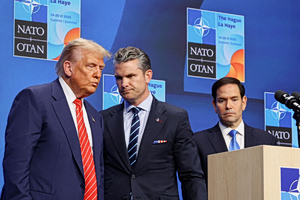
The U.S., he planned to say, was preparing additional cuts to its forces in Europe that would go beyond the canceled deployment of an armored brigade to Poland and the earlier withdrawal of an infantry brigade from Romania, people familiar with the matter said. But Hegseth’s proposal was nixed after it was shared with Marco Rubio —President Trump’s national-security adviser—and other senior officials, the people said.
Instead, Hegseth said the U.S. would conduct a review of its force posture in Europe that could last as long as six months.
The incident suggests the administration isn’t yet settled on the pace and scope of potential cuts in U.S. troop levels in Europe. While Trump has talked of punishing NATO countries that he thinks don’t spend enough on their own defense or that didn’t support the U.S. war with Iran, Hegseth’s proposals and fiery speeches have rattled allies and lawmakers—including some leading Republicans—who worry he will cause lasting damage to the alliance and embolden Russia.
The White House referred questions to the Defense Department. Sean Parnell , chief Pentagon spokesman, said, “Secretary Hegseth ensured his message was aligned with the president’s objectives and agenda, and he did not want to impede upon the president’s decision space.”
U.S. troop levels and allied military spending are expected to be a focus when Trump meets with NATO leaders in Ankara, Turkey, next week.
NATO officials hope the Ankara summit will showcase unity with the U.S. and support for Ukraine in its war against Russia but say they fear tensions with Trump could overshadow the summit. NATO officials are considering scrapping plans to hold a summit next year in Albania, officials said, a development earlier reported by Reuters.
“The United States spends more money on NATO than any other country, by far, to protect them, without getting any benefit from so doing,” Trump said in a social-media post Thursday.
The Pentagon’s defense strategy issued in January signaled that the U.S. would reduce its military presence in Europe as it focuses more on the western Pacific and the Western Hemisphere. The goal, the strategy said, is to give European nations the main responsibility for the conventional defense of the continent.

U.S. Navy Unmanned Surface Vessel Division (USVDIV) drone boat sails during the NATO exercise BALTOPS 26 in the Baltic Sea, off the coast of Gdynia, Poland, June 15, 2026. REUTERS/Lukasz Glowala
In May, Hegseth abruptly canceled the nine-month rotation of an armored brigade to Poland from Fort Hood, Texas. The decision by Hegseth drew sharp criticism from Republican and Democratic lawmakers and concerned Polish officials, who told The Wall Street Journal they weren’t consulted about the move.
It also surprised Trump, who later called Hegseth to ask why he was treating a valued ally so poorly, officials told the Journal in May. Trump then announced he would send 5,000 troops to Poland, though no additional troops have yet been deployed, U.S. officials said.
The prospect of further U.S. troop cuts in Europe is still looming. Hegseth and his chief policy aide, Elbridge Colby , have been particularly assertive in trying to shrink the U.S. forces that are committed to Europe. In his years in and out of the Pentagon, Colby has been seen as a prioritizer who favors limiting U.S. obligations outside Asia, to free up resources to counter Beijing.

The Iran war provided Hegseth and Colby with a new opportunity to rethink troop commitments. While Britain made a base available for U.S. long-range bombers that were used to strike Iran, Spain declined to make its facilities available for attacks on the country. After the German chancellor criticized the Trump administration’s Iran strategy, Trump in May continued his criticism of Europe and threatened to remove troops from Germany.
The Pentagon’s recent push for troop cuts has alarmed Republican as well as Democratic lawmakers, who have inserted provisions in draft military spending legislation that would bar the Defense Department from reducing troop levels below 76,000 without a review of the risk by the head of the U.S. European Command and the chairman of the Joint Chiefs of Staff and a certification by Hegseth.
Those concerns escalated last month, when Hegseth’s office scheduled a phone call with lawmakers ahead of the June meeting with NATO defense ministers, said some of the people familiar with the matter. But when the call took place, Hegseth said only that he was planning a review.
Hegseth, in announcing his review, took aim at Europe .
“Make no mistake about it—this will be a real review,” Hegseth said at the opening of a twice-yearly gathering of NATO defense chiefs. “It will be designed to ensure that NATO is moving fast and irreversibly toward Europe stepping up to take primary responsibility for the defense of Europe.”