 Μake us preferred on Google
 EAST RUTHERFORD, N.J.—Ninety minutes of the World Cup final had come and gone, and Argentina—the defending champion, unbeaten at any major tournament since 2019, and blessed by the existence of Lionel Messi—hadn’t managed a single shot.
And yet, on a baking afternoon in front of a hostile crowd, a vastly superior Spain couldn’t find a way to punish them. Even when Argentina was reduced to 10 men, the wave of Spanish jerseys kept crashing into the same resolute defense. Nerves crept in, and as the match entered extra time, Spain began to fear that this final would go down as un robo , a robbery.
Instead, it will be retold as something far more epic than that. This was the day when Spain downed Argentina 1-0 and won the World Cup for the second time.
“Even against 10 men at the end we had to suffer,” Spain coach Luis De La Fuente said. “But, we like to suffer, and I’ll say it again, we were prepared for everything.”
Sixteen years after first lifting the trophy in South Africa, La Roja demonstrated without a doubt that no country commands the world’s most popular sport quite like Spain. With an approach so complete, so technically sound that its players look permanently untroubled, they have shown the world how it looks when cool competence is elevated to high art.
It’s no coincidence that Spain is now a simultaneous Olympic, European, and world champion, or that it currently holds both the men’s and women’s World Cups. This is a nation that has worked out how to develop soccer players as plentifully as it grows oranges and lemons.
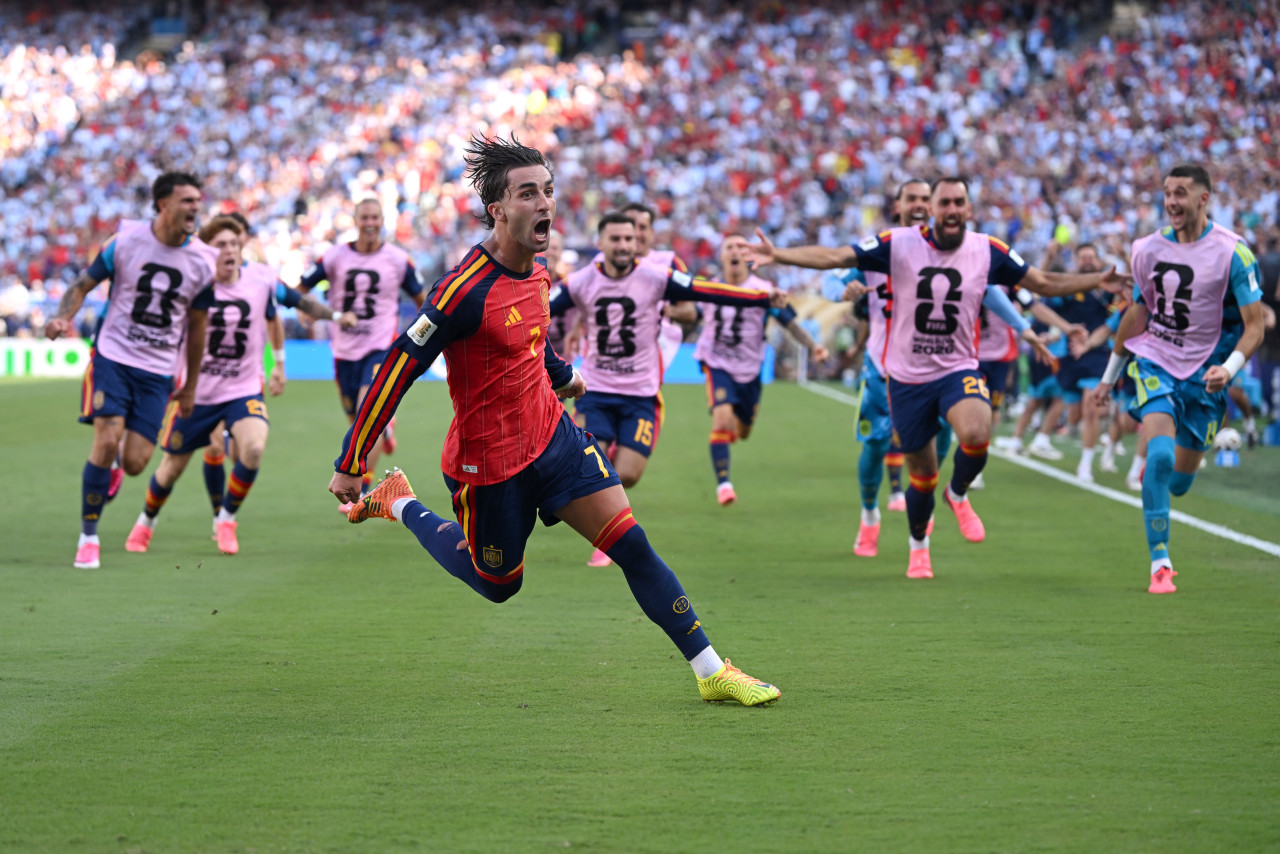
When the breakthrough finally came, it arrived with Spain’s 20th shot of the match. After 104 games, the largest World Cup in history had required an extra half-hour to decide its champion and now, in the 16th minute of extra time, Ferran Torres was the man to enter the history books. After a high ball to the back post, headed down by Nico Williams, the 26-year-old Torres lashed it home.
This was the one effort that Argentina goalkeeper Emiliano Martinez, who set a World Cup final record for saves, couldn’t keep out.
But if Spain’s tactics revolved around control, patience, and invention, Argentina’s approach to Sunday focused more squarely on intimidation. And with a permissive referee running the show, Argentina took every inch of latitude—at least until Enzo Fernandez was ejected in second-half stoppage time for a second yellow card.
Over 120 minutes, the defending champions produced just one shot on target but committed 25 fouls. And Messi found himself with precious little to work with—in the first 15 minutes, he had touched the ball just once on the opening kickoff.
Back in 2010, the Netherlands had tried a similar tack against Spain in a World Cup final. Faced with a peak version of the pretty-passing, high-possession, tiki-taka style, the Dutch realized that they simply couldn’t out-soccer La Roja . Their response was to make the match as physical as possible and hope for the best. That time, Spain found a winner in the 26th minute of extra time.
On Sunday, the decisive moment arrived slightly earlier, as the center of the soccer universe migrated to an NFL bowl in a New Jersey parking lot. All at once, it contained President Trump, the King of Spain, and half the royalty of American entertainment.
Mostly, though, the stands heaved with fans from Argentina. Just as they did in Qatar—and more recently in Atlanta and Dallas and Kansas City—supporters in sky blue and white swarmed the stadium, outnumbering Spain fans by at least three-to-one. This is a country where adoration of the national team is so fervent that many fans build their financial planning around the World Cup, taking out loans to buy tickets every four years. It’s also the country with the most psychologists per capita in the world. These facts are perhaps not unrelated.
“The fans are absolutely crazy, different to other countries,” Argentina’s Martinez said before the game. “Seeing them celebrate at 2 a.m. in the cold Argentine weather means a lot.”
But there would be no repeat of those scenes on Sunday night as it lost a World Cup final for the fourth time in its history. Instead, Argentina could only look on as Messi’s World Cup career came to a close with his second defeat in three finals, 12 years after losing his first against Germany.
Only now, the country that defined Messi’s club career over two decades at FC Barcelona, was the one doling out the punishment.
Write to Joshua Robinson at Joshua.Robinson@wsj.com