 Μake us preferred on Google
 Not long ago, we visited the Hungarian National Gallery in Budapest, one of the country’s most important museums, which presents in a unique way the development of Hungarian visual art from the 11th century to the present. It is housed in the Royal Palace of Buda Castle and was founded in 1957, based mainly on the Hungarian collections of the Museum of Fine Arts. Its collection includes about 110,000 works.
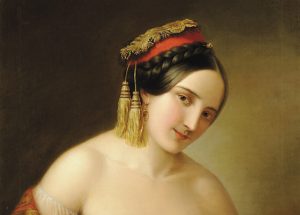
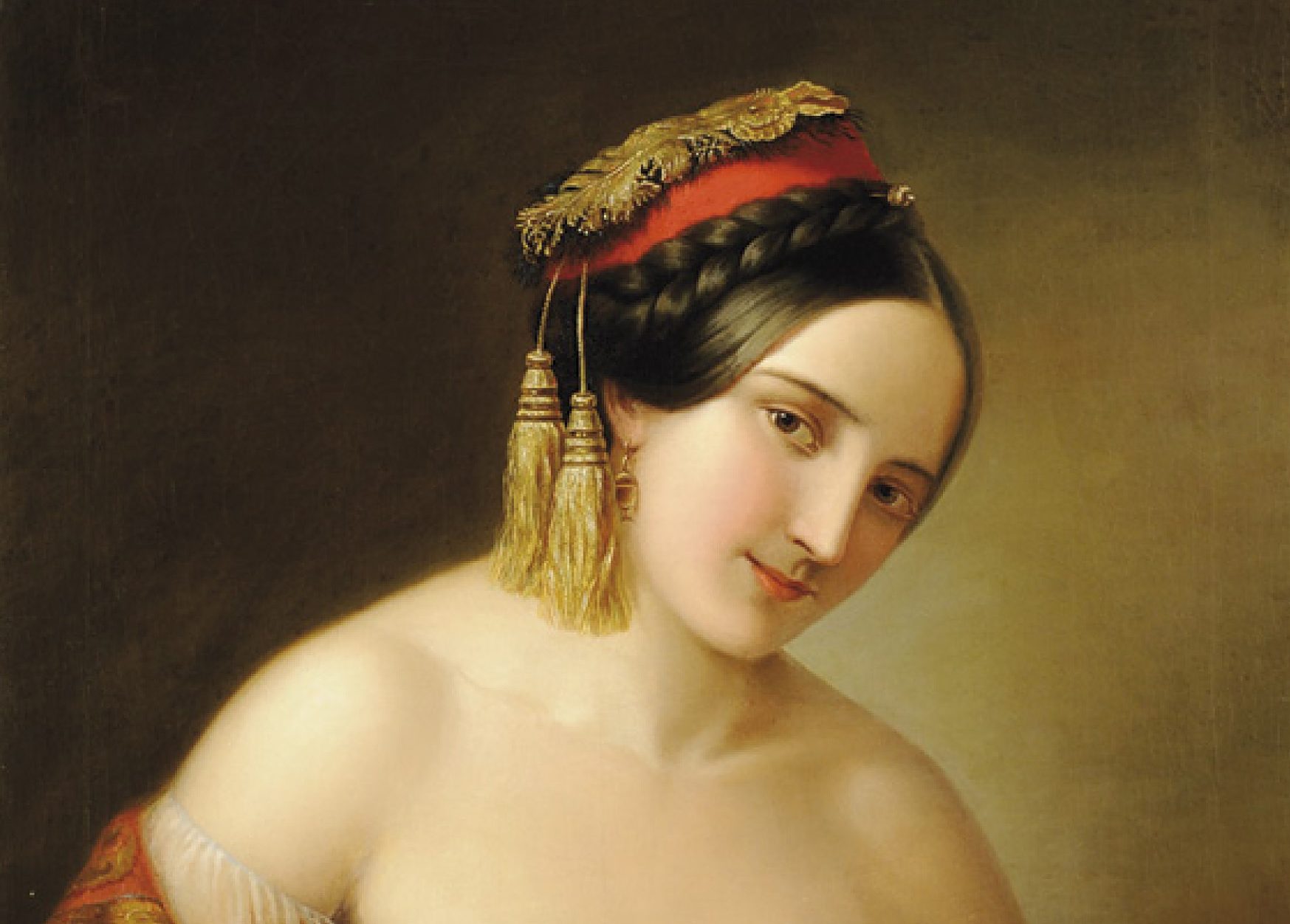
On the first floor of the gallery, we came across “Greek Woman.” It is a work by Jakab Marastoni (1804-1860), a painter of Italian origin who settled and worked in Pest and became one of the most important figures in the history of Hungarian art.
His work “Greek Woman,” painted in 1845, is considered extremely important for the creation of the Hungarian National Gallery’s collection. It is the first work that marked the beginning of the systematic collection of Hungarian painting in national institutions. It is also the painter’s best-known and most iconic work.
The painting measures about 77 x 61.5 cm. The model is not Greek, but Marastoni’s wife, Giovanna Bianchi, who was from Venice. The painter depicted her in traditional (or imagined) Greek dress of the period, following the fashion of Romanticism. The image combines exoticism, subtle eroticism, and ideal beauty.
The Story
In 1845, the Pest Art Society, the first art society in Hungary, bought one work each year from its annual exhibition to donate to the Hungarian National Museum, which at the time also included the picture gallery.
Marastoni’s “Greek Woman” was the work it chose and donated in November 1845. As a result, it was recorded as the first work in the museum’s painting collection. The National Museum already had some donations, but the systematic collection of Hungarian art essentially began with this work. The National Gallery later inherited this collection from the National Museum.
In short, a work by an Italian artist (trained in Venice) depicting a “Greek woman” (in reality, his wife) became the foundation of the Hungarian national collection. This reflects the multiethnic and multicultural reality of 19th-century Habsburg Hungary.
The choice sparked heated debate and became the “first art scandal” of the time because of the eroticism the model conveyed. However, the painting was also very popular, which fueled the national conversation about art.
Today, the work remains iconic and is often displayed as the starting point of the gallery’s 19th-century painting collection. It symbolizes how Hungarian art was built with contributions from foreign artists who became part of the country, like Marastoni.
The Creation of the Gallery
If you take a walk along Deák Ferenc Street in the city center, it may be worth looking up above the shop windows from time to time. You will see not only classical facades but also memorial plaques, such as the one at number 21, which reads: “The First Hungarian Painting Academy, founded by Jakab Marastoni.”
Nineteenth-century Pest was a truly multicultural city. Germans, Hungarians, Greeks, Italians, Serbs, and many other smaller ethnic groups lived here peacefully side by side. Each cultivated its own culture, but one thing united them: they all also wanted to be Hungarian and sought to serve Hungarian culture through their activities.
At that time, Marastoni submitted his application for the painting academy to the Royal Lieutenancy Council, just as the National Picture Gallery Association, a “department collecting exclusively Hungarian painting,” was being founded within the Hungarian National Museum.
All of this happened in 1845, and this burst of cultural activity may have been the result of the National Museum wanting to properly honor the 50th anniversary of Archduke Joseph of Austria taking office.
The association bearing the archduke’s name was finally approved by the Royal Lieutenancy Council in September 1845. The Archduke Joseph National Picture Gallery can therefore be considered the first national institution to collect Hungarian paintings.
The gallery received donated works from both associations and private individuals. The most important among them was Jakab Marastoni’s “Greek Woman,” donated to the gallery in November 1845 by the Pest Art Society. So it can be said that the history of the museum collection of Hungarian painting began with “Greek Woman.”
But why a Greek woman? Modern (not ancient) Greek subjects appeared in European painting with the Greek Revolution against the Ottoman Empire in the 1820s. Naturally, European Romanticism’s sympathy for the Greeks also influenced Hungarian art.
Greeks, and especially Greek women, were a frequent subject in 19th-century Hungarian painting, and in a sense, the “Greek woman” came to represent an exotic theme with a hint of eroticism.
And if today we find “Greek Woman” openly revealing her beauty and charm, we should not forget that this was a fashionable subject. However seductively this beautiful woman beckons to us, in a historical sense, this work is one of the most important in Hungarian museology.
The Painter
Jakab Marastoni (Giacomo Marastoni) was born in Venice in 1804 and studied at the city’s famous Academy of Fine Arts.
He traveled to Vienna in the early 1830s, passed through present-day Bratislava in 1833, and settled permanently in Pest in 1836. He became a sought-after portrait painter among aristocratic and middle-class families, as well as during parliamentary sessions.
In 1846, he founded the First Hungarian Painting Academy in Pest, the first private school in Hungary devoted exclusively to painting. His students included major Hungarian artists such as Károly Lotz, Mihály Zichy, and Soma Orlai Petrich, among others. In 1846, he became an Honorary Citizen of Pest.
In the last years of his life, he took up daguerreotype photography and was the first professional practitioner of this technique in Hungary. He died in a psychiatric clinic, and his school closed shortly afterward.