 Μake us preferred on Google
The facade of the Greek Parliament is regularly illuminated to mark international awareness campaigns, most recently World Organ Donation Day and World Sight Day. Inside, however, the mood is considerably less bright.
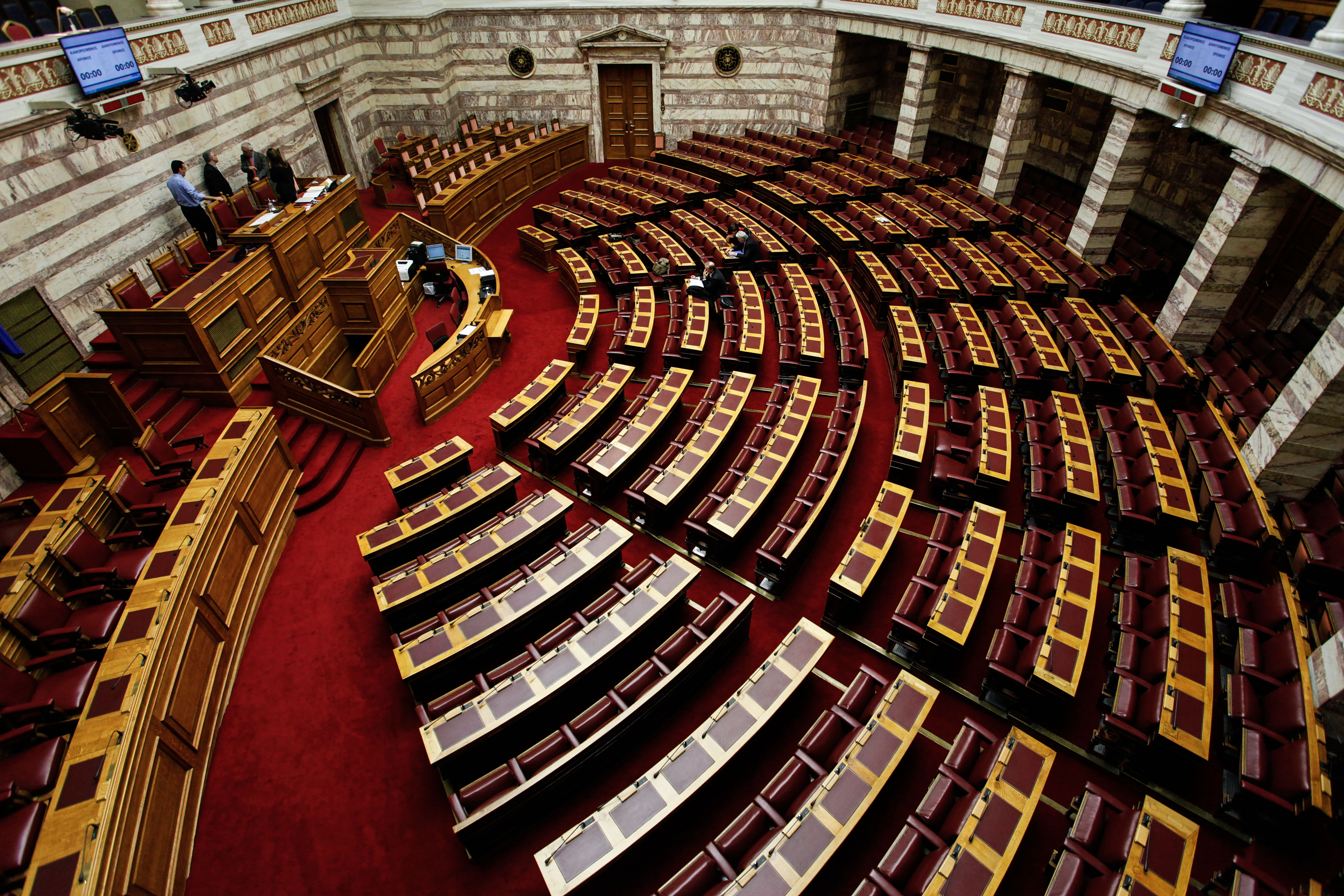
Rows of empty seats have become a familiar sight in the chamber, where the business of legislating appears to have become a secondary concern for some lawmakers. Yet even as attendance dwindles, the question of increasing their compensation has found its way onto the parliamentary agenda.
A proposal recently surfaced to double the payment lawmakers receive for attending parliamentary committee meetings, from 75 euros to 150 euros per session. There was also discussion of raising the monthly housing allowance for lawmakers elected outside Athens, who currently receive 1,000 euros to help cover accommodation costs. Neither proposal got very far. With thousands of Greek households struggling to make ends meet, any increase in lawmakers’ benefits would have been difficult to defend politically.
The episode nevertheless underscored a broader problem: Parliament is increasingly struggling to command the attention of its own members. With Greece already in a prolonged period of pre-election campaigning, lawmakers have turned their attention to their constituencies, courting the voters they will need to retain their seats. The result is a legislature where chronic absenteeism has begun to resemble an unofficial work stoppage.
A Parliament Increasingly on the Sidelines
The shortage of legislation moving through Parliament and the poor attendance of lawmakers are symptoms of the same institutional weakness. Under the government’s centralized model of administration, often referred to in Greece as the “executive state,” Parliament has increasingly been relegated to processing decisions made elsewhere. That diminished role has contributed to political apathy and further weakened public confidence in an institution already struggling with its credibility.
A succession of controversies has taken its toll, among them the Predator surveillance scandal, the investigation into alleged fraud involving agricultural subsidies administered by OPEKEPE and the handling of the 2023 Tempi train disaster. Questions have also been raised about the government’s adherence to legislative standards and repeated violations of parliamentary rules. Political instability has compounded the problem. The fragmentation of parliamentary parties, particularly the unprecedented movement of seats and lawmakers associated with the left-wing SYRIZA party, has further diminished the standing of the parliament. Meanwhile, the toxic tone of parliamentary debate has only added to the problem.
The extended election campaign has only intensified these tendencies. With opinion polls pointing to an uncertain electoral outcome, lawmakers are devoting more time to securing their political futures. Cabinet ministers, too, have become increasingly preoccupied with constituency politics. The closer the country moves toward an election, the stronger that pressure is likely to become, even as households contend with rising prices, high energy costs and a persistent housing crisis.
When Attendance Becomes Optional
What is particularly troubling is the extent to which absenteeism has become normalized. Whether in parliamentary committees, where proposed legislation is examined, or in the plenary chamber, where it is debated and approved, participation increasingly appears to be treated as a matter of personal discretion rather than a fundamental responsibility of elected office, further diminishing the role of elected representatives and widening the gap between Parliament and the public. That erosion can also benefit political forces that openly challenge the legitimacy of parliamentary institutions, creating fertile ground for populism, extremist rhetoric and the far right.
The figures from a recent parliamentary debate are telling. Last Thursday, during deliberations on legislation introduced by Justice Minister Giorgos Floridis to improve alternative dispute resolution and ease pressure on the courts, an average of just 15 lawmakers attended. Seven of them were parliamentary party representatives.
Parliamentary Rules and Chronic Absenteeism
The question of tightening parliamentary rules has been raised repeatedly over the years. Empty seats are not a new phenomenon, but absenteeism has reached unprecedented levels and has become almost routine.The shift toward remote participation during the COVID-19 pandemic has also contributed to the situation. Videoconferencing remains an option during parliamentary committee meetings, while lawmakers can participate in votes through written voting procedures.
Article 76 of Parliament’s Rules of Procedure requires lawmakers to attend plenary and committee sessions. Those who miss more than five meetings in a month face a deduction of one-thirtieth of their monthly compensation unless the parliamentary speaker accepts their explanations for the absences. Despite these provisions, absenteeism remains widespread.
Proposals to Improve Parliamentary Attendance
“The worrying thing is that we’ve become so accustomed to seeing Parliament half-empty that we no longer find it alarming,” Spyros Vlachopoulos, a professor at the University of Athens Law School, told To Vima. “The time has come to consider how we can improve the situation,” Vlachopoulos said, suggesting that Parliament could introduce a minimum quorum for its sessions. “It makes no sense for even the smallest collective administrative body to require a quorum for its meetings, while no such requirement exists for sessions of the people’s elected representatives,” he said.
Vlachopoulos also suggested requiring lawmakers to vote in person, rather than continuing the current practice of determining their votes on the basis of positions expressed by their parties’ parliamentary representatives. Any such changes, he said, would require “an open and measured discussion about strengthening Parliament, which is unfortunately absent from public debate.” He also questioned why the functioning of Parliament has received so little attention in discussions about constitutional revision. “Is it really a coincidence that, in the context of constitutional revision, issues concerning the functioning of Parliament are hardly discussed at all?” he asked.
Plans to Overhaul Parliamentary Rules
Parliament Speaker Nikitas Kaklamanis has announced plans to revise Parliament’s Rules of Procedure, with changes expected to modernize and tighten regulations governing its operations. The overhaul is intended to address the challenges posed by the growing number of political parties represented in Parliament, violations of parliamentary rules, declining respect for parliamentary institutions and persistent absenteeism.
Whether administrative reforms can restore the political and institutional standing of lawmakers remains to be seen.
The next Parliament could be even more fragmented. If current opinion polls prove accurate, as many as nine parties could win seats, potentially leading to greater polarization and more confrontational parliamentary proceedings. Such a development would present a further test of Greece’s parliamentary system, whose institutions have already come under considerable strain.