 Μake us preferred on Google
The ascent of the far right in Europe is no longer a forecast; it is a measurable reality that has outlasted two decades of policy response. As centrist coalitions scramble for novel frameworks, this article argues that the most urgent task is diagnosis, not invention: why have firewalls, normalization, and moral denunciation repeatedly underperformed? It does not claim that these strategies caused the far right’s rise or failed everywhere, only that their failure mechanisms are predictable and the debate has not reckoned with them honestly.
The term “far right” spans parties with different histories and relationships to liberal democracy: governing illiberals (Fidesz), de-demonized electoral machines (Rassemblement National), and oppositional radicals (AfD). Strategies may work differently against each, so this analysis treats the Western European oppositional radical right as its primary case and flags where the logic may not travel. Because the counterfactual (what would have happened absent a given strategy) cannot be settled with observational data, the claims below are conditional rather than causal. For each tool, we specify the mechanism, the conditions under which it should operate, and the evidence that would count for or against it.
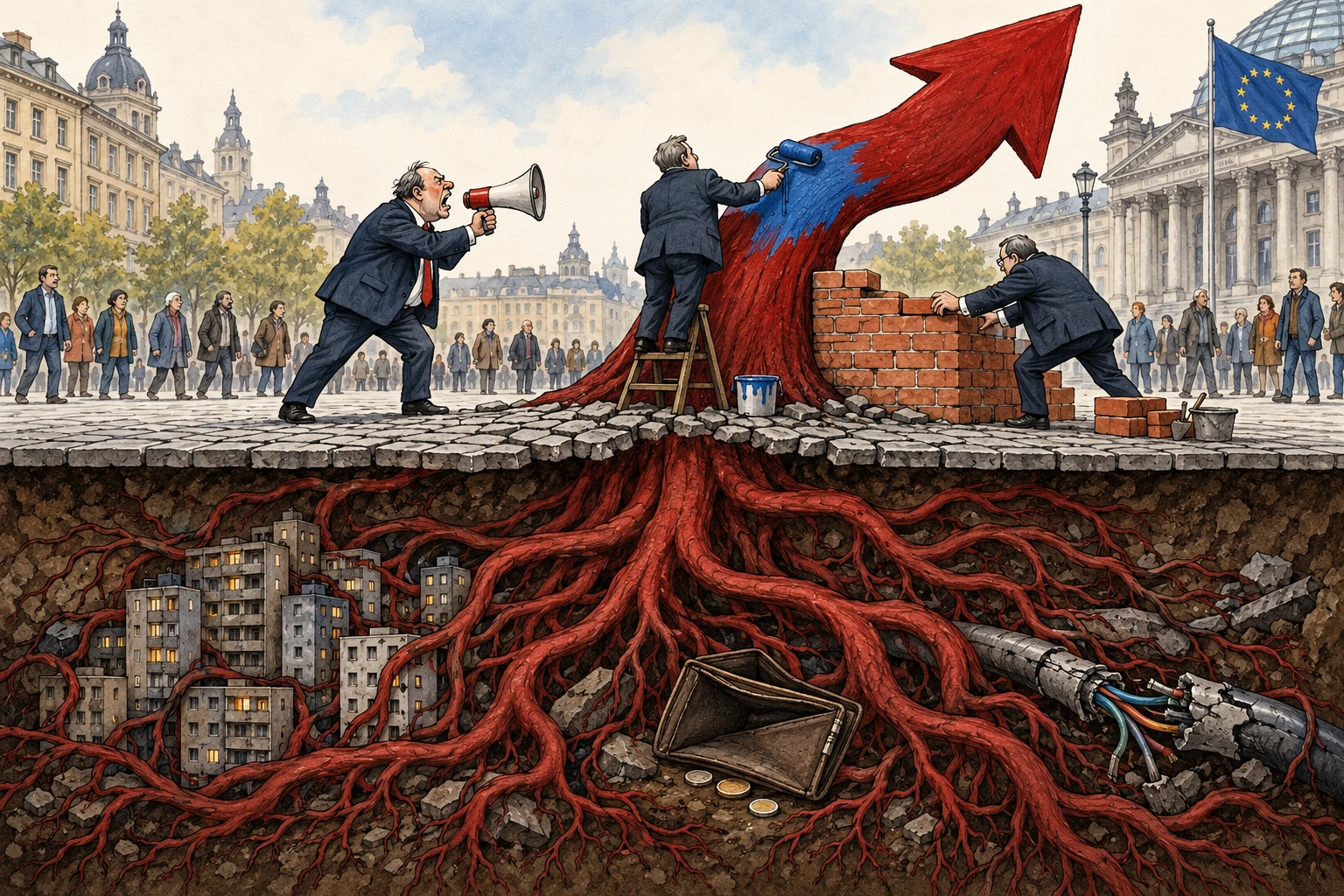
The cordon sanitaire has been the default strategy across Western Europe. By refusing parliamentary cooperation, mainstream actors hoped to starve far-right parties of legitimacy. The record is mixed. The RN has repeatedly led first-round legislative voting in France, and the AfD became the largest opposition party in the Bundestag, with strong state-election results in Thuringia and Saxony in 2024. Yet firewalls have held elsewhere, as in Belgium’s long exclusion of Vlaams Belang and Spain’s regional treatment of Vox, and isolation has prevented immediate seizures of executive power.
The honest diagnosis is narrower than “the firewall failed”: firewalls manage symptoms without addressing demand. Exclusion supplies the far right with its most potent narrative, that of a victim persecuted by an out-of-touch elite [Saldivia et al, 2026, pp 1-15]. That narrative needs three conditions to succeed: (1) media access sufficient to broadcast the grievance, (2) an electorate already disposed to distrust mainstream institutions, and (3) a firewall that appears selective rather than principled. Where these are absent, as in Belgium, where exclusion has been applied consistently across parties, the narrative has less purchase; where they are present, as in Germany, the cost is real. Firewalls have not reversed the trend, and they carry a predictable rhetorical cost under identifiable conditions.
When firewalls fail, the next instinct is accommodation. Center-right parties in Denmark, Austria, and the Netherlands have adopted portions of the far-right agenda to co-opt its voters. The evidence is contested. Denmark is the key counter-case: the Social Democrats adopted restrictive immigration policy and simultaneously defeated the Danish People’s Party electorally. But that success rested on factors that may not travel, namely a small electorate, a consensus-oriented party system, and a far-right party already in decline. The trap mechanism remains real, because adopting far-right rhetoric legitimizes the original movement’s positions and shifts the spectrum rightward. The cost appears outweighed by electoral containment only when the co-opting party has governing credibility and the far-right party cannot credibly claim to be the authentic original. Germany is consistent with the trap thesis, as the CDU/CSU’s tough-on-migration turn has coincided with record AfD highs and historic CDU/CSU lows, though incumbency, coalition fatigue, and economic conditions are plausible alternative explanations. Co-optation without credibility and a governing record is the trap.
The third response, moral denunciation, is plausibly the most counterproductive, though the evidence is weaker than advocates of this view often claim. Progressive forces stigmatize far-right voters as immoral or misguided, hoping to shame them back into the democratic fold, but telling citizens their concerns are illegitimate confirms their belief that the elite despises them. Results are mixed because stigma deters weakly attached voters while galvanizing those with genuine grievances, so the net effect is context-dependent. The cost is also asymmetric: voters bear the stigma, while far-right leaders convert it into solidarity. Denunciation therefore alienates a segment of the electorate that persuasion would need to re-engage, at little cost to the denounced party’s leadership.
Elite strategy is the supply side. The demand side (economic precarity, housing, immigration salience, media fragmentation, generational polarization) is where the far right’s fuel actually accumulates. An account that omits it risks overstating what any supply-side tactic can achieve: if demand dominates, the debate over firewalls versus normalization versus denunciation concerns second-order effects. The medical metaphor of patient and remedy also assumes that far-right support is a symptom awaiting cure rather than, in part, a genuine distributive and cultural conflict. If it is the latter, the appropriate response is a distributive settlement rather than a better tactic, a claim outside this article’s scope that the diagnosis must nonetheless acknowledge.
Europe does not suffer from a deficit of ideas; it suffers from a refusal to confront partial failure honestly. The evidence supports a modest conclusion: firewalls isolate without persuading and carry a martyrdom cost under identifiable conditions; normalization can contain but risks legitimizing, and depends on credibility and governing record; denunciation satisfies the base while alienating persuadable voters. None of this is a verdict of uniform failure. If the center wishes to survive, it must abandon the comfort of repetition and ask under what conditions each tool works, and for which type of far-right party. Only then, and by taking demand-side drivers seriously, can we discuss viable alternatives, a task this article deliberately defers.
Emmanouil Kokkinos is a Political Science and Public Administration Student at the University of Athens and member of SAFIA.