 Μake us preferred on Google
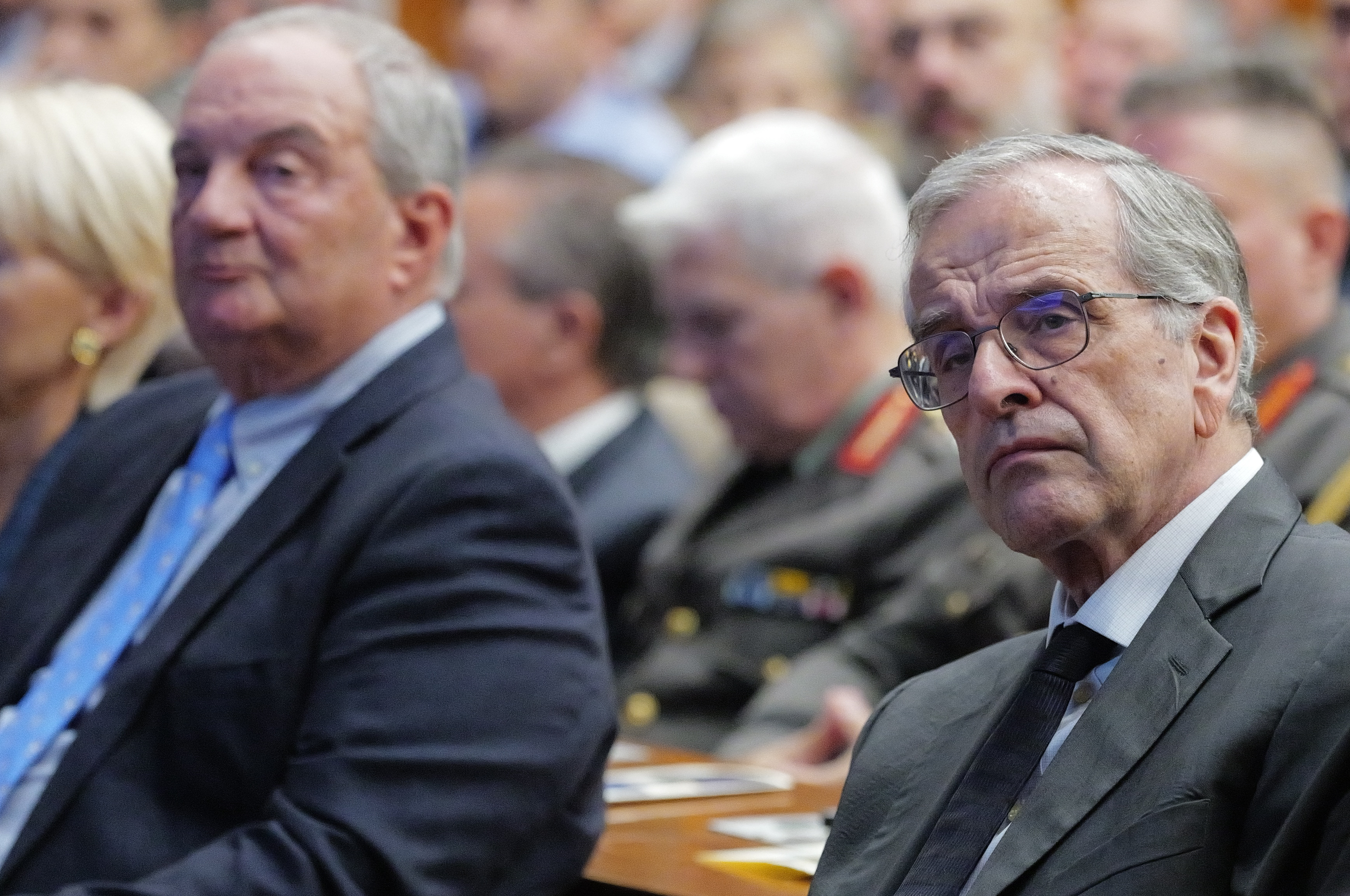
Former Greek prime ministers Kostas Karamanlis and Antonis Samaras have again criticized the government’s foreign policy handling following the Libyan parliament’s approval of a disputed maritime agreement with Turkey. Karamanlis warned against concessions to Ankara during a speech at the War Museum in Athens on Sunday, while Samaras, in an article published the same day in the newspaper Estia, described the latest developments in Libya as a failure of the government’s foreign policy and called for the dismissal of Foreign Minister George Gerapetritis.
Their remarks followed the Oct. 20 vote by Libya’s eastern-based parliament to approve a 2019 maritime agreement with Turkey, reversing its previous rejection of the deal. Greece and the European Union have opposed the agreement, with the EU maintaining that it infringes on the sovereign rights of third countries, violates the law of the sea and cannot produce legal consequences for those countries. The government has sought to play down the significance of the vote, insisting that parliamentary approval does not give the Turkish-Libyan agreement legal standing under international law.
Reactions within New Democracy have varied. Dimitris Kairidis described the development as a “political defeat,” while Deputy Prime Minister Kostis Hatzidakis and former Foreign Minister Dora Bakoyannis acknowledged that it was an unwelcome development. MP Dimitris Kalogeropoulos offered a more blunt assessment, using a colloquial Greek expression roughly equivalent to “We’re screwed.”
Karamanlis Warns Against Concessions to Ankara
Speaking at an event organized by the Association of Retired Army Officers, Karamanlis criticized the notion of mutual concessions in Greek-Turkish relations. He argued that repeated attempts to improve relations since 1974 had failed to change Turkey’s approach and accused Ankara of pursuing a strategy aimed at altering the status quo in the Aegean. “Those who promote such views are mistaken, and gravely so,” he said.
Karamanlis cited Turkey’s longstanding threat of war if Greece extends its territorial waters in the Aegean, its claims concerning the continental shelf and exclusive economic zones of Greek islands, the establishment by Turkey of marine parks as well as disputes over the sovereignty of islands and islets. He argued that Turkey was increasingly using demands for the demilitarization of Greek islands to challenge Greek sovereignty, accusing Ankara of embracing a “might makes right” approach at the expense of international law.
The former prime minister devoted particular attention to the planned electricity interconnection between Greece and Cyprus (GSI), warning against accepting any Turkish role in authorizing work on the planned electricity interconnection between Greece and Cyprus.
“Any request for permission from Turkey for the cable cannot be accepted, whether it is called notification, an announcement or anything else,” he said. He warned that accepting such a requirement would have consequences for other Greek activities in the Aegean. “After that, we would no longer be able to do anything in the Aegean without Turkey’s permission, not even the smallest infrastructure project between our islands.”
Karamanlis also took aim at Greece’s Western allies, accusing them of refusing to take sides in disputes with Turkey, even when Greek sovereignty was at stake. He contrasted Western support for Ukraine with what he said was insufficient attention to Cyprus and criticized pressure on Greece over its relations with Russia and China, its position on Kosovo, the Prespa Agreement, military assistance to Ukraine and claims for German wartime reparations. While reaffirming Greece’s place in the West and the European Union, he called for reciprocity and greater respect for Greek interests. “No one respects someone who does not defend their rights, their principles and their country,” he said.
Samaras Calls for Gerapetritis’ Dismissal
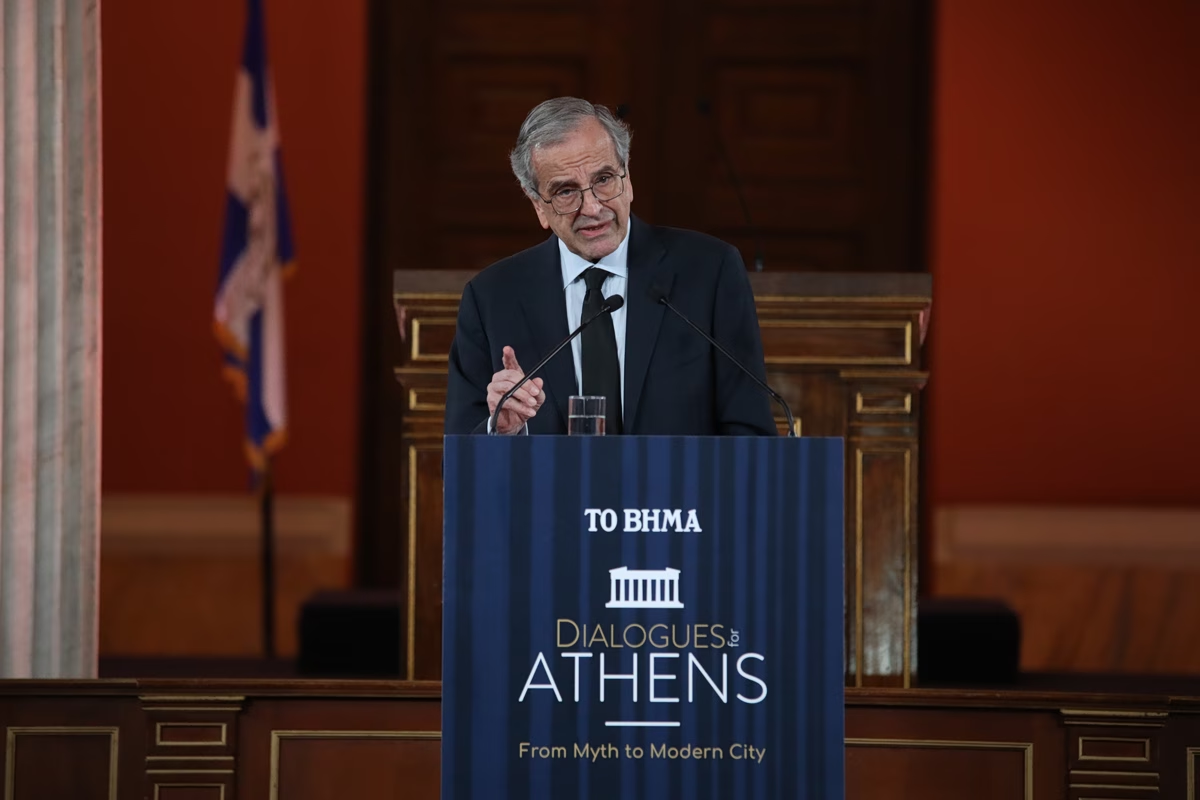
Samaras, who attended Sunday’s event at the War Museum, had earlier published a sharply critical article in Estia targeting the government’s handling of relations with Turkey. He described the Libyan parliament’s approval of the maritime agreement as a failure in analysis, anticipation, management and outcome.
The former prime minister also repeated his criticism of the government’s handling of Greek Turkish relations and its “calm waters” approach. He accused Gerapetritis of implicitly recognizing Turkish jurisdiction through his handling of the Greece-Cyprus electricity interconnection and again called for his removal from office.
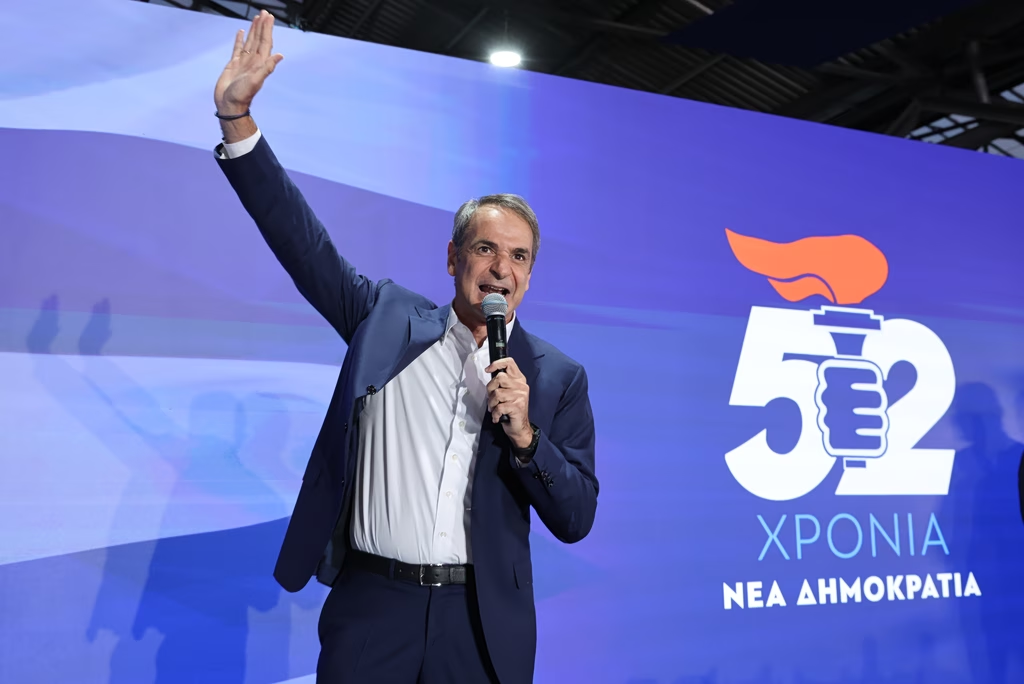
Samaras called Gerapetritis’ dismissal the only way to bring about a change in foreign policy. He placed political responsibility on Mitsotakis and warned the government against continuing its current approach.
Different Positions Within New Democracy
Although both former prime ministers have criticized the government’s approach to Turkey, their positions within New Democracy differ.
Karamanlis, who served as prime minister from 2004 to 2009, has maintained his ties to New Democracy while publicly criticizing the government’s handling of issues ranging from surveillance and judicial independence to relations with Turkey.
Samaras, who served as prime minister from 2012 to 2015, is in open conflict with Mitsotakis and has repeatedly called for changes to the government’s foreign policy. He is also expected to announce the creation of a new political party to the right of New Democracy in the near future.