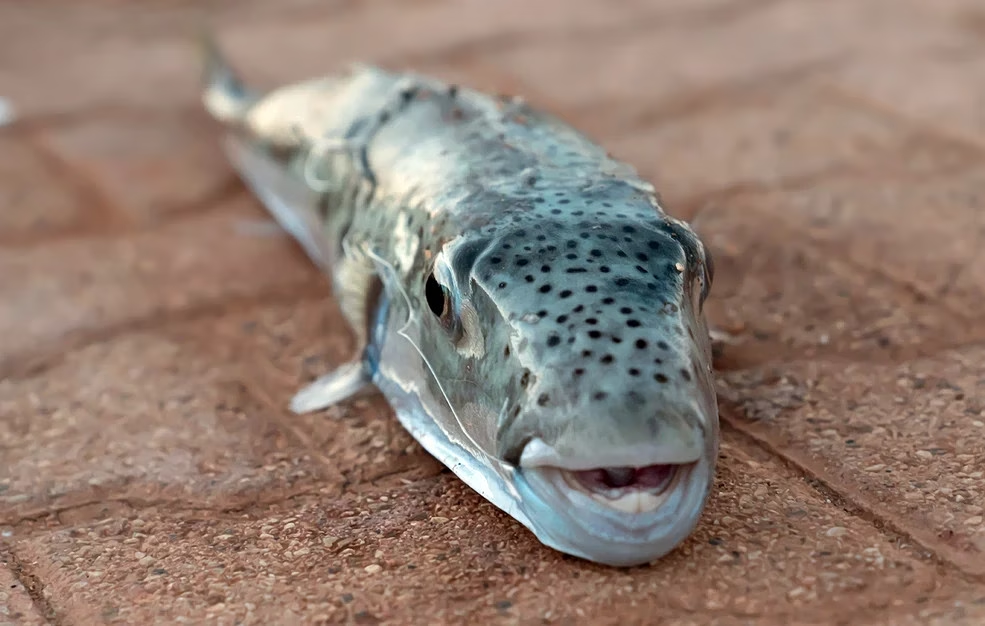
The panic over the presence of pufferfish in Greek waters, though many experts consider it unwarranted, has led to the installation of floating barriers and special nets at beaches, so that swimmers can feel safe.
In fact, these particular beaches are being advertised as the only ones where swimmers can dive and bathe in the sea without fearing an attack from a pufferfish.
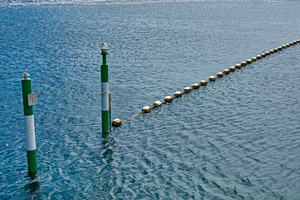
A characteristic example is Chalkida, where municipal authorities have installed floating barriers at beaches as safety zones to keep out both jellyfish and pufferfish, according to the municipality.
The Chalkida Experiment: 2.5 kilometers of protective netting
Deputy Mayor of Chalkida Antonis Spanos, who oversaw the installation of the first such floating barrier in Greece, told the Guardian that public safety must be the authorities’ duty and top concern, adding that it is better to prevent than to regret.
The deputy mayor explained that authorities worked for months to secure funding, complete the necessary procedures, and install the most suitable system, which was approved by Greece’s General Chemical State Laboratory.
In total, 2.5 kilometers of protective netting will be placed in bays across the area.
He noted that last year they had a major problem with jellyfish, but as the saying goes in Greek, one stone can kill two birds, and now, if pufferfish show up, they’ll be ready.
He added that many elderly residents had been calling the town hall asking when the barriers would go up, noting that just that morning, a woman said she would only feel safe taking her grandchildren swimming once the barriers were installed.
The Mayors office posted the announcement of the nets installation on Facebook.

What a diver who installed seabed barriers had to say
Chalkida is not the only area taking measures, the Guardian report continues.
Nikos Houlieris, 63, who has run a diving school for years, was out at sea with his team in recent days, securing new barriers to the seabed at other beaches along the Evoikos Gulf.
He said he has been diving for more than 40 years and never thought he would see the day he’d be doing something like this.
He pointed out that sea temperatures have clearly risen, creating much more favorable conditions for what they’re seeing today.
In the coming weeks, an estimated 7 kilometers of floating barriers are expected to be transported to the region from Athens. He added that he doesn’t think anything can get through the netting, not even a pufferfish’s teeth, since it’s extremely dense and durable.
A map tracking pufferfish sightings
To keep swimmers informed, a digital map has been created using Google My Maps, tracking the spread and sightings of pufferfish at Greek beaches.
The map is titled “Lagocephalus sceleratus” and comes from the ELNAIS network (Early Warning System for Alien Species in Greece).
Reactions and differing views
University of the Aegean scientist Yiannis Batzakas believes that reports about the danger posed by an “encounter” with a pufferfish are exaggerated.
He acknowledged that they have large teeth and look frightening, and that they can cause problems for fishermen and their nets, but explained that like most wild animals, they don’t attack humans, and on the rare occasions when they do, it’s usually because they were provoked.
Others point to the damage the pufferfish is causing to the fishing industry.

Red Cross guidance in case of a pufferfish bite
The Hellenic Red Cross issued a public health warning, urging people to seek immediate medical attention in case of a bite, since the fish’s beak like jaws can cause serious wounds and heavy bleeding.
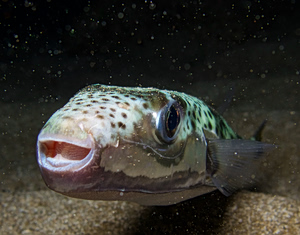
It also warned that the species must never be eaten under any circumstances, since its organs and flesh contain the potentially deadly neurotoxin tetrodotoxin. There is no known antidote, and the poison can kill not only predators but also humans who consume it.