 Μake us preferred on Google
 Global shipping is confronting a new and far less predictable world — more fragmented, more geopolitically charged, weighed down by energy insecurity, trade barriers, higher costs and new technological demands. In that environment, the industry’s task is no longer simply to withstand the turbulence, but to adapt to it, manage the risks, protect ships and crews, and at the same time ensure that global trade and energy keep flowing.
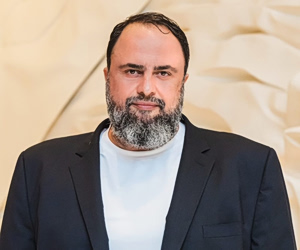
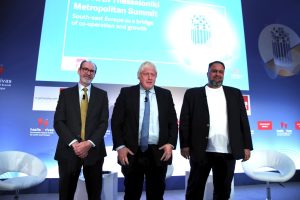
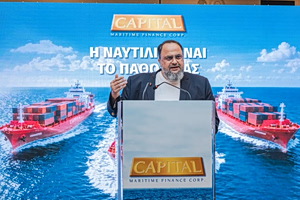
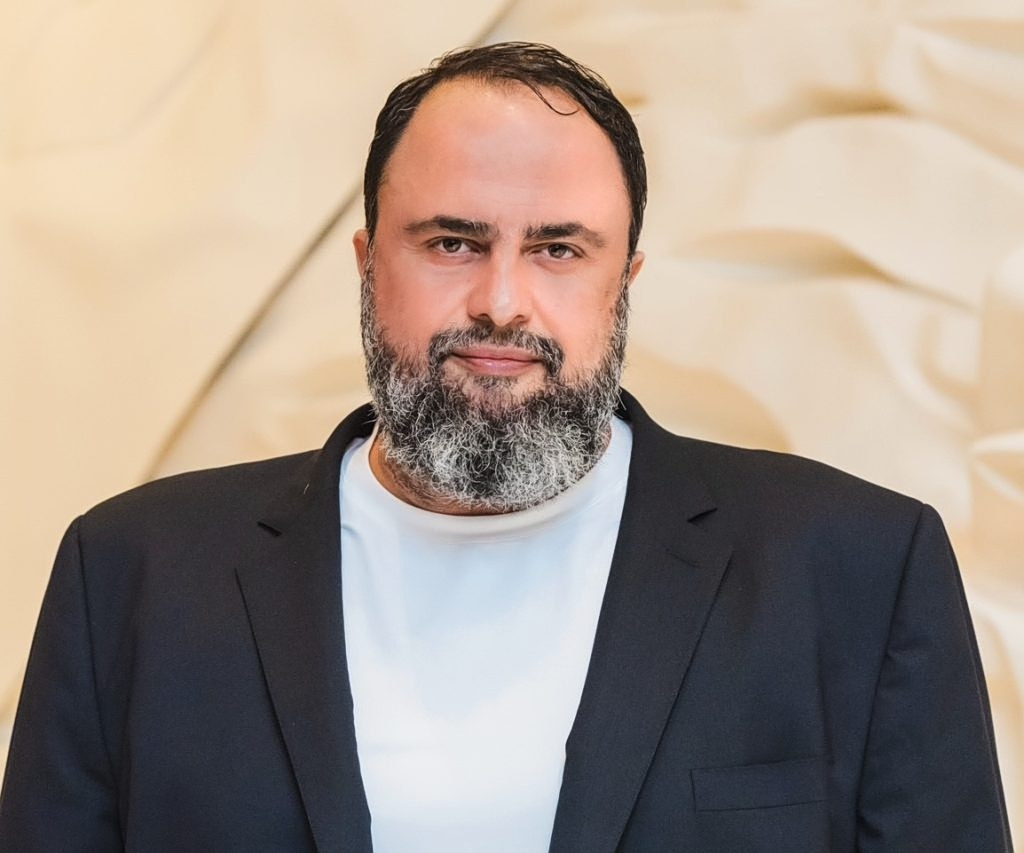
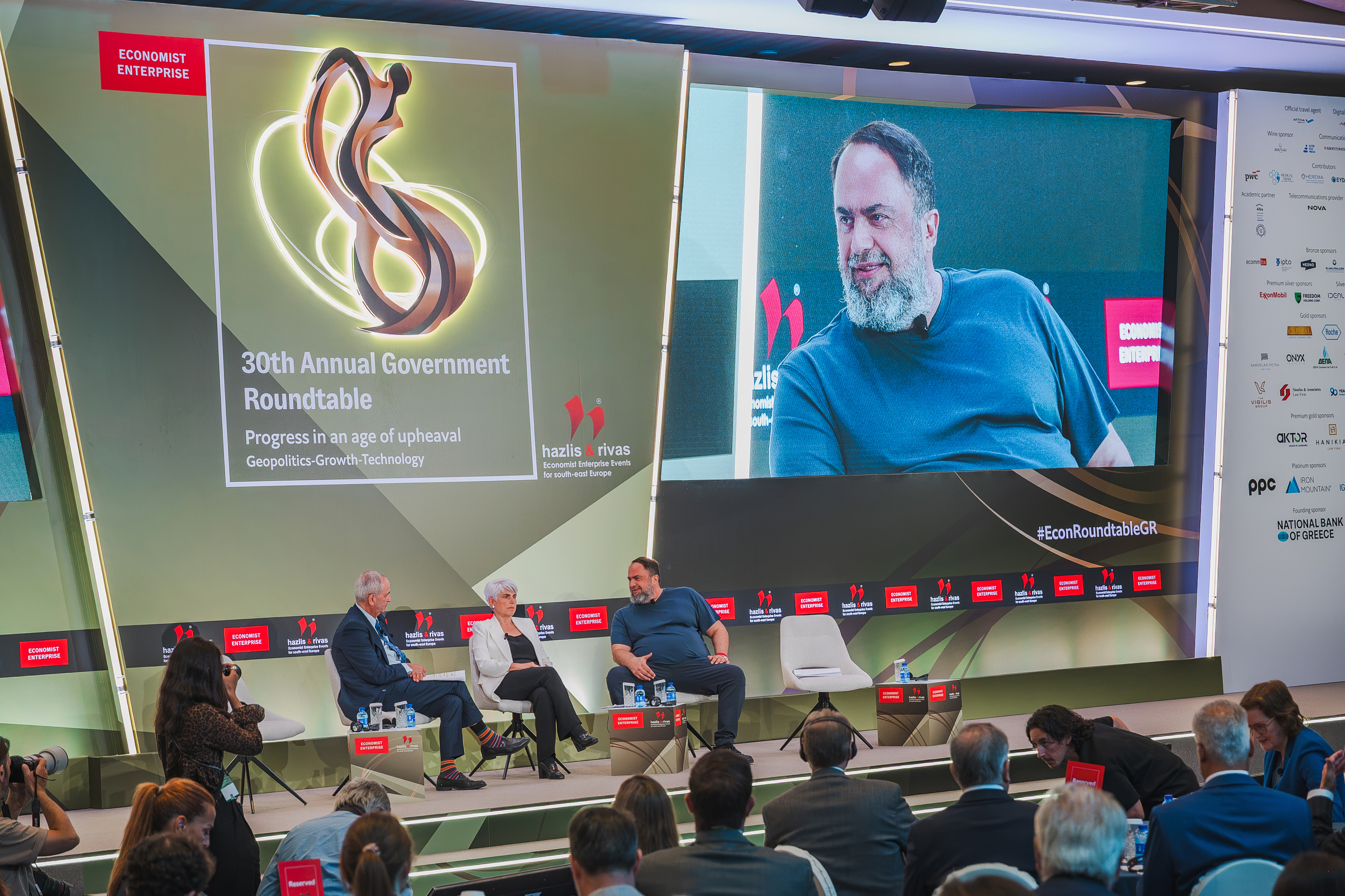
That was the central message delivered by Evangelos Marinakis, founder and chairman of Capital Maritime & Trading Corp., and Angeliki Frangou, chairwoman and chief executive of Navios Maritime Partners, as they shared a stage at The Economist’s 30th Annual Government Roundtable in Lagonissi, in a session on trade and geopolitics chaired by the publication’s Daniel Franklin. The two Greek owners portrayed a shipping industry that now functions under conditions of continuous crisis — but also one that is acquiring even greater strategic value for governments, economies and companies alike.
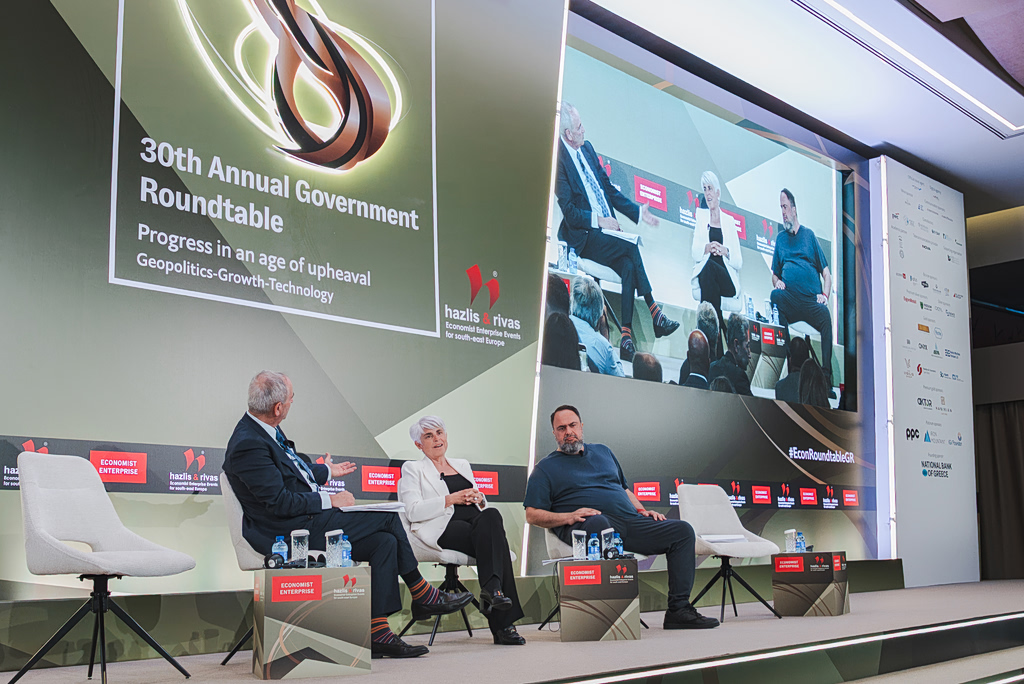
Evangelos Marinakis, founder and chairman of Capital Maritime & Trading Corp., and Angeliki Frangou, chairwoman and chief executive of Navios Maritime Partners, speak at The Economist’s 30th Annual Government Roundtable in Lagonissi during a session on trade and geopolitics chaired by Daniel Franklin
A toll for free navigation through Hormuz
At the center of the discussion was Marinakis’s proposal for a toll in the Strait of Hormuz in exchange for free and safe passage — an idea he said he has already put formally to the United States. Pressed by Franklin on why a shipowner would actually want to pay a toll, and whether it could ever happen, Marinakis set out his reasoning at length.
“First of all, that was a proposal that was put forward during Posidonia a month ago in Athens. I have also sent this proposal to the Trump administration, and it’s formal. I believe that is the right thing to go ahead, and I can explain my argument. First of all, right now — and also for all these years — we have been paying extra war-risk premiums, whether there is a war or not, because of the risk involved in trading in the area. Right now, the premiums are between 1 million and 3 million dollars, depending on the value of the vessel. So it’s a significant expense. So by having a toll and having free navigation, you don’t pay for the war-risk premium, which is, as I said, substantially high.
Secondly, when you have free navigation, you can have wars going on for years without interrupting the world economies. Leaders have sufficient time, and they are not under pressure to make sure that they have a proper agreement, as far as nuclear weapons are concerned, democracy, leadership, free navigation. The third thing is that economies are already hurt. Economies in the Far East, economies in Europe, they cannot cope with inflation and with the higher prices in energy and in all products that we need for our daily life, from the supermarket, whatever. So that means that the solution must be found.”
The revenue from such a toll, he explained, could be shared out among the parties affected by the conflict.
“The amount of money from this toll could be divided, as stated within the proposal, between all the countries in the Arab world that have already been hurt and have damages from this war, Iran, and, of course, a proportion to the United States for all this huge expense for this whole war operation. So I think that is a win-win situation for all parties concerned and everybody will be a winner out of this — and mostly the world and the world economy.”
‘Totally unprecedented’
Marinakis framed the proposal against a backdrop of accumulating geopolitical shocks that, he argued, have permanently altered the way shipping operates.
“First of all, what we have seen in the last six years is totally unprecedented. I mean, we had Covid, we had the Panama Canal, we had the Suez Canal closure with the Red Sea war, then the Russia–Ukraine war and, what has been going on between Israel and Iran and Lebanon for all this time. So these are major disruptions that are affecting our industry and make our industry very valuable for all states, especially as far as energy transportation is concerned.”
For shipping companies, he stressed, the first priority remains the safety of crews.
“We need to be there to ensure that our crews are safe. We manage an efficient fleet and we will be there to deliver cargo when it is needed, even more. So it’s challenging.”
From globalization to ‘old-fashioned mercantilism’
Frangou, for her part, offered a broader diagnosis of a global economy shifting away from the era of globalization and efficiency toward something more complex, more costly and less predictable.
“I have seen a lot of markets, but I’ll say global trade is complex today, and I’m a lifelong subscriber to The Economist, even when it used to be only hard copy. You could easily take the weekend edition, go in the back pages, see GDP, industrial production in advanced economies, emerging economies, and you would very quickly be able to have a reliable idea of where global trade was going. Today, even though we have a lot of digital feeds, the world is more complex, and it’s not easy. I think we are moving from globalization and efficiency to old-fashioned mercantilism. And Europe knows a couple of things about mercantilism — 200 years of that. England and the Netherlands were at the forefront of that. And basically four factors are affecting trade: national security, geopolitical conflicts, defense spending and AI. And each one is a huge subject, and it affects how we are trading, and the complexity.”
The first two of those forces, she argued, are turning an optimized system into an inefficient one — and, paradoxically, that is precisely what generates demand for ships.
“The first two, national security and geopolitical conflicts, are basically changing the world from an efficient, low-cost, optimized world to total inefficiency.”
When Franklin observed that shipping seems to do well whatever the upheaval, Frangou’s answer was characteristically blunt — and it doubled as a warning.
“Until it doesn’t. But, you know, basically, if you take inefficiency, it means more ton-miles, more routes, more everything, so more vessels needed.”
AI’s very physical footprint
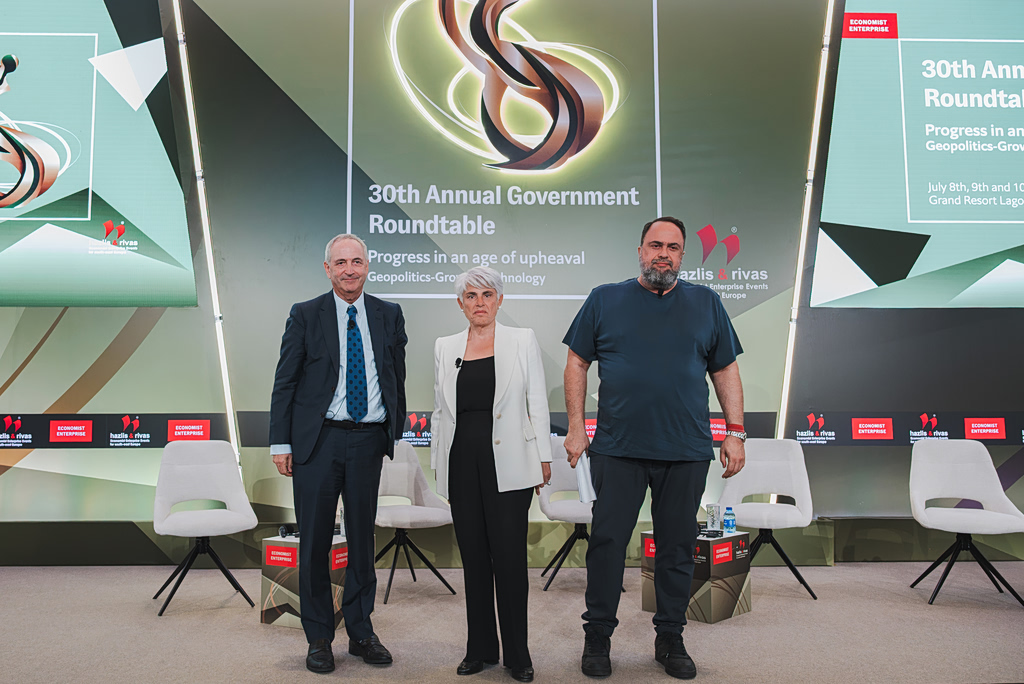
Evangelos Marinakis, founder and chairman of Capital Maritime & Trading Corp., and Angeliki Frangou, chairwoman and chief executive of Navios Maritime Partners, speak at The Economist’s 30th Annual Government Roundtable in Lagonissi during a session on trade and geopolitics chaired by Daniel Franklin
Artificial intelligence was another central strand of Frangou’s analysis. AI, she insisted, is not merely software or a change in how we work: behind it lies a vast new global infrastructure, comparable in significance to the railways and pipelines of the past.
“It’s not only about software, it’s about semiconductor factories, about data centers, about energy and distribution of energy. This is a new infrastructure that has to be created in the same way railway and pipelines were in the past. And there are huge amounts to be spent. We are talking about $1.5 trillion only in the United States in 2025, in the last five years, and additionally in the next five years, only the United States is about another $5 trillion. And these are global trends around the world, because China is doing the same thing, Europe is doing the same thing. So this is a huge amount of capital allocated. And about one-third of that is in commodities we carry, from steel, cement, energy from LNG, coal — every form of energy. These are macro trends that are underlying.”
Hormuz, diversification and the return of energy
On the Strait of Hormuz itself, Frangou underlined how much of the world’s energy depends on the passage, and how tension there forces a rethink of supply.
“You are talking about 20 million barrels of oil coming out, about 20% of global consumption and about 20% of the gas. So basically you will have to have a diversification in the short term. You will see more pipelines and more storage facilities being created. And in the midterm, new areas will be developed without a choke point. There will be a diversification on the sources, on nuclear, on renewables, because of the need of energy across.”
For all the risks, Frangou argued that even developments Europeans have long viewed with unease — chief among them rising defense spending — can carry real upside.
“Even a very negative thing, like defense spending, as a European, can actually bring very positive events for Europe. I was here at The Economist Roundtable two years ago, and it was unheard of for a European that we will be spending in defense. And today NATO has reached $1.5 trillion expense in 2025, 50% higher than 2015, and growing to about 5%. And what this will bring us is basically advanced manufacturing technologies and technological innovations. This can have very good effects in the globe, in civil society.”
Principles first
Asked what could go wrong, Marinakis returned to first principles — and to the human stakes behind the numbers.
“First of all, we need to respect and protect human life. Secondly, we need to respect and protect the history of nations, the culture of nations, and, of course, democracy. So if we all agree on this principle — first of all our leaders, and then us as leaders in our own industry — I think that we should be on the right track. All these ups and downs that we have in the market, in the oil prices, in all commodities throughout, are creating damage. Maybe we still see that the markets are doing incredibly well, and we see that the American economy is doing very well. But the question is for how long? And secondly, we need to ensure that energy sufficiency is there.”
His conclusion was that stability must be restored quickly — through, as he put it, “quick actions and prompt actions” — before the accumulated strain on economies does lasting damage. It was a message that, from a shipowner whose vessels are among those most exposed to the world’s choke points, carried a certain weight: the industry that profits from a fragmenting world was, on this stage, arguing hardest for putting it back together.
The session, “Trade and geopolitics in a changing world,” formed part of The Economist’s Government Roundtable at the Grand Resort Lagonissi.